Energy–Efficient Cold Storage Solutions to Reduce Post–Harvest Losses
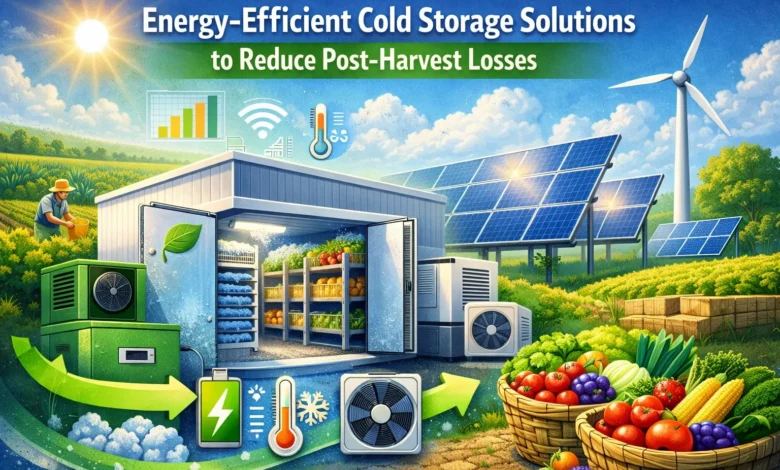
Post harvest losses remain one of the biggest issues for the world agricultural sector as they challenge food security, farmer’s incomes, and sustainability of the environment. The amount of food that gets lost or is wasted globally amounts to almost one third of all the food made on earth, according to the Food and Agriculture Organization, and post harvest losses are a big part of this. Fruits, vegetables, milk products, and fish are the most exposed commodities because they easily get spoiled if temperature and humidity change.
People are getting more and more convinced that energy efficient cold storage solutions are a necessary measure to limit such losses and at the same time reduce the use of energy and the cost of running the operation.
Post–Harvest Losses and Temperature Control
Postharvest loss is the reduction of quality or quantity of agricultural produce due to spoilage or damage between harvest and consumption. The speed at which food goes bad is largely influenced by temperature. Research has demonstrated that for many types of fresh fruits and vegetables, a rise in temperature by 10°C can double their rate of deterioration. Without proper cooling, heating, water loss, and microorganisms activity intensifies so fast that products get spoiled even before they are sold at the market.
Cold storage helps to reduce these biological processes by keeping controlled environments. But, old, fashion cold storage systems are usually heavily dependent on outdated technology, which results in excessive energy consumption and temperature control irregularity. For areas with electricity supply problems, these inefficiencies even escalate the spoilage risk, hence, energy efficiency becomes an essential factor in a successful post harvest management.
Importance of Energy Efficiency in Cold Storage Infrastructure
Energy efficiency in cold storage systems helps solve economic as well as environmental challenges. Cooling is the major energy consumer in food supply chains (accounts for almost 40%), thus it is one of the most energy intensive processes in agriculture. Besides increasing the cost of operations, inefficient equipment also emits more greenhouse gases.
The International Energy Agency states that switching to energy, efficient refrigeration technologies can cut electricity use by 25 – 45%. For farmers and food distributors, this means lower operating costs and the possibility of having a more solid financial base.
Besides that, energy efficiency increases the reliability of the system which makes it possible to have the right storage conditions at all times even in places where the electricity supply is not stable.
Structural Design and Insulation Efficiency
Thermal Insulation and Heat Management
Effective insulation plays a very important role in energy, efficient cold storage. Good insulation helps to minimize the transfer of heat from outside to inside, thus, cold storage facilities can easily maintain a constant internal temperature without using much energy. Studies show that just by improving insulation, the amount of energy required for cooling can be reduced by 15 – 20%.
Meanwhile, the use of building design also contributes to the efficiency of the system. Components such as thickness of the wall, the reflectiveness of the roof, and the level of airtightness in the building can have a big impact on its thermal performance.
The use of reflective roofs and the provision of shade to exterior walls in hot areas can greatly reduce the amount of heat the buildings absorb, and therefore, the cooling systems will not have to work so hard.
Advanced Refrigeration Technologies
High-Efficiency Compressors and Controls
More and more, modern cold storage systems are opting for high, efficiency compressors with variable speed drives. In contrast to traditional fixed speed compressors, these systems vary their output depending on the cooling demand measured in real-time.
Such an operation on the fly comes to the rescue of energy wastage during low load conditions and thus, the total system efficiency is increased.
According to industry research, variable speed refrigeration systems can be as much as 30% more energy efficient while still being able to maintain stable temperature levels. Besides, the mechanical stress is far less in these systems, which means that the equipment will have a longer life and the maintenance requirements will be lower.
Environmentally Safer Refrigerants
The choice of refrigerant has a direct impact on energy efficiency and environmental performance. High global warming potential traditional refrigerants are being replaced gradually by low GWP refrigerants which also provide better thermodynamic efficiency. This basically makes it possible to comply with regulations and at the same time, to have an effective cooling performance for different storage applications.
Renewable Energy Integration in Cold Storage
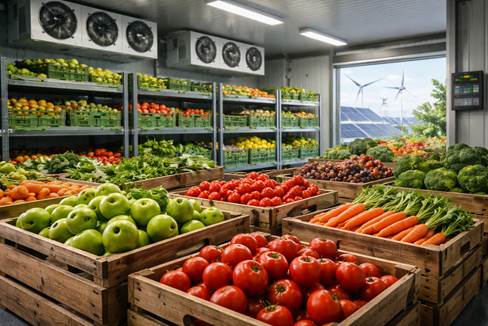
Renewable energy, powered cold storage solutions are becoming increasingly popular, especially in rural and off-grid areas. Solar powered cold storage solutions use solar panels together with energy, efficient refrigeration units to provide reliable cooling without requiring the conventional power grid.
Solar storage is expected to reduce costs by 40 – 60% compared to the use of diesel generators, according to the industry sources. Such systems also ensure that the cold storage remains operational during extended power outages.
These usually lead to spoilage of produce in developing countries. The cost of solar panels and energy storage has come down making renewable energy-based cold storage systems more feasible than before.
Smart Monitoring and Digital Optimization
Real-Time Temperature and Energy Monitoring
Digital monitoring systems play a very important role in improving the energy efficiency of freezer storages. Sensors are constantly measuring temperature, humidity, and energy consumption, thus facilitating the storage conditions to be kept at the most optimal level. In the event of a change, it can be detected immediately so that the necessary actions can be taken in time before the product quality gets affected.
Studies show that smart monitoring and automated controls can cut energy waste by as much as 10 – 15% while storage consistency is also getting better. Thus, through predictive maintenance based on data analytics, one can prevent equipment breakdown and the resulting energy losses due to inefficient operation.
Reduction of Post–Harvest Losses Through Efficient Storage
By using energy efficient cold storage solutions, we can greatly reduce the amount of post harvest loss through the extension of the shelf life of perishable produce. Carefully regulated temperature and humidity levels not only retard the growth of microbes but also the natural deterioration of the produce, thus keeping qualities like freshness, texture, and nutritional value intact.
For instance, when apples are kept in properly optimized cold storage conditions, they can stay in marketable quality for as long as six months, whereas if kept under normal temperature, the shelf life is only about two weeks. Likewise, proper refrigerated storage can prolong the shelf life of leafy vegetables by a number of weeks, thereby greatly cutting down the wastage in the supply chain.
Less spoilage leads to increased supply chain efficiency as it results in a stable market supply and less fluctuation in prices. Farmers, by the way, have more options on the timing of their sales which means that they can avoid distress selling at the time of the peak harvest.
Economic and Environmental Impacts
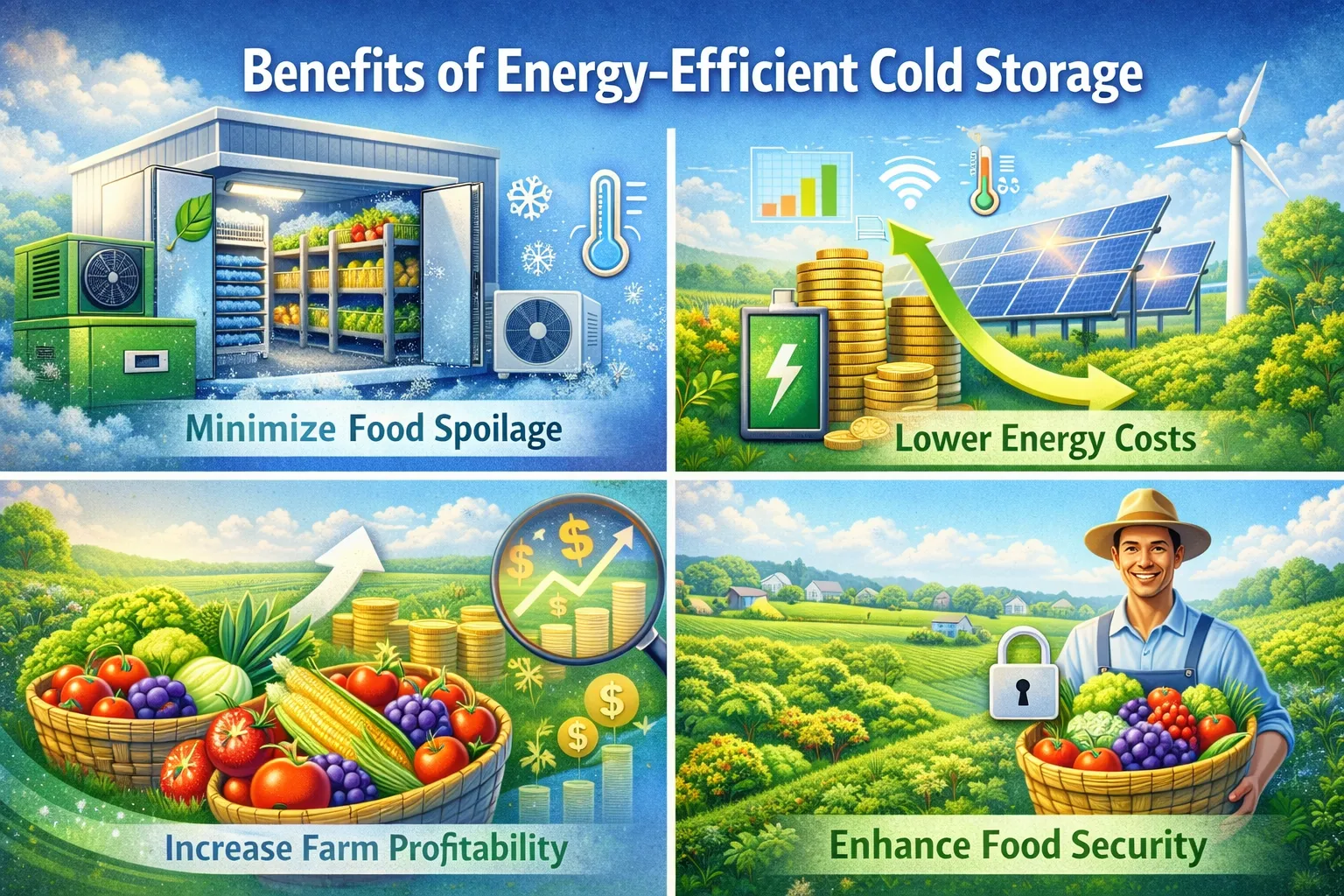
There are several other benefits resulting from energy, efficient cold storage besides saving on energy. According to the World Bank, better cold chain infrastructure can raise farmer incomes by 15 – 25% through loss reduction and quality enhancement of products. Increased storage availability also means easier access to far markets, which is a way of fostering the rural economy.
Environmentally speaking, lowering food waste means the carbon footprint of agriculture as a whole is reduced. The global food system is estimated to be responsible for about 26% of total greenhouse gas emissions, so one way of climate mitigation is to make good use of storage in order to cut down waste. Besides that, lesser energy use and lower refrigerant emissions still add to the environmental advantages of energy efficient cold storage systems.
Barriers to Adoption and Implementation
However, the adoption of energy efficient cold storage, which is highly beneficial, is still facing several difficulties. The most significant obstacle which is the high initial cost of the investment, especially for small scale farmers, is a limiting factor. Besides, the unavailability of technical skills and lack of funds are also some of the reasons that the rollout in many areas has been very slow.
In order to grow the adoption, it is essential that there is policy support, training, and incentives that are well directed. One of the ways of creating the whole environment for the use of energy, efficient cold storage technologies is using public/private partnerships and sustainable agriculture, focused government programs to help rural communities and farmers gain access to the necessary facilities.