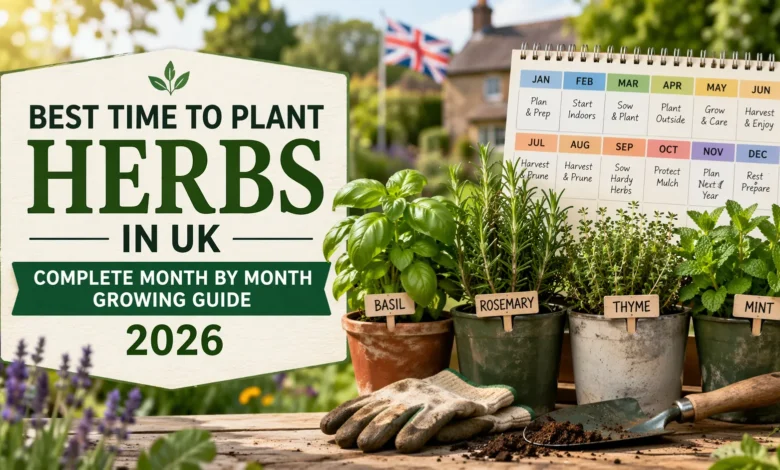
When to Plant Herbs UK – Month by Month Growing Guide 2026

There is something deeply satisfying about stepping into your garden, snipping a handful of fresh thyme, or crushing a mint leaf between your fingers on a crisp British morning. Growing herbs in the UK is one of the most rewarding and accessible forms of gardening — requiring minimal space, modest investment, and delivering enormous returns in flavor, fragrance, and wellbeing.
But the UK’s notoriously unpredictable weather makes timing absolutely critical. A late frost in April can wipe out newly planted basil in hours. A wet summer can rot rosemary that thrives just fine in drier conditions. Understanding exactly when to plant each herb — adjusted for the UK’s unique regional climate differences — is the difference between a flourishing herb garden and a frustrating series of failed attempts.
This complete guide covers everything you need to know about the when to plant herbs UK — organized by month, region, RHS hardiness rating, and individual herb — so you can grow confidently anywhere from Cornwall to the Scottish Highlands.
1. Understanding the UK Climate for Herb Growing
The United Kingdom’s climate is classified as oceanic temperate — characterised by mild winters, cool summers, high humidity, and rainfall distributed throughout the year. This creates both unique advantages and specific challenges for herb growers:
Advantages of the UK climate for herbs:
- Mild winters allow many Mediterranean perennials to survive outdoors year-round in southern regions
- Cool summers are perfect for cool-season herbs like parsley, chives, and mint
- High rainfall reduces irrigation demands once herbs are established
- Long summer daylight hours promote vigorous leafy growth
Challenges of the UK climate for herbs:
- Unpredictable late frosts threaten warm-season herbs well into May in northern regions
- High humidity encourages fungal diseases in Mediterranean herbs that prefer dry conditions
- Cool summers limit the performance of true tropical herbs like basil and lemongrass
- Short growing season in Scotland and Northern England requires careful timing
Understanding these characteristics helps you select the right herbs and plant them at exactly the right time for your specific location.
2. UK Frost Dates by Region
Unlike the USA which uses a standardised zone map, the UK relies primarily on average last spring frost dates and first autumn frost dates which vary significantly by region, elevation, and proximity to the coast.
| UK Region | Average Last Spring Frost | Average First Autumn Frost | Frost-Free Days |
|---|---|---|---|
| Cornwall & South Devon | Mid-March | Late November | ~260 days |
| South East England (Kent, Sussex) | Late March – Early April | Late October | ~210 days |
| London & Greater London | Late March – Early April | Late October | ~200 days |
| East Anglia (Norfolk, Suffolk) | Mid-April | Mid-October | ~185 days |
| Midlands (Birmingham, Nottingham) | Mid-April – Early May | Mid-October | ~170 days |
| Wales (South) | Late March – Mid-April | Late October | ~200 days |
| Wales (North & Highland) | Late April – Mid-May | Early October | ~150 days |
| Yorkshire & Humber | Late April – Early May | Mid-October | ~165 days |
| North West England (Manchester, Liverpool) | Late April | Mid-October | ~170 days |
| North East England (Newcastle) | Early May | Early October | ~150 days |
| Scotland (Central — Edinburgh, Glasgow) | Early May – Mid-May | Late September | ~135 days |
| Scotland (Highlands) | Late May – Early June | Early September | ~100 days |
| Northern Ireland (Belfast) | Late April | Mid-October | ~170 days |
💡 Find your exact last frost date using the Met Office climate data: metoffice.gov.uk or the RHS plant finder tool at rhs.org.uk
3. RHS Hardiness Ratings Explained
The Royal Horticultural Society uses a standardised hardiness rating system that tells UK gardeners how cold-tolerant a plant is. This is essential for understanding which herbs survive UK winters outdoors.
| RHS Rating | Description | Min Temperature | Example Herbs |
|---|---|---|---|
| H1a | Heated greenhouse only | Above 15°C | Lemongrass, ginger |
| H1b | Warm greenhouse | 10–15°C | Basil, tulsi |
| H1c | Cool greenhouse | 5–10°C | Lemon verbena |
| H2 | Tender — protect from frost | 1–5°C | Tender rosemary varieties |
| H3 | Half hardy — frost protection needed | -5°C | French tarragon, bay laurel |
| H4 | Hardy in most UK gardens | -10°C | Rosemary, sage, thyme, oregano |
| H5 | Hardy in most UK conditions | -15°C | Parsley, chives, mint, fennel |
| H6 | Hardy in all UK conditions | -20°C | Lemon balm, lovage, horseradish |
| H7 | Hardy in the harshest UK winters | Below -20°C | Chives, horseradish |
💡 Always check the RHS hardiness rating before planting herbs in exposed northern gardens or at high elevations.
4. Best Time to Plant Herbs — Month by Month UK Calendar
This is the most practical section of this guide — a complete month-by-month reference for UK herb gardeners.
January
Indoors only. January is one of the coldest months in most of the UK with frequent frosts making outdoor herb sowing impossible except in the mildest spots of Cornwall and the Scilly Isles.
- Sow parsley indoors on a warm windowsill with bottom heat (18–21°C)
- Sow chives indoors under grow lights
- Pot up mint divisions from stored roots for early indoor harvests
- Order herb seeds from reputable suppliers for the season ahead
- Clean and prepare seed trays, pots, and propagation equipment
February
Indoors — early season sowing begins. Daylight is increasing and a propagator or warm windowsill makes indoor herb sowing viable.
- Sow parsley, chives, and lemon balm indoors with heat
- Sow rosemary and thyme indoors — slow germinators that benefit from an early start
- Sow basil on a very warm south-facing windowsill or under grow lights (not for outdoor planting yet)
- In Cornwall and South Devon only — direct sow hardy herbs like chives outdoors under fleece
March
The main indoor sowing season begins in earnest. Temperatures are rising but outdoor frosts are still a real risk across most of the UK.
| Herb | Sow Indoors | Sow Outdoors | Notes |
|---|---|---|---|
| Basil | ✅ Yes | ❌ Too early | Needs 18°C minimum |
| Parsley | ✅ Yes | South only | Soak seeds 24hrs first |
| Chives | ✅ Yes | South only | Hardy — can risk outdoors |
| Coriander | ✅ Yes | South only | Direct sow preferred |
| Dill | ✅ Yes | South only | Does not transplant well |
| Mint | ✅ Yes | South only | From divisions or cuttings |
| Thyme | ✅ Yes | ❌ Too early | Slow from seed |
| Oregano | ✅ Yes | ❌ Too early | Needs warmth to germinate |
April
The most important month for UK herb gardeners. Outdoor sowing becomes possible across most of England and Wales as frost risk reduces — though Scotland and northern England still need caution.
- Plant out cold-hardy herbs outdoors in the south: chives, parsley, mint, lemon balm
- Continue indoor sowing of basil, coriander, dill, and fennel
- Direct sow coriander, dill, and fennel outdoors in sheltered spots in southern England
- Harden off indoor seedlings started in February and March
- Prepare herb beds with well-rotted compost and good drainage
⚠️ Do not plant basil outdoors in April anywhere in the UK. Even in the South East, April nights regularly drop below the 10°C minimum basil needs to survive.
May
The main outdoor planting month for most of the UK. After the May Day bank holiday, frost risk drops significantly across England and Wales — though Scotland remains cautious until late May.
| Herb | England & Wales | Scotland & N Ireland | Northern England |
|---|---|---|---|
| Basil | Plant out after 15th May | Wait until June | Wait until late May |
| Coriander | Direct sow | Direct sow late May | Direct sow late May |
| Dill | Direct sow | Direct sow late May | Direct sow |
| Parsley | Plant out | Plant out late May | Plant out |
| Mint | Plant out | Plant out | Plant out |
| Thyme | Plant out | Plant out late May | Plant out |
| Oregano | Plant out | Plant out late May | Plant out |
| Rosemary | Plant out | Plant out late May | Plant out |
- Chelsea Chop reminder: The RHS Chelsea Flower Show (late May) is the traditional signal for UK gardeners that the last frost risk has passed in most of England — a useful if informal guide for herb planting timing.
June
Peak growing season begins. All herbs can now be planted outdoors across the entire UK including Scotland. Long daylight hours promote rapid leafy growth.
- Plant out all remaining herbs including basil, lemongrass (in pots), and tender varieties
- Make succession sowings of coriander and dill every 3 weeks
- Pinch out basil flower buds to encourage bushy leafy growth
- Harvest chives, mint, parsley, and thyme regularly to promote new growth
- Sow second crop of parsley for autumn harvests
July
High summer — maintain and harvest. Focus shifts from planting to maintaining, harvesting, and preserving.
- Make final succession sowings of coriander before summer heat causes bolting
- Sow fast-maturing herbs like coriander and dill for late summer harvest
- Harvest and dry lavender, thyme, oregano, and sage at peak potency
- Water container herbs daily during hot dry spells
- Watch for aphids and whitefly on basil — common in UK summer
August
Late summer — prepare for the cool season renaissance.
- Sow coriander and dill outdoors for excellent autumn harvests
- Sow parsley indoors for overwintering and spring production
- Take cuttings of rosemary, thyme, sage, and mint to propagate new plants
- Begin hardening off any tender herbs you plan to bring indoors for winter
- Sow chervil directly outdoors — prefers cool autumn conditions
September
The autumn herb planting window opens. One of the most underutilised opportunities in UK herb gardening.
- Sow coriander directly outdoors — September sowings often outperform spring ones
- Sow parsley for overwinter harvests — it is surprisingly hardy
- Plant garlic chives and ordinary chives from divisions
- Bring basil and lemongrass indoors before first frost
- Pot up mint, parsley, and chives to bring indoors for winter windowsill harvests
October
Wind down outdoors, wind up indoors.
- Lift and pot mint roots for indoor winter growing
- Bring tender herbs (basil, lemongrass, lemon verbena) inside before first frost
- Plant garlic (a culinary herb-vegetable) in prepared beds — October is ideal
- Mulch rosemary, thyme, sage, and oregano in colder northern gardens
- Last chance to sow coriander and chervil outdoors in the south under cloche
November & December
Dormancy and planning season.
- Most outdoor herb growing has ended except in the mildest regions
- Grow mint, chives, and parsley on indoor windowsills
- Grow basil under artificial grow lights indoors
- Plan next year’s herb garden — order seeds from the RHS seed library or specialist suppliers
- Protect marginally hardy herbs (rosemary, bay, lemon verbena) with horticultural fleece in cold snaps
5. Best Time to Plant Herbs by UK Region
South West England & Cornwall
The mildest region in the UK. Benefits from the warming influence of the Gulf Stream.
- Outdoor herb planting: March to October
- Year-round possibilities: Bay laurel, rosemary, thyme, sage, mint, chives
- Special advantage: Can grow lemon verbena and myrtle outdoors in sheltered spots
- Best months for all herbs: April to September
South East England & London
Long growing season with relatively low rainfall and the warmest summer temperatures in the UK.
- Outdoor herb planting: April to September
- Best month for basil: Mid-May to August
- Special advantage: Warmest UK summers make basil and Mediterranean herbs perform at their best
- Watch out for: Summer drought — container herbs need daily watering in July and August
East Anglia
Low rainfall, cold east winds, and late spring frosts make timing critical here.
- Outdoor herb planting: Late April to September
- Best for: Drought-tolerant Mediterranean herbs — thyme, oregano, rosemary, sage
- Watch out for: Late cold snaps in April — protect newly planted herbs with fleece
- Special challenge: Cold east winds in spring can damage new herb transplants
Midlands
Inland location means colder winters and hotter summers than coastal regions.
- Outdoor herb planting: May to September
- Best month to start: Early to mid-May
- Perennial herbs: Rosemary, thyme, and sage all overwinter reliably
- Indoor sowing: Start in late February to March
Wales
Varied climate — South Wales is mild and wet, North Wales and highland areas are colder with shorter seasons.
- South Wales: Herb planting from April onwards
- North Wales and uplands: Wait until mid-May
- Best suited herbs: Mint, chives, lemon balm, parsley — all handle Welsh wet conditions well
- Challenge: High rainfall encourages fungal disease on Mediterranean herbs — ensure excellent drainage
North West England (Manchester, Liverpool, Lake District)
Higher rainfall than the south but milder winters than the north east due to Atlantic influence.
- Outdoor herb planting: May to September
- Reliable perennials: Mint, chives, lemon balm, lovage — all handle wet conditions
- Mediterranean herbs: Grow in pots for better drainage control
- Lake District uplands: Short season — treat many perennials as annuals
Yorkshire & North East England
Cold winters and shorter growing season require careful variety selection and timing.
- Outdoor herb planting: Mid-May to August
- Best strategy: Start everything indoors in March to April
- Reliable herbs: Chives, mint, parsley, lemon balm, lovage
- Challenge: Basil struggles in cooler Yorkshire summers — choose sheltered sunny spots
Scotland
The most challenging UK region for herb growing but by no means impossible with the right approach.
- Outdoor herb planting: Late May to August
- Central Scotland (Edinburgh, Glasgow): Plant from late May
- Highlands: Plant from early June — short season of 100 days
- Most reliable herbs: Chives, mint, parsley, lemon balm, lovage, angelica
- Special opportunity: Long summer daylight hours (up to 18 hours in June) promote surprisingly rapid herb growth
Northern Ireland
Mild oceanic climate similar to western England with reliable rainfall.
- Outdoor herb planting: Late April to September
- Well-suited herbs: Mint, parsley, chives, thyme, lemon balm
- Mediterranean herbs: Possible but require sheltered sunny spots
- Reliable perennials: Rosemary and sage overwinter in most of Northern Ireland
6. Best Time to Plant Popular Herbs — Individual UK Guide
Basil
Best UK planting time: Indoors — late February to April. Outdoors — mid-May to June. Basil is the most challenging common herb to grow in the UK due to its demand for warmth. UK summers are rarely hot enough for truly vigorous basil growth — choose the warmest, most sheltered spot available. Varieties like Genovese, Sweet Basil, and Aristotle perform best in UK conditions. Greek basil (compact, small-leaved) is more tolerant of cool conditions.
| Region | Sow Indoors | Plant Outdoors |
|---|---|---|
| South England | February–March | After 15th May |
| Midlands | March | After 20th May |
| North England | March–April | After 25th May |
| Scotland | April | After 1st June |
Coriander (Cilantro)
Best UK planting time: March to April (spring) and August to September (autumn) Coriander actually performs better in the UK than in hot countries because our cool summers delay bolting significantly. Two excellent windows exist — spring and autumn. Autumn sowings often produce the most productive plants. Always sow directly — coriander’s taproot makes transplanting unreliable.
| Sowing Window | Expected Harvest | Notes |
|---|---|---|
| March–April | May–June | May bolt in warm summers |
| August–September | October–November | Often best UK harvest |
Mint
Best UK planting time: March to May outdoors, anytime indoors One of the easiest and most rewarding herbs for UK gardeners. Mint is fully hardy throughout the UK — it dies back in winter and returns reliably each spring. Always plant in containers to prevent aggressive spreading. Dozens of varieties available — spearmint, peppermint, apple mint, chocolate mint, and Moroccan mint all thrive in UK conditions.
Parsley
Best UK planting time: March to May and July to August Parsley is a biennial that is surprisingly hardy in the UK — surviving most winters outdoors even in the Midlands and North. Soak seeds in warm water for 24 hours before sowing to improve the notoriously slow germination (can take 3 to 6 weeks). Two sowings — one in spring and one in late summer — give year-round harvests.
Rosemary
Best UK planting time: Spring (April to May) or autumn (September) Rosemary is a Mediterranean perennial fully hardy in most UK gardens (RHS H4). It thrives in well-drained soil in a sunny position. The biggest killer of rosemary in the UK is not cold — it is waterlogged soil in wet winters. Always plant in free-draining soil or raised beds. Common varieties like Miss Jessopp’s Upright and Tuscan Blue are the most reliable for UK conditions.
Thyme
Best UK planting time: April to May outdoors, February to March indoors One of the most reliable perennial herbs for UK gardens. Thyme is fully hardy (RHS H5-H6) and once established requires almost no maintenance. Common thyme, lemon thyme, and creeping thyme all perform excellently in UK conditions. Excellent for rockeries, raised beds, and container growing.
Chives
Best UK planting time: February to May (indoors from February, outdoors from March) One of the hardiest and most rewarding herbs for UK gardeners. Chives are perennial throughout the entire UK including Scotland and will return each spring for many years. They produce beautiful purple flowers in late spring that are also edible. Division every 3 to 4 years keeps plants vigorous.
Sage
Best UK planting time: April to May Hardy perennial (RHS H5) in most UK gardens. Sage prefers well-drained soil and a sunny position. It can become woody over time — cut back hard in spring to encourage fresh growth. Common sage, purple sage, and golden sage all perform well in UK conditions.
Dill
Best UK planting time: April to July (successional sowings every 3 weeks) Fast-growing annual that performs well in cool UK summers. Always sow directly — dill strongly dislikes transplanting. Make succession sowings every 3 weeks from April through July for a continuous harvest. Dill attracts beneficial insects and makes an excellent companion plant.
Fennel
Best UK planting time: April to May Hardy perennial (RHS H5-H6) that self-seeds prolifically in UK gardens. Both bronze and green fennel are ornamental as well as useful. Allow some plants to flower and set seed for natural re-establishment each year.
Lemongrass
Best UK planting time: May to June (indoors), June outdoors in the south only Lemongrass is a tropical grass (RHS H1b) that cannot survive UK winters outdoors. Grow in large pots, place outdoors from June to September, and bring indoors before the first autumn frost. With a heated conservatory or greenhouse lemongrass grows vigorously and provides abundant harvests.
Bay Laurel
Best UK planting time: Spring (April to May) for young plants Bay is a large evergreen shrub (RHS H3-H4) that grows slowly but lives for decades in UK gardens. Young plants are more vulnerable to cold — protect in the first two winters with fleece. Once established bay laurel is surprisingly tough. Excellent as a topiary standard in large containers flanking doorways.
7. When to Plant Herbs UK Indoors vs Outdoors
| Method | Best For | Timing |
|---|---|---|
| Indoors on windowsill | Basil, parsley, chives, coriander | January–April |
| Indoors under grow lights | Basil, microherbs, winter harvests | Year-round |
| Propagator (heated) | Basil, rosemary, thyme, oregano | February–April |
| Cold frame / cloche | Hardy herbs, early season protection | March–May |
| Direct outdoor sowing | Coriander, dill, fennel, parsley | April–September |
| Outdoor transplanting | Most herbs started indoors | May–June |
Hardening off — essential for UK herb gardeners: UK spring weather is notoriously changeable. Never move indoor-raised herb seedlings directly outdoors. Harden off over 10 to 14 days by placing outdoors in a sheltered spot for increasing periods each day. This acclimatises plants to outdoor light intensity, temperature fluctuation, and wind — dramatically improving survival rates.
8. Cool Season vs Warm Season Herbs in the UK
Cool Season Herbs — Thrive in UK Conditions
The UK’s cool temperate climate is actually ideal for many cool-season herbs that struggle in hotter countries.
| Herb | Ideal UK Temp | Best UK Season | RHS Rating |
|---|---|---|---|
| Coriander | 15–22°C | Spring & Autumn | Annual |
| Parsley | 10–20°C | Spring & Autumn | H5 Biennial |
| Chervil | 10–18°C | Autumn & Winter | H5 Annual |
| Dill | 15–22°C | Spring & Summer | Annual |
| Fennel | 15–22°C | Spring–Autumn | H5-H6 |
| Chives | 10–22°C | Spring–Autumn | H7 |
| Lemon Balm | 10–25°C | Spring–Autumn | H6 |
| Mint | 10–25°C | Spring–Autumn | H6 |
Warm Season Herbs — Need the Best UK Spots
These herbs need the warmest, most sheltered positions in the UK and benefit from south-facing walls, raised beds, and dark mulch to increase soil heat.
| Herb | Minimum Temp | Best UK Position | Overwinter? |
|---|---|---|---|
| Basil | 10°C | South-facing, sheltered | No — annual |
| Lemongrass | 15°C | Conservatory or pot | Indoors only |
| Lemon Verbena | 5°C | Sheltered south wall | H3 — protect |
| Ginger | 15°C | Heated greenhouse | No |
| Tulsi | 15°C | Warmest spot, pot | Indoors only |
Year-Round Hardy Perennials for UK Gardens
Plant these once and harvest for years:
Rosemary, thyme, sage, chives, mint, fennel, lemon balm, lovage, French tarragon, bay laurel, horseradish, and oregano all establish permanent presence in UK gardens with minimal annual effort.
9. Best Time to Plant Herbs in Pots & Containers
Container herb growing is especially popular in the UK given the prevalence of small gardens, patios, courtyards, and balconies — particularly in cities like London, Manchester, and Edinburgh.
| Herb | Pot Size | Best UK Planting Time | Position |
|---|---|---|---|
| Basil | 20–25cm | May–June | Warmest south-facing spot |
| Coriander | 25–30cm | March–April & Aug–Sep | Partial shade in summer |
| Mint | 25–30cm | April–May | Any — partial shade fine |
| Parsley | 20–25cm | March–April & July | Partial sun |
| Chives | 15–20cm | March–April | Full to partial sun |
| Rosemary | 30–40cm | April–May | Full sun, sheltered |
| Thyme | 20–25cm | April–May | Full sun |
| Oregano | 20–25cm | April–May | Full sun, sheltered |
| Bay Laurel | 40–60cm | April–May | Sheltered sunny spot |
| Lemongrass | 40–50cm | June | Conservatory or very warm spot |
Essential UK container herb tips:
- Use a loam-based compost (John Innes No. 2 or 3) mixed with horticultural grit for Mediterranean herbs — standard multipurpose compost retains too much moisture
- Raise pots on feet to improve drainage — particularly important in wet UK winters
- Group pots together to create a warmer microclimate — beneficial for heat-loving herbs
- Water in the morning rather than evening to reduce fungal disease risk in the UK’s humid climate
- Bring tender herbs indoors before the first October frost
10. Growing Herbs on UK Windowsills & Indoors
Indoor herb growing extends your growing season dramatically and provides fresh herbs year-round regardless of the British weather outside.
Best herbs for UK windowsill growing:
| Herb | Light Needed | Ideal Windowsill | Harvest Time |
|---|---|---|---|
| Basil | 6+ hours | South-facing | Year-round with grow light |
| Mint | 4–6 hours | East or West | Year-round |
| Chives | 4–6 hours | East or West | Year-round |
| Parsley | 4–6 hours | South or East | Year-round |
| Coriander | 4–6 hours | East-facing | Autumn–Spring |
| Thyme | 6+ hours | South-facing | Year-round |
| Oregano | 6+ hours | South-facing | Year-round |
Grow lights for UK herb growing: The UK’s short winter daylight hours — often only 7 to 8 hours in December and January — make grow lights invaluable for year-round indoor herb production. Full spectrum LED grow lights placed 15 to 30cm above plants for 14 to 16 hours per day produce indoor herbs that rival outdoor summer growth. Particularly transformative for basil which struggles on even south-facing UK windowsills in winter.
11. Common Herb Planting Mistakes UK Gardeners Make
Planting basil outdoors too early The most common and costly UK herb gardening mistake. Basil planted before mid-May — even in the South East — will suffer cold damage, turn yellow or purple, and become vulnerable to damping off. Patience pays with basil. Wait until the Chelsea Flower Show has passed and nights are consistently above 10°C.
Planting Mediterranean herbs in heavy clay soil Rosemary, thyme, sage, and oregano all originate from dry Mediterranean hillsides. UK clay soil that stays wet in winter will kill these herbs through root rot far more reliably than cold ever would. Always incorporate horticultural grit or plant in raised beds or containers.
Ignoring regional differences UK gardening advice is often written for southern England. If you garden in Yorkshire, Scotland, or Northern Ireland you need to delay planting by 2 to 4 weeks compared to standard advice. Always adjust for your specific microclimate.
Not making succession sowings of coriander Planting one batch of coriander in spring and expecting a continuous harvest is wishful thinking. Coriander bolts quickly — make small sowings every 3 weeks from March through September for a continuous supply.
Overwatering Mediterranean herbs UK gardeners often overwater out of habit in a country associated with rain. Rosemary, thyme, sage, and oregano all prefer dry conditions between waterings. Water thoroughly then allow soil to dry before watering again.
Not hardening off indoor-raised seedlings Moving seedlings straight from a warm propagator to outdoor conditions in unpredictable British spring weather is a recipe for transplant shock. Always harden off over 10 to 14 days minimum.
Buying supermarket herb pots for permanent outdoor planting Supermarket herb pots contain multiple seedlings crammed together and grown in nutrient-depleted compost under artificial conditions. They are designed for short-term kitchen use, not outdoor planting. Either separate and repot them carefully or buy properly hardened-off plants from garden centres.
12. Frequently Asked Questions
May is the single best all-round month for outdoor herb planting across most of the UK. By mid-May frost risk has dropped significantly in England and Wales and all herbs including basil can be safely planted outdoors in sheltered spots.
Yes — by growing hardy perennials outdoors (rosemary, thyme, chives, mint) and using indoor windowsills or grow lights for tender herbs like basil and coriander during winter months.
Mint, chives, parsley, lemon balm, and thyme are the easiest herbs for UK beginner gardeners. All are hardy, low-maintenance, and productive throughout the British growing season.
The most common causes are cold temperatures (below 10°C), overwatering, and insufficient light. Keep basil in the warmest spot available, water sparingly, and ensure at least 6 hours of direct light daily.
Yes — rosemary is hardy (RHS H4) throughout most of the UK and survives British winters outdoors provided it has well-drained soil. In Scotland and northern England provide some winter protection in severe cold snaps.
For most herbs February to March is the ideal indoor sowing window. This gives seedlings 8 to 12 weeks of indoor growth before they are ready to harden off and transplant outdoors from May.
Mint, parsley, chervil, lemon balm, and chives all tolerate partial shade and perform well in gardens that receive less than 4 to 6 hours of direct sun daily.
No — July is still a good time to plant many herbs. Direct sow coriander and dill for autumn harvests. Plant out container-grown mint, chives, and parsley. Take cuttings of rosemary, thyme, and sage for new plants.
13. External Resources for Further Reading
- Royal Horticultural Society — Herb Growing Guide — The UK’s most authoritative gardening organisation
- RHS Plant Hardiness Ratings — Official UK hardiness rating guide
- Met Office — UK Climate Information — Official UK frost and temperature data
- Gardeners World — When to Sow Herbs — BBC’s trusted UK gardening resource
- National Allotment Society — UK allotment herb growing guidance
- Which? Gardening — Herb Reviews — Independent UK gardening advice
- Kew Gardens — Medicinal Herb Resources — World-class botanical authority
Further Reading on fasalbachao.com
- Best Time to Plant Herbs in USA — Complete Zone Guide
- Best Time to Plant Herbs in Pakistan — Complete Guide
- Moringa Cultivation Guide
- Kitchen Gardening in Pakistan
- Medicinal Plants in Pakistan
- Garlic Cultivation Guide