DIY Tips to Getting Rid of Invasive Emerald Ash Borers in Your Yard

Yes, you can fight emerald ash borer yourself — but only part of the battle is genuinely DIY. Identifying the beetle, monitoring for it, keeping your ash vigorous, and applying a homeowner soil treatment where the law allows are all in your hands. Saving a tree that is already thinning, however, takes a professional trunk injection, and no spray you mix at home reaches the larvae doing the damage under the bark. This guide separates what works from what wastes the season — because with this pest, a wasted season is usually a dead tree.
How to tell if it is really emerald ash borer
The first DIY job is a correct identification, because the treatment decision depends on it. The emerald ash borer (Agrilus planipennis) is an invasive beetle from eastern Asia, first detected in Michigan in 2002, whose larvae feed under the bark of ash trees and cut off the flow of water and nutrients. Adults are narrow, metallic emerald-green beetles about half an inch long, active from late spring through summer. Almost all the destruction happens out of sight, in flat, S-shaped feeding galleries packed with fine sawdust-like frass just beneath the bark. Look for these signs, which tend to appear in this order:
- Woodpecker flecking (“blonding”) — pale patches where woodpeckers strip the outer bark to reach larvae; often the earliest outward sign.
- Canopy thinning from the top down — the upper crown leafs out late, yellows and dies back while the lower canopy still looks reasonable.
- D-shaped exit holes — about 1/8 inch (3–4 mm) across, with one flat side; adults chew out through these, and nothing else attacking ash leaves that shape at that size.
- Vertical bark splits — cracks that open over the galleries feeding beneath them.
- Sprouting low on the trunk — epicormic shoots near the base, usually a late sign that the tree is already failing.
| Sign | What you see | What it tells you |
|---|---|---|
| Woodpecker blonding | Light, flaked patches on trunk and large limbs | Larvae are feeding under the bark; often year 2–3 of attack |
| Top-down dieback | Thinning, yellowing crown starting at the top | Galleries are interrupting water flow to the crown |
| D-shaped exit holes | Holes ~1/8 inch wide with one flat side | Confirms emerald ash borer — diagnostic at this size and shape |
| Bark splits | Vertical cracks, S-shaped tunnels beneath | Established larval feeding under that section of bark |
What can you actually do yourself?
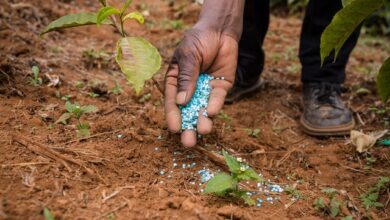
Three things, and they matter most before the canopy starts to thin. First, monitor: purple prism traps and green funnel traps with lures are how agencies detect new infestations, and a trap on your property tells you the beetle has arrived — but understand that traps detect, they do not protect a tree. Second, where your state allows homeowner use, a soil-applied imidacloprid product drenched around the root flare is the one true DIY treatment: the tree takes it up systemically, it is dosed by trunk circumference exactly as the label states, and it must be repeated every year. Extension-cited research found it protects ash under about 15 inches in trunk diameter well; on larger trunks it becomes unreliable. Third, keep the tree vigorous — water during drought, mulch the root zone without piling it against the trunk, and avoid bark wounds — because a healthy tree tolerates pressure better and stays a treatment candidate longer. This monitor-first, treat-on-thresholds habit is the core of integrated pest management, and it is the same discipline that works against field pests like fall armyworm: identify correctly, act on evidence, and do not spray on hope.
Trunk injection: the treatment that saves thinning trees
Once a canopy is thinning, the effective treatment is a trunk injection of emamectin benzoate, applied by a certified professional — this is the standard approach for emerald ash borer on valuable trees. The product is injected into healthy sapwood at the trunk base and carried through the tree’s own circulation, killing adults feeding on the leaves and larvae feeding under the bark. It is the most effective and consistent option available and the only one used to rescue an already-thinning tree: university research found a single injection gave essentially complete larval control for two to three years, and one treatment normally protects for about two years before it must be renewed. Emamectin benzoate is a restricted-use pesticide in the United States — it is sold to and applied only by certified applicators — and the dose is set by trunk diameter, not guesswork. Timing runs from bud break into June, in moist soil conditions, because the tree must be actively moving water. Verify product, rate and applicator requirements against the current label and local regulations before booking any treatment.
| Method | Typical active ingredient | DIY? | Repeat | Best for |
|---|---|---|---|---|
| Soil drench / granules | Imidacloprid | Yes, where state rules allow | Every year | Healthy trees under ~15 in trunk diameter |
| Trunk injection | Emamectin benzoate | No — certified applicator | Every 2 years | Large trees and trees already thinning |
| Basal bark spray | Dinotefuran | Rarely — mainly professional | Every year | Fast uptake where drilling is not wanted |
Treat or remove? Use the canopy test
Canopy loss is the measurement extension programs use to make the treat-or-remove call, because treatment travels through the very tissue the larvae destroy. A tree that has lost up to roughly a third of its canopy is generally a good candidate for rescue injection and often recovers. Beyond about half the canopy gone, treatment is generally not recommended — too much of the conductive system is destroyed for the product to distribute — and by 60–70% crown loss the tree is past saving, so the money belongs in removal and replanting with a species this beetle does not attack. Do not wait for certainty before acting on a healthy tree: preventive treatment becomes worthwhile once emerald ash borer is confirmed within about 15 miles, and damage is invisible for the first year or more, so a tree that “looks fine” nearby may already be a year into decline. If your tree sits near the boundary between bands, pay for an arborist’s assessment rather than guessing — the whole decision hangs on that judgement.
| Canopy lost | Verdict | Reason |
|---|---|---|
| None yet, beetle within ~15 miles | Start preventive treatment | Prevention is the most reliable and cheapest protection over time |
| Up to about 30% | Treat — rescue injection | Enough healthy tissue remains to carry the product; trees often recover |
| Around 50% | Get an arborist’s verdict | Boundary zone; thresholds vary slightly between programs |
| Over 50–70% | Remove and replant | Conductive tissue is too damaged for treatment to work |
Popular DIY remedies that do not work
Honesty matters here, because the old advice for this pest is full of remedies that feel productive and achieve nothing. Sprays applied to the outside of the tree — insecticidal soap, neem oil, garlic spray and similar home mixtures — cannot reach larvae feeding under the bark, which is where essentially all the damage happens; at best they kill a few adults on contact. Sticky wraps and tape bands on the trunk do not stop females laying eggs in bark crevices higher up. Dish soap, vinegar and salt concoctions do not control this beetle, can injure the tree and soil, and using household chemicals as pesticides is illegal in many places. Fertilising an infested tree is not a treatment either: it cannot restore conductive tissue the larvae have already destroyed. Extension services give the same warning given for plantation pests in pest and disease control in plantations — a control method only counts if it reaches the pest where it actually feeds. With emerald ash borer, that means systemic treatment or nothing.
Biological control helps the neighbourhood, not one tree
There is a genuine natural-enemy programme, but it works at landscape scale and over years, not as a rescue for a single yard tree. Government programmes in North America have released tiny, non-stinging parasitoid wasps from the beetle’s home range — species such as Tetrastichus planipennisi, Spathius agrili and Spathius galinae, which attack the larvae, and Oobius agrili, which attacks the eggs. In established release areas these wasps have parasitised a substantial share of the borer population, and woodpeckers add heavy predation of their own. The realistic expectation is that biological control gradually lowers beetle numbers so that ash can persist and regenerate in forests and neighbourhoods; it will not pull an already-infested shade tree back. Welcome the wasps if your area has releases — just do not let them substitute for treating a tree you intend to keep.
If the tree has to come down
Removal is the right call for a tree past the treatment threshold, and it comes with two safety rules. First, dead ash becomes unusually brittle and unpredictable, so a tree near a house, driveway or power line is a professional removal, not a weekend DIY job — get a certified arborist. Second, whatever comes down, do not move the wood. Long-distance spread of this beetle has been overwhelmingly human-assisted, through firewood and untreated ash logs carried to new areas; chip, burn or use the wood on site, and check your local rules on ash wood movement before transporting any of it. Replant with a different species so the replacement is not simply the next host in line, and keep monitoring any remaining ash each spring, when blonding and fresh exit holes are easiest to spot.
Frequently asked questions
Can I save an ash tree with home remedies like garlic spray or neem oil?
No. The larvae feed under the bark, where surface sprays cannot reach them. Extension services are explicit that home remedies do not control emerald ash borer; the only proven protection for an individual tree is a systemic insecticide programme, renewed on schedule.
What is the one treatment a homeowner can apply themselves?
A soil-applied imidacloprid drench or granular product around the root flare, where state rules allow homeowner use — dosed by trunk circumference per the label and repeated every year. It works best on healthy trees under about 15 inches in trunk diameter; always check the current label and your local regulations first.
How much canopy loss is too much to treat?
Up to roughly 30% canopy thinning is generally a good rescue candidate. Above roughly 50%, treatment is generally not recommended because the tree can no longer distribute the product, and by 60–70% crown loss the tree is past saving.
How long does a trunk injection protect the tree?
An emamectin benzoate injection protects for about two years — university research recorded essentially complete larval control for two to three years from a single treatment — and then must be renewed for as long as you keep the tree. Certified applicators only.
Should I treat a healthy ash tree before I see any damage?
Yes, if emerald ash borer has been confirmed within about 15 miles and the tree matters to you. Damage is invisible for the first year or more, and preventive treatment of a full-canopy tree is far more reliable — and cheaper over time — than a rescue attempt later.
Disclaimer: Always read and follow the label directions of any insecticide you use — the label is the law — and check your local rules before treating ash trees. If an infestation is advanced or a tree is large, consult a licensed arborist or your local extension service.