Soil Water Holding Capacity Calculator | Fast & Easy
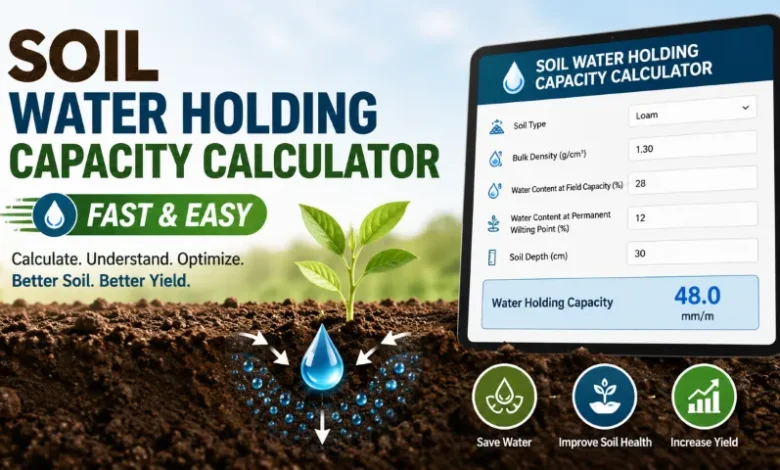
🌱 Soil Water Holding Capacity Calculator
Calculate maximum water holding capacity, field capacity, wilting point, and available water using the Keen Box method, soil texture estimation, or direct lab values.
Calculate Water Holding Capacity of Soil — Complete Guide with Formulas
What Is Water Holding Capacity?
Water holding capacity (WHC) is the maximum amount of water a soil can retain against gravity, expressed as a percentage of the soil’s dry weight or volume. It reflects the soil’s total water retention capacity — essentially, how much of a sponge your soil is. Farmers, agronomists, and irrigation planners rely on this single number to make decisions about irrigation frequency, drainage design, and crop suitability, which is why learning to calculate water holding capacity accurately matters more than simply knowing the definition.
Soil water holding capacity isn’t a fixed universal number — it depends heavily on texture, organic matter, and structure. This is why clay soil water holding capacity and the water holding capacity of loam soil can differ dramatically even on the same farm, and why a single conversion factor can’t be applied blindly across every field.
The Three Reference Points Behind Every WHC Calculation
Before you can calculate water holding capacity, it helps to understand the three-point moisture scale it’s built on:
- Saturation (Maximum WHC) — every soil pore filled with water; measured immediately after saturation
- Field Capacity (FC) — water remaining after gravity drains the larger pores, typically 1–3 days after irrigation (matric potential ≈ −1/3 bar)
- Permanent Wilting Point (PWP) — the point where remaining water is held too tightly for roots to extract it (matric potential ≈ −15 bar)
The water retention capacity actually usable by a crop is the water held between Field Capacity and Permanent Wilting Point — called Available Water Capacity (AWC):
AWC (%) = Field Capacity (%) − Permanent Wilting Point (%)
Method 1: How to Calculate Water Holding Capacity Using the Keen Box (Gravimetric) Method
This is the standard lab method for determining soil water holding capacity, and the most reliable way to calculate it directly rather than estimate it.
Step 1 — Take three weight measurements:
- W1 = Weight of the empty Keen box (grams)
- W2 = Weight of box + oven-dried soil, dried at 105°C for 24 hours (grams)
- W3 = Weight of box + fully saturated soil, after 24 hours of capillary saturation (grams)
Step 2 — Apply the WHC formula:
WHC (%) = [(W3 − W2) ÷ (W2 − W1)] × 100
Step 3 — Calculate Bulk Density (needed for volume-based results):
Bulk Density (g/cm³) = (W2 − W1) ÷ V
where V is the internal volume of the box (Length × Width × Height, in cm³).
Step 4 — Estimate Field Capacity and Wilting Point from WHC (approximation):
Field Capacity (%) ≈ WHC × 0.65
Permanent Wilting Point (%) ≈ WHC × 0.25
Worked Example:
W1 = 50g, W2 = 150g, W3 = 190g, V = 75 cm³
- WHC = (190−150) ÷ (150−50) × 100 = 40%
- Bulk Density = (150−50) ÷ 75 = 1.33 g/cm³
- Field Capacity ≈ 40 × 0.65 = 26%
- Wilting Point ≈ 40 × 0.25 = 10%
- AWC = 26 − 10 = 16%
Method 2: Estimating Water Holding Capacity from Soil Texture
When lab equipment isn’t available, water holding capacity can be estimated from sand, clay, and organic matter content using pedotransfer function regressions (based on Saxton-Rawls type models):
Field Capacity (decimal) = 0.451(Clay) − 0.298(Sand) + 0.05(OM%) + 0.218
Wilting Point (decimal) = 0.302(Clay) − 0.06(Sand) + 0.014(OM%) + 0.038
(Clay and Sand entered as decimals, e.g. 20% = 0.20; multiply final result by 100 to get percentage)
Available Water Capacity = Field Capacity − Wilting Point
This method is less precise than the Keen Box method but useful for quick field-level planning, and it’s exactly where the difference between clay soil water holding capacity and loam soil water holding capacity becomes visible in the numbers — see below.
Method 3: Calculating Available Water Capacity from Known FC and PWP
If you already have Field Capacity and Permanent Wilting Point from pressure plate lab testing, the calculation is direct:
AWC (%) = Field Capacity (%) − Permanent Wilting Point (%)
Converting AWC into Actual Water Storage (mm or liters)
Knowing AWC as a percentage isn’t very actionable on its own — converting it into a real depth of stored water is what makes it usable for irrigation planning:
Water Storage (mm) = (AWC% ÷ 100) × Bulk Density × Root Zone Depth (mm)
Water Storage (Liters/acre) = Water Storage (mm) × 4,046.86
Example: A loam soil with 16% AWC, bulk density 1.33 g/cm³, and a 300mm (30cm) root zone:
Water Storage = (16/100) × 1.33 × 300 = 63.8mm, or roughly 258,200 liters/acre
Clay Soil Water Holding Capacity
Clay soil has small particle sizes and very high total pore space, which gives it a high maximum water holding capacity — often the highest of any texture class at saturation. However, clay’s water retention capacity comes with a catch: much of that retained water is held so tightly in clay’s micro-pores that it sits below the permanent wilting point, meaning it’s physically present but unusable by crop roots.
This is why clay soil water holding capacity numbers can be misleading if read in isolation — a clay soil might show 40%+ WHC at saturation, but its actual Available Water Capacity is often lower than a well-structured loam, because a larger proportion of clay’s water is non-plant-available. Clay soils also drain slowly, so distinguishing between total WHC and usable AWC matters more here than in any other soil type.
Typical clay soil AWC range: 1.2 – 1.8 inches/foot (30 – 46 mm per 30cm)
Water Holding Capacity of Loam Soil
Loam soil consistently shows among the best water retention capacity for actual crop use, because its balanced mix of sand, silt, and clay particles creates a strong proportion of medium-sized pores — exactly the pore size range that holds water between field capacity and wilting point, i.e., water plants can actually use.
The water holding capacity of loam soil is a frequent benchmark in irrigation planning precisely because it represents the practical “sweet spot”: high enough total capacity to reduce irrigation frequency, but structured well enough that most of that stored water remains available rather than locked away like in heavy clay.
Typical loam soil AWC range: 1.5 – 2.1 inches/foot (38 – 53 mm per 30cm)
Silt loam (often even higher): 2.0 – 2.5 inches/foot (51 – 64 mm per 30cm)
Comparison Table: Water Holding Capacity Across Soil Textures
| Soil Texture | AWC (inches/foot) | AWC (mm/30cm) | Notes |
|---|---|---|---|
| Sand | 0.5 – 1.0 | 13 – 25 | Low WHC, but nearly all water is plant-available |
| Loamy Sand | 0.7 – 1.1 | 18 – 28 | Slightly better retention than pure sand |
| Sandy Loam | 1.0 – 1.6 | 25 – 41 | Balanced but still drains relatively fast |
| Loam | 1.5 – 2.1 | 38 – 53 | Best practical balance of capacity and availability |
| Silt Loam | 2.0 – 2.5 | 51 – 64 | Often the highest AWC of any texture class |
| Clay Loam | 1.6 – 2.0 | 41 – 51 | Good capacity, moderate drainage |
| Silty Clay | 1.5 – 2.0 | 38 – 51 | High total water, moderate availability |
| Clay | 1.2 – 1.8 | 30 – 46 | High saturation WHC, but lower AWC due to tightly bound water |
What Affects Soil Water Holding Capacity
- Texture — the primary driver, as shown in the comparison table above
- Organic matter — each 1% increase in organic matter meaningfully improves available water capacity by creating medium-sized, plant-available pores
- Bulk density / compaction — compacted soils store less water regardless of texture, since fewer pores are available
- Soil structure — well-aggregated soil holds and releases water more efficiently than structureless or compacted soil
- Salinity — saline soils hold more water at the wilting point due to osmotic effects, effectively reducing usable water retention capacity even when total WHC looks normal
Common Mistakes When Calculating Water Holding Capacity
- Treating WHC and AWC as the same number — WHC (saturation) is not the water a plant can use; always calculate down to AWC for irrigation decisions.
- Incomplete saturation in the Keen Box method — if the 24-hour capillary saturation step is rushed, W3 reads low and understates true WHC.
- Ignoring bulk density — two soils with identical texture but different compaction levels can have meaningfully different actual water storage; texture percentages alone don’t capture this.
- Using one soil sample for an entire field — water holding capacity of loam soil (or any texture) can vary within a single field due to mixed alluvial deposits, so multiple sample points give a more reliable picture than one test.
Frequently Asked Questions
How do you calculate water holding capacity of soil?
Using the Keen Box (gravimetric) method: WHC (%) = [(W3 − W2) ÷ (W2 − W1)] × 100, where W1 is the empty container weight, W2 is container + oven-dried soil, and W3 is container + saturated soil.
Which soil has the highest water holding capacity?
Clay generally has the highest maximum WHC at saturation, but a large share of that water is held too tightly for plant use. Silt loam typically has the highest Available Water Capacity — the water actually usable by crops.
Why is loam soil considered ideal for water retention?
Loam soil balances sand, silt, and clay particles, creating enough medium-sized pores to store significant water while keeping most of it in the plant-available range between field capacity and wilting point.
How much water can clay soil hold that plants can actually use?
Typically 1.2–1.8 inches of available water per foot of soil depth — lower than its total saturation capacity would suggest, because clay binds a large portion of its water too tightly for root uptake.
What’s the difference between water holding capacity and water retention capacity?
The terms are generally used interchangeably in agronomy — both describe a soil’s ability to retain water against gravity. Available Water Capacity is the more specific technical term for the plant-usable portion of that retained water.