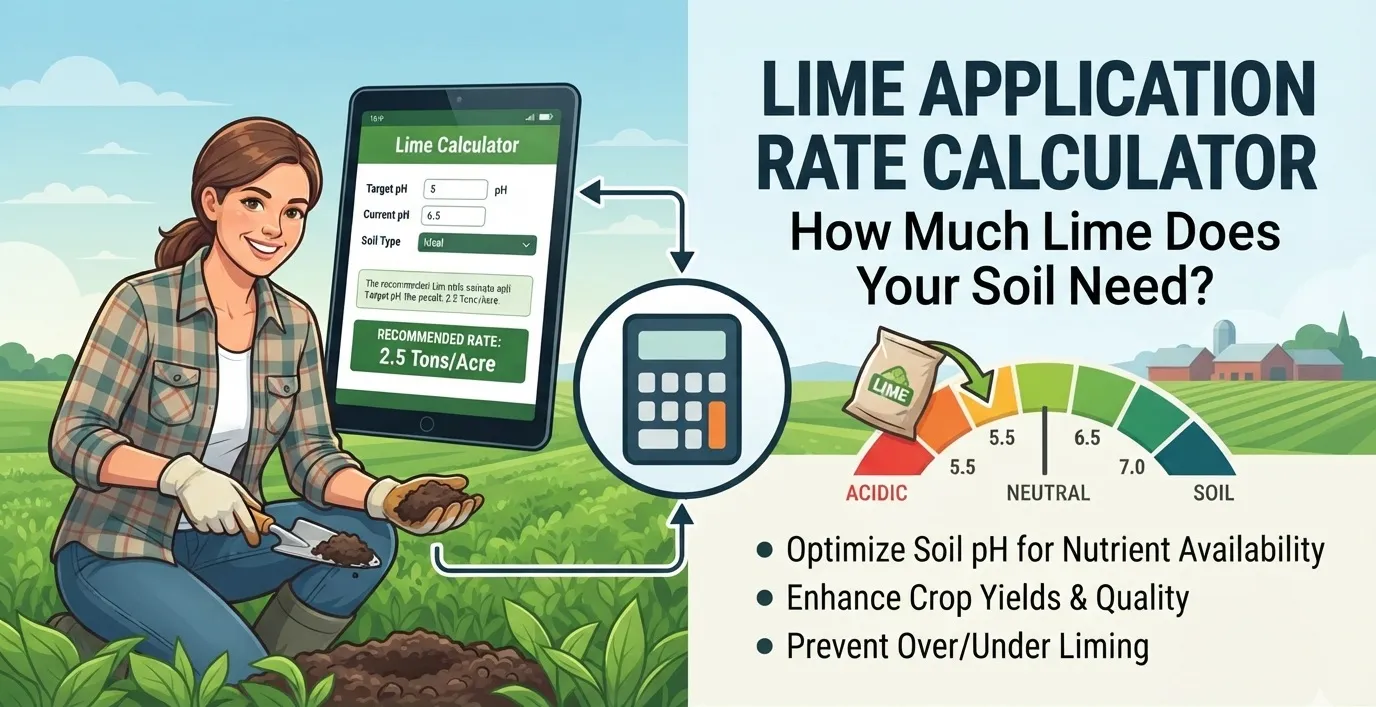
Lime Application Rate Calculator – How Much Lime Does Your Soil Need?
🌱 Lime Application Rate Calculator
Estimate how much agricultural lime your soil needs to improve soil pH and crop growth.
Step 1 — Tell Us About Your Field
Step 2 — Soil Type
🌾 Sandy Soil
Drains water quickly.Needs the least amount of lime.
🌱 Loam Soil
Balanced soil.Medium lime requirement.
🧱 Clay Soil
Heavy soil.Usually needs the most lime.
Step 3 — Field Size
Step 4 — Lime Product
Your Lime Recommendation
🛒 Bags Needed
💰 Estimated Cost
🌱 Soil Health
⚙ Advanced Options (Optional)
Your Soil pH Status
Nutrient Availability
| Nutrient | Availability |
|---|---|
| Nitrogen (N) | |
| Phosphorus (P) | |
| Potassium (K) | |
| Calcium (Ca) | |
| Magnesium (Mg) |
🌱 Why Apply Lime?
Lime reduces soil acidity, improves nutrient availability, encourages healthy root growth, and increases fertilizer efficiency.
📅 Best Time
Apply lime 2–4 months before planting so it has enough time to react with the soil.
🚜 Application
Spread lime evenly and mix it into the top 15–20 cm of soil whenever possible.
💧 After Application
Rainfall or irrigation helps lime begin reacting with the soil more quickly.
Frequently Asked Questions
How often should I apply lime?
Most fields require liming every 2–4 years depending on soil type, rainfall, crop removal, and soil test results.
Can too much lime harm crops?
Yes. Excessive lime can make nutrients such as iron, manganese, zinc, and phosphorus less available. Always follow soil test recommendations.
What is the difference between calcitic and dolomitic lime?
Calcitic lime mainly supplies calcium. Dolomitic lime supplies both calcium and magnesium, making it useful where magnesium levels are low.
Should I apply lime and fertilizer together?
Avoid mixing lime directly with ammonium-based fertilizers. If possible, apply them separately.
Lime Application Rate Calculator | Complete Guide 2026
Introduction: The Hidden Yield Killer Most Farmers Ignore
Ask any experienced agronomist what single soil problem silently destroys more crop yields globally than any other — and the answer is almost always the same.
Wrong soil pH.
Not drought. Not pests. Also Not poor seed quality. Simply soil that is too acidic for the crop growing in it.
Soil pH affects virtually every chemical and biological process that determines crop performance. pH controls how efficiently plant roots absorb nutrients from the soil. It governs the activity of beneficial soil bacteria and fungi that break down organic matter and fix nitrogen. It determines whether applied fertilizers actually reach your crop — or simply lock up in the soil where plants cannot access them.
When soil pH is too low — too acidic — even a perfectly fertilized field can produce disappointing yields. Nitrogen, phosphorus, potassium, calcium, and magnesium all become less available as pH drops below the optimal range. Toxic levels of aluminum and manganese become more soluble in acidic soils, actively poisoning root systems. Beneficial soil biology collapses.
The solution is lime — one of agriculture's oldest and most reliable soil amendments. But applying the wrong amount is almost as bad as applying none at all. Too little and the soil remains acidic. Too much and you create alkalinity problems that are equally damaging to crops and significantly harder to reverse. This is exactly why a reliable Lime Application Rate Calculator is one of the most practically valuable tools any farmer can use. Our free calculator at the top of this page gives you precise, field-specific lime recommendations — by soil type, lime material, crop, and field size — in seconds.
Also check out: 🧮 Fertilizer Calculator — Calculate Exact Fertilizer for Your Crop
What is Soil pH and Why Does It Matter for Farmers?
Understanding the pH Scale in Agriculture
Soil pH is a measure of hydrogen ion concentration in your soil — expressed on a scale from 0 to 14. A pH of 7.0 is neutral. Values below 7.0 indicate acidic soil. Values above 7.0 indicate alkaline soil.
For agricultural purposes the relevant range runs from approximately 4.0 — extremely acidic, found in some tropical and heavily leached soils — to around 8.5, found in arid regions with naturally alkaline parent material.
| pH Range | Soil Classification | Typical Agricultural Impact |
|---|---|---|
| Below 4.5 | Extremely Acidic | Severe aluminum and manganese toxicity, almost no nutrient availability |
| 4.5 – 5.5 | Strongly Acidic | Significant nutrient deficiency, poor legume nodulation, reduced soil biology |
| 5.5 – 6.0 | Moderately Acidic | Acceptable for some crops, phosphorus fixation begins, lime beneficial |
| 6.0 – 7.0 | Slightly Acidic to Neutral | Optimal range for most crops — maximum nutrient availability |
| 7.0 – 7.5 | Neutral to Slightly Alkaline | Good for most crops, some micronutrient limitations begin |
| 7.5 – 8.5 | Moderately Alkaline | Iron, manganese, zinc, and boron deficiencies common |
| Above 8.5 | Strongly Alkaline | Severely limited crop production, specialist management required |
The optimal range of 6.0 to 7.0 is where the vast majority of agricultural crops perform best. In this range nutrient availability is maximized, soil biology is most active, and applied fertilizers deliver their best return.
How Soil Becomes Acidic
Soil acidification is a natural process that is accelerated by agricultural practices. Understanding the causes helps farmers manage pH proactively rather than reactively:
Natural Causes
- Rainfall leaches basic cations (calcium, magnesium, potassium) from the soil profile
- Natural decomposition of organic matter releases organic acids
- Parent rock material that is inherently acidic in composition
- High rainfall regions experience faster natural acidification than arid areas
Agricultural Causes
- Nitrogen fertilizers — particularly ammonium-based products like urea and DAP — are the single largest driver of agricultural soil acidification
- Continuous cropping removes basic cations through harvested biomass
- Irrigation with acidic or high-sodium water
- Removal of crop residues that would otherwise return organic matter and basic cations
A continuous wheat or maize system applying nitrogen fertilizer year after year can reduce soil pH by 0.1 to 0.3 units per year without any lime management. Over a decade this transforms a productive neutral soil into a significantly acidic one — with measurable yield consequences across every season.
How to Test Your Soil pH — Before Using the Calculator
Why Soil Testing is Non-Negotiable
The lime application rate calculator requires your current soil pH as an input. Without an accurate soil pH measurement the calculation is meaningless — and applying lime based on guesswork is a waste of money at best and harmful to crops at worst.
Soil testing is the foundation of any rational liming program and should be conducted:
- Before establishing a new crop rotation or farming system
- Every 2 to 3 years in existing production fields
- When yields unexpectedly decline without an obvious cause
- When fertilizer response appears poor despite correct application rates
- Before any major lime application to establish a baseline
Soil Testing Methods Available to Farmers
| Testing Method | Cost | Accuracy | Best For |
|---|---|---|---|
| Laboratory soil test | Moderate | ⭐⭐⭐⭐⭐ | Commercial farm decisions — most reliable |
| Digital soil pH meter | Low one-time cost | ⭐⭐⭐⭐ | Regular farm monitoring |
| Soil test kit (colorimetric) | Very low | ⭐⭐⭐ | Quick field screening |
| pH indicator strips | Very low | ⭐⭐ | Basic home garden screening |
| Extension service testing | Free or subsidized | ⭐⭐⭐⭐⭐ | Available through agriculture departments |
For commercial farm decisions — particularly before investing in large-scale lime applications — laboratory soil testing from a certified agricultural laboratory provides the most reliable results. In Pakistan, the University of Agriculture Faisalabad (UAF) soil laboratory, provincial agriculture department soil testing services, and NARC provide reliable analytical services for farmers.
How to Collect a Proper Soil Sample
Incorrect soil sampling is one of the most common causes of misleading pH results. Follow these steps for a representative sample:
Step 1 — Plan your sampling grid
Divide large fields into management zones based on visible differences in crop performance, soil color, or drainage patterns. Sample each zone separately.
Step 2 — Collect multiple sub-samples
Take 15 to 20 individual soil cores from random locations across each zone using a soil probe or clean trowel. Walk in a W or zigzag pattern across the sampling area.
Step 3 — Sample at the correct depth
For tillage-incorporated lime recommendations sample at 0 to 20 cm depth. For no-till systems where lime is surface-applied sample both 0 to 10 cm and 10 to 20 cm separately.
Step 4 — Mix and subsample
Combine all cores from one zone in a clean plastic bucket. Mix thoroughly and remove approximately 500 grams as your submitted sample. Label clearly with field name, depth, and date.
Step 5 — Submit promptly
Deliver or ship the sample to your chosen laboratory within 48 hours. Avoid exposing the sample to extreme heat or direct sunlight before submission.
Understanding Lime Types — Which Material Should You Use?
The Neutralizing Value Concept
Not all lime materials neutralize soil acidity with equal efficiency. The neutralizing value (NV) — also called calcium carbonate equivalent (CCE) — expresses each material's acid-neutralizing capacity relative to pure calcium carbonate (rated at 100%).
Our lime application rate calculator automatically adjusts the required quantity based on which material you select — so you always get the correct amount regardless of which lime type is available to you.
| Lime Material | Neutralizing Value | Key Characteristics | Best Application |
|---|---|---|---|
| Calcitic Limestone (CaCO₃) | 95–100% | Most widely available, safe to handle, slow-acting | Standard farm liming — most common choice worldwide |
| Dolomitic Limestone | 100–110% | Supplies both calcium AND magnesium | Magnesium-deficient soils — common in sandy soils |
| Quicklime (Burnt Lime) | 170–180% | Highly concentrated, fast-acting, caustic | Large-scale applications where transport costs are high |
| Hydrated Lime (Slaked) | 130–135% | Fast-acting, fine powder, reactive | Emergency pH correction, faster results needed |
| Marl | 50–90% | Natural calcium carbonate deposit, variable quality | Local availability, large-volume low-cost applications |
| Wood Ash | 40–60% | Also supplies potassium, widely available on farms | Small-scale application, kitchen gardens, organic systems |
| Sugar Beet Lime | 80–90% | By-product of sugar industry, often free or cheap | Areas near sugar mills — Pakistan, India, Europe |
| Chalk | 90–95% | Fine particle size improves reactivity, easy to spread | Available in specific geological regions |
Lime Material Selection Guide for Pakistani Farmers
For most farmers in Pakistan and South Asia the practical choice narrows to:
Calcitic limestone — most widely available through agricultural input dealers, reliable quality, safe to handle, well-understood application rates. This is the recommended default for most farm liming programs.
Dolomitic limestone — choose this when a soil test also indicates magnesium deficiency alongside low pH. Common in sandy Punjab soils that have been intensively cropped.
Sugar beet lime — if your farm is located near a sugar mill this material may be available free or at very low cost as a mill by-product. Despite its lower neutralizing value the cost advantage often makes it the most economical choice.
Wood ash — valuable for kitchen gardens, small vegetable plots, and organic farming systems where other lime materials are not appropriate or available.
How Soil Type Affects Your Lime Requirement
Understanding Soil Buffering Capacity
One of the most important and least understood aspects of lime application is that soils with the same pH do not necessarily require the same amount of lime to reach a target pH. This is because of soil buffering capacity — the soil's resistance to pH change.
Clay soils and organic-matter-rich soils have high buffering capacity. They contain many negatively charged surfaces that hold hydrogen ions tightly — requiring more lime to neutralize them and shift the pH upward.
Sandy soils have low buffering capacity. They contain fewer charged surfaces, hold fewer hydrogen ions, and respond more quickly to lime addition — but also re-acidify more quickly and require more frequent liming at lower rates.
| Soil Type | Buffering Capacity | Lime Needed Per pH Unit | Re-acidification Rate |
|---|---|---|---|
| Sand | Very Low | 800 kg/acre | Fast — re-test every 2 years |
| Loamy Sand | Low | 950 kg/acre | Fast — re-test every 2 years |
| Sandy Loam | Low-Medium | 1,100 kg/acre | Moderate — re-test every 3 years |
| Loam | Medium | 1,350 kg/acre | Moderate — re-test every 3 years |
| Silt Loam | Medium-High | 1,500 kg/acre | Moderate — re-test every 3 years |
| Sandy Clay Loam | Medium-High | 1,600 kg/acre | Slow — re-test every 4 years |
| Clay Loam | High | 1,900 kg/acre | Slow — re-test every 4 years |
| Silty Clay Loam | Very High | 2,100 kg/acre | Slow — re-test every 4–5 years |
| Clay | Very High | 2,400 kg/acre | Very slow — re-test every 5 years |
This is why our lime calculator asks for soil type — it is not a minor detail. A clay soil farmer and a sandy soil farmer with the same pH problem may require dramatically different lime quantities to achieve the same correction.
Convert Acres to Hectare from here.
Ideal Soil pH for Major Crops — Complete Reference Guide
Why Crop Choice Determines Your Target pH
Different crops have evolved in different natural soil environments and have adapted to specific pH ranges. Choosing the wrong target pH for your specific crop is a common and costly mistake.
Our calculator includes a crop selection feature that automatically fills your target pH based on the crop you select. Here is the complete reference:
Cereal and Grain Crops
| Crop | Urdu Name | Optimal pH Range | pH Below Which Yield Drops |
|---|---|---|---|
| Wheat | گندم | 6.0 – 7.0 | Below 5.8 |
| Rice / Paddy | چاول | 5.5 – 6.5 | Below 5.0 |
| Maize / Corn | مکئی | 6.0 – 7.0 | Below 5.8 |
| Barley | جو | 6.0 – 7.0 | Below 5.8 |
| Oats | جئی | 5.5 – 7.0 | Below 5.5 |
Cash and Industrial Crops
| Crop | Urdu Name | Optimal pH Range | Notes |
|---|---|---|---|
| Cotton | کپاس | 6.0 – 7.0 | Sensitive to iron deficiency above 7.5 |
| Sugarcane | گنا | 6.0 – 7.5 | Tolerates wider pH range than most crops |
| Canola / Rapeseed | کینولہ | 6.0 – 7.0 | Clubroot risk increases below 6.5 |
| Mustard | سرسوں | 6.0 – 7.0 | Also clubroot sensitive below 6.0 |
| Sunflower | سورج مکھی | 6.0 – 7.5 | Relatively pH tolerant |
| Soybean | سویا بین | 6.0 – 7.0 | Nitrogen fixation most efficient above 6.2 |
| Sesame | تِل | 6.0 – 7.0 | Prefers well-drained neutral soils |
Vegetable Crops
| Crop | Urdu Name | Optimal pH Range | Special Notes |
|---|---|---|---|
| Tomato | ٹماٹر | 6.0 – 7.0 | Blossom end rot risk increases below 6.0 |
| Potato | آلو | 5.5 – 6.5 | Scab disease increases above 6.5 — do not overlime |
| Onion | پیاز | 6.0 – 7.0 | Poor root development below 6.0 |
| Garlic | لہسن | 6.0 – 7.0 | Nutrient uptake most efficient 6.0–6.5 |
| Spinach | پالک | 6.5 – 7.0 | Prefers near-neutral conditions |
| Carrot | گاجر | 6.0 – 7.0 | Forked roots common in acidic soils |
| Chilli / Pepper | مرچ | 6.0 – 7.0 | Susceptible to calcium deficiency below 6.0 |
| Cabbage | بند گوبھی | 6.5 – 7.0 | Clubroot risk significant below 6.5 |
⚠️ Important Note for Potato Farmers: Potato is one of the few major crops where overliming causes a serious disease problem. Common scab disease of potato is strongly promoted by pH above 6.5. Always target 5.5 to 6.0 for potato crops and never apply lime immediately before a potato crop.
Fruit and Orchard Crops
| Crop | Urdu Name | Optimal pH Range | Notes |
|---|---|---|---|
| Mango | آم | 5.5 – 7.0 | Tolerates moderate acidity |
| Citrus / Orange | کنو | 6.0 – 7.0 | Iron chlorosis above 7.5 |
| Guava | امرود | 6.0 – 7.5 | Relatively pH tolerant |
| Apple | سیب | 6.0 – 7.0 | Bitter pit increases below 6.0 |
| Strawberry | — | 5.5 – 6.5 | Prefers moderately acidic conditions |
Fodder and Pasture Crops
| Crop | Urdu Name | Optimal pH Range | Notes |
|---|---|---|---|
| Alfalfa / Lucerne | لوسرن | 6.5 – 7.5 | Most pH-demanding common fodder crop |
| Clover | — | 6.0 – 7.0 | Nitrogen fixation requires pH above 6.0 |
| Rye Grass | رائی گھاس | 6.0 – 7.0 | Moderate pH requirements |
| Sorghum | جوار | 6.0 – 7.5 | Relatively tolerant of pH range |
How to Use the Lime Application Rate Calculator — Step by Step
Our free lime calculator at the top of this page is designed to be simple and practical for farmers with any level of technical experience. Here is exactly how to use it:
Step 1 — Enter Soil and Field Information
Soil Type: Select the soil texture that best describes your field. If you are unsure — sandy soils feel loose and gritty and do not hold shape when squeezed. Clay soils feel sticky and plastic when wet and form a ribbon when squeezed between thumb and forefinger. Loam soils fall in between.
Lime Material: Select the lime product you plan to use. If you are unsure which material to choose — calcitic limestone is the most common and widely available option and is a safe default for most situations.
Tillage Method: Select how the lime will be incorporated. Full tillage (plowing) incorporates lime most deeply and uniformly. No-till applications leave lime on the surface where it reacts more slowly.
Field Area: Enter your total field size and select your preferred measurement unit — acre, hectare, kanal, or marla.
Application Depth: The depth to which lime will be incorporated. For plowed fields 15 to 20 cm is standard. Surface applications for no-till should be entered as the effective reaction depth (typically 5 to 10 cm).
Step 2 — Enter Your Soil pH Values
Current Soil pH: Enter the pH value from your soil test. This should come from a recent laboratory or reliable field measurement. The valid range is 4.0 to 7.0 — if your pH is above 7.0 your soil is alkaline and does not need lime.
Target Soil pH: Enter the pH you want to achieve. This should be based on your crop's optimal pH range from the guide above. If you select a crop from the dropdown the target pH fills automatically.
Step 3 — Select Your Crop and Season
Selecting a crop auto-fills the target pH with the recommended optimum for that crop — saving you from having to look it up separately.
The season selection helps the calculator provide appropriate application timing advice in the recommendation text.
Step 4 — Calculate and Read Your Results
Click Calculate Lime Requirement and the tool instantly provides:
- Lime required per acre and per hectare
- Total lime needed for your entire field
- Number of 50 kg bags required
- A split application plan — 60% first dose and 40% follow-up
- A personalized written recommendation for your specific situation
- Safety notes for reactive lime materials
Lime Application Methods — How to Apply Lime Correctly
Choosing the Right Application Equipment
| Equipment Type | Best For | Coverage | Accuracy |
|---|---|---|---|
| Spinner spreader (broadcast) | Large field applications | Wide coverage | Good for even terrain |
| Lime slurry tanker | Fine lime materials, precision applications | Variable | Excellent — no dust |
| Bulk pneumatic spreader | Very large operations | Very wide | Good — even distribution |
| Tractor-mounted spreader | Medium farm operations | Good | Adequate for most farms |
| Manual broadcasting | Small plots, kitchen gardens | Limited | Variable — operator skill dependent |
| Injection into irrigation | Hydrated lime only, drip systems | Excellent | High precision |
Application Timing — When to Apply Lime
Lime application timing significantly affects how quickly and completely the pH correction is achieved.
Best timing — 3 to 6 months before planting
This is the gold standard for lime application. Applying lime well ahead of planting gives it time to react with soil moisture, dissolve, and distribute through the soil profile before roots encounter acidic conditions.
Application during fallow periods
The fallow period between crops is ideal for lime application in rotation systems. Incorporating lime immediately after harvest and allowing a full season of reaction time before the next planting maximizes effectiveness.
Autumn application in temperate climates
For farming systems with autumn soil preparation, applying lime after harvest and before winter allows the freeze-thaw cycle to assist lime incorporation and distribution through the soil.
Avoid applying lime immediately before planting
Freshly applied unreacted lime can interfere with seed germination and early root development. Always allow at least 4 to 6 weeks between lime application and seeding.
The Split Application Principle
For pH corrections greater than 0.5 units our calculator recommends splitting the total lime requirement into two applications. This approach offers several practical advantages:
- Reduces risk of over-liming in any specific area
- Allows better lime incorporation at each application
- Reduces the risk of creating temporary calcium excess conditions
- More practical for large total quantities that are difficult to apply uniformly in a single pass
- Enables mid-correction soil testing to confirm progress before final application
The recommended split is 60% in the first application followed by 40% in the second application 3 to 4 weeks later.
Lime Application Rates — Reference Guide by Crop and Soil Type
The following tables provide general lime application rate guidelines for reference. For precise field-specific recommendations always use the calculator above with your actual soil pH data.
Wheat and Cereal Crops — Lime Rates to Achieve pH 6.5
| Current pH | Sandy Loam (kg/acre) | Loam (kg/acre) | Clay Loam (kg/acre) |
|---|---|---|---|
| 6.0 – 6.4 | 250 – 350 | 350 – 450 | 550 – 700 |
| 5.5 – 5.9 | 500 – 650 | 700 – 900 | 1,100 – 1,400 |
| 5.0 – 5.4 | 800 – 1,000 | 1,100 – 1,350 | 1,700 – 2,100 |
| 4.5 – 4.9 | 1,100 – 1,300 | 1,500 – 1,800 | 2,300 – 2,800 |
| Below 4.5 | Split into 2 seasons | Split into 2 seasons | Split into 2 seasons |
Vegetable Crops — Lime Rates to Achieve pH 6.5
| Current pH | Sandy Loam (kg/acre) | Loam (kg/acre) | Clay Loam (kg/acre) |
|---|---|---|---|
| 6.0 – 6.4 | 250 – 350 | 350 – 450 | 550 – 700 |
| 5.5 – 5.9 | 500 – 650 | 700 – 900 | 1,100 – 1,400 |
| 5.0 – 5.4 | 800 – 1,000 | 1,100 – 1,350 | 1,700 – 2,100 |
Alfalfa / Lucerne — Lime Rates to Achieve pH 7.0
| Current pH | Sandy Loam (kg/acre) | Loam (kg/acre) | Clay Loam (kg/acre) |
|---|---|---|---|
| 6.5 – 6.9 | 250 – 350 | 350 – 450 | 550 – 700 |
| 6.0 – 6.4 | 550 – 700 | 750 – 950 | 1,150 – 1,450 |
| 5.5 – 5.9 | 850 – 1,050 | 1,150 – 1,400 | 1,750 – 2,200 |
💡 Note: All rates above are for calcitic limestone (NV = 100%). Adjust quantities proportionally for other lime materials using the neutralizing values in the table above.
Common Liming Mistakes and How to Avoid Them
Applying lime without a soil test
Lime application without knowing your actual soil pH is guesswork. You may apply too little and see no improvement, or too much and create new problems. Always test before you lime.
Ignoring soil type when calculating lime rates
Using a single published lime rate recommendation regardless of your soil texture is one of the most common mistakes. A clay farmer applying the same rate as a sandy soil neighbor will seriously under-lime their field.
Overliming — raising pH too high
Raising pH above 7.5 in most cropping systems creates micronutrient deficiencies — particularly iron, manganese, zinc, and boron. These deficiencies are expensive to correct and harder to reverse than original soil acidity. Never exceed your crop's optimal target pH.
Applying lime immediately before planting
Freshly applied lime is reactive and can interfere with germination. Always allow adequate reaction time between lime application and seeding.
Using poor quality lime with low neutralizing value
Cheap lime that is poorly ground, wet, or contaminated delivers far less neutralizing value per kilogram than the price per bag suggests. Always request a CCE (calcium carbonate equivalent) certificate from your lime supplier.
Applying lime without incorporating it
Surface-applied lime on tilled soils should be incorporated by plowing or discing within 24 to 48 hours of application. Unincorporated lime on the soil surface reacts only with the top few centimeters and has minimal effect on the root zone.
Not re-testing after liming
Always re-test soil pH 3 to 6 months after a lime application to confirm the pH has moved toward your target. Soil buffering capacity sometimes surprises even experienced agronomists — a follow-up test confirms whether a second application is needed.
Lime Application Safety Guidelines
Handling Different Lime Materials Safely
| Lime Type | Hazard Level | Safety Requirements |
|---|---|---|
| Calcitic Limestone | Low | Dust mask recommended during spreading |
| Dolomitic Limestone | Low | Dust mask recommended during spreading |
| Quicklime (Burnt Lime) | HIGH | Full PPE essential — gloves, goggles, face shield, long sleeves. Highly caustic — causes severe burns on contact with moist skin |
| Hydrated Lime | Medium-High | Gloves, goggles, dust mask — irritating to eyes and respiratory system |
| Marl | Low | Standard dust precautions |
| Wood Ash | Low | Dust mask — fine particles irritating if inhaled |
Environmental Safety Considerations
- Never apply lime within 10 meters of water bodies, drainage channels, or irrigation canals
- Avoid lime application on sloping ground before rainfall to prevent runoff into waterways
- Store lime in dry covered conditions — moisture dramatically reduces effectiveness
- Do not apply lime to waterlogged soils — it can create localized pH extremes harmful to soil biology
- Keep lime away from livestock feed and water sources during application
Frequently Asked Questions
What is the best time of year to apply lime in Pakistan?
The best time to apply lime in Pakistan is during the Rabi season preparation period (September to October) — after Kharif harvest and before Rabi sowing. This gives lime 2 to 3 months of reaction time before wheat and other Rabi crops are planted. The second best window is the fallow period between Rabi harvest and Kharif planting (April to May) for fields going into summer crops.
How long does lime take to work?
Finely ground calcitic limestone typically shows measurable pH change within 3 to 6 months when properly incorporated and adequate moisture is present. Coarser materials take longer. Quicklime and hydrated lime react significantly faster — often showing results within 4 to 8 weeks. Full stabilization of pH at the target level typically takes 6 to 12 months.
How often do I need to apply lime?
Re-liming frequency depends on soil type, crop system, nitrogen fertilizer use, and rainfall. Sandy soils in high-rainfall areas under intensive nitrogen fertilization may need liming every 2 to 3 years. Clay soils in lower-rainfall areas may maintain pH for 5 to 7 years after a single application. Always base re-liming decisions on soil test results rather than a fixed schedule.
Can I apply lime and fertilizer at the same time?
Generally lime and fertilizer should not be applied simultaneously or mixed together. Lime can react with ammonium nitrogen fertilizers to release ammonia gas — wasting expensive nitrogen. Lime can also react with phosphate fertilizers to form insoluble compounds. As a general rule apply lime at least 2 to 4 weeks before or after nitrogen and phosphate fertilizers.
What happens if I apply too much lime?
Over-application of lime raises soil pH above the optimal range for your crop. This causes secondary micronutrient deficiencies — particularly iron, manganese, zinc, and boron — that produce symptoms resembling various disease conditions. Over-limed soils are significantly harder and more expensive to correct than acidic ones. This is why using the calculator with accurate soil test data is so important.
Can I use wood ash from my farm as a lime substitute?
Yes — wood ash has lime-equivalent properties and can raise soil pH. However its neutralizing value (40 to 60% of calcitic limestone) is significantly lower than commercial lime materials and its quality varies enormously depending on the wood source. Wood ash also supplies potassium which can be beneficial or problematic depending on existing soil potassium levels. Use our calculator and select Wood Ash as the lime material to get the correct quantity.
What is the maximum lime rate I should apply in a single season?
Most agronomic guidelines recommend a maximum single-season lime application of 2 to 3 tonnes per acre (5 to 7.5 tonnes per hectare) for calcitic limestone. For pH corrections requiring more than this amount — typically when current pH is below 5.0 and target pH is 6.5 or higher — split the total requirement across two or more seasons to avoid over-correction and soil chemistry disruption.
Is lime different from gypsum?
Yes — lime and gypsum (calcium sulfate) are completely different soil amendments with different functions. Lime raises soil pH by neutralizing acidity. Gypsum does not change soil pH but improves soil structure, reduces sodium in sodic (salt-affected) soils, and provides calcium and sulfur. In Pakistan's sodic soils gypsum is widely used for soil reclamation. The two materials are sometimes used together but serve distinctly different purposes.