Sulphur Application Rate Calculator – How to Lower Soil pH & Fix Sulphur Deficiency 2026
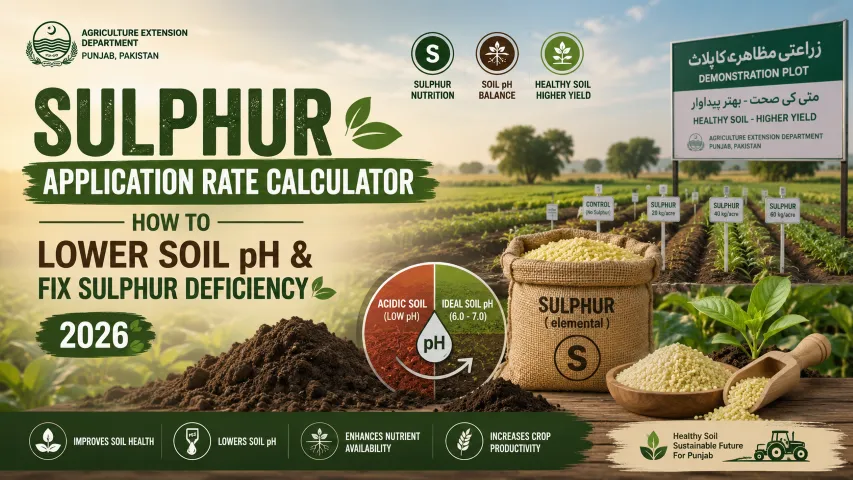
Sulphur Application Rate Calculator
Calculate exact sulphur needed — to lower soil pH, fix sulphur deficiency, or protect your crops
| Parameter | Per Acre | Per Hectare | Total Field |
|---|
Sulphur is an essential macronutrient for protein synthesis, enzyme function, and chlorophyll formation. Deficiency causes yellowing of young leaves and reduced crop quality.
| Parameter | Per Acre | Per Hectare | Total Field |
|---|
Sulphur is one of the oldest and most effective fungicides for powdery mildew, rust, and other fungal diseases. Calculate exact spray quantities for your tank and field.
| Parameter | Per Acre | Per Hectare | Total Field |
|---|
Recommended sulphur (S) rates per acre for deficient soils. Rates are for elemental sulphur equivalent — adjust for actual product S content.
Sulphur Application Rate Calculator – How Much Sulphur Does Your Soil & Crop Need? Complete Guide 2026
Introduction: The Most Underrated Nutrient in Modern Agriculture
If you asked most farmers to name the four most important plant nutrients, the answers would almost always be the same — nitrogen, phosphorus, potassium, and perhaps calcium. Sulphur rarely makes the list.
Yet sulphur deficiency is now one of the most widespread and economically damaging nutritional problems in global agriculture. In Pakistan alone, studies from the University of Agriculture Faisalabad estimate that more than 70% of agricultural soils are deficient in sulphur to varying degrees. Similar findings have been reported across South Asia, Sub-Saharan Africa, parts of Europe, and the Americas.
Why has sulphur deficiency become so widespread so quickly? The answer lies in a well-intentioned environmental achievement — the dramatic reduction in industrial sulphur dioxide emissions over the past three decades. Until the 1990s, acid rain deposited significant quantities of sulphur into agricultural soils as an unintentional byproduct of industrial activity. As air quality improved and industrial emissions declined, this invisible sulphur input disappeared — and crop deficiencies began appearing in fields that had never experienced them before.
At the same time, the widespread shift to high-analysis fertilizers — urea, DAP, MAP, and potassium chloride — eliminated the incidental sulphur that older fertilizer formulations like ammonium sulphate and single superphosphate used to provide as a matter of course.
But sulphur's role in agriculture extends far beyond nutrition. It is one of the most versatile substances in the farmer's toolkit — simultaneously a plant nutrient, a soil pH amendment, and one of the oldest and most effective crop protection fungicides known to agriculture.
Our free Sulphur Application Rate Calculator covers all three functions in a single tool — helping you calculate exactly how much sulphur you need for soil pH correction, crop nutrition, or fungal disease control. This complete guide explains the science behind each application and how to use the calculator for maximum benefit.
Sulphur management works best as part of a complete soil fertility program. Use the free Fertilizer Calculator at fasalbachao.com to calculate your complete nutrient program alongside your sulphur requirements.
Part 1: Sulphur for Soil pH Correction — Lowering Alkaline Soils
Why Would a Farmer Need to Lower Soil pH?
Most farmers are familiar with lime — the material used to raise soil pH in acidic soils. But the opposite problem — soil that is too alkaline — is equally widespread and equally damaging to crop production.
Alkaline soils — those with pH above 7.5 — are particularly common in:
- Arid and semi-arid regions with low rainfall that does not leach basic cations
- Irrigated agricultural areas where irrigation water carries dissolved calcium carbonate
- Naturally calcareous soils formed from limestone parent material
- Areas where excessive lime has been applied in previous seasons
- Coastal regions with marine sediment parent material
In Pakistan, large areas of Punjab and Sindh have naturally alkaline soils — and decades of irrigation with calcium-rich canal and groundwater have pushed pH even higher in many fields.
How High pH Damages Crop Production
When soil pH rises above 7.5 — and particularly above 8.0 — a cascade of nutritional problems develops that directly reduces crop yields:
| pH Level | Agricultural Impact |
|---|---|
| 7.0 – 7.5 | Slight iron and manganese limitations beginning |
| 7.5 – 8.0 | Significant iron, zinc, manganese, and boron deficiency risk |
| 8.0 – 8.5 | Phosphorus fixation increases, serious micronutrient deficiency |
| Above 8.5 | Severe crop growth limitation, aluminum toxicity in some soils |
The most visible symptom of high pH in crops is interveinal chlorosis — a yellowing of leaf tissue between the veins while the veins themselves remain green. This is caused by iron deficiency that becomes progressively worse as pH rises. Zinc deficiency, causing stunted growth and small distorted leaves, is also extremely common in alkaline Pakistani soils.
Beyond micronutrient problems, high pH reduces phosphorus availability through a process called phosphorus fixation — where phosphate ions react with calcium in the soil to form insoluble calcium phosphate compounds that plant roots cannot absorb. Farmers applying expensive DAP or SSP to alkaline soils often see very poor phosphorus response for exactly this reason.
How Sulphur Lowers Soil pH — The Chemistry
Elemental sulphur — yellow granules or powder consisting of pure sulphur atoms — is the primary material used to lower soil pH in agricultural settings. The pH reduction process works through a fascinating biological mechanism:
- Step 1: Elemental sulphur is applied to the soil and incorporated by tillage.
- Step 2: Soil bacteria — particularly Thiobacillus thiooxidans and related species — oxidize the elemental sulphur in the presence of moisture and oxygen.
- Step 3: This bacterial oxidation converts elemental sulphur to sulphuric acid (H₂SO₄).
- Last Step 4: The sulphuric acid reacts with soil calcium carbonate and basic cations, displacing them and releasing hydrogen ions that lower soil pH.
This entire process takes time — typically 6 to 12 weeks under warm, moist soil conditions. This is why elemental sulphur must be applied well ahead of planting — it is not a quick fix but a systematic soil chemistry correction.
The rate of reaction depends critically on:
| Factor | Effect on Reaction Speed |
|---|---|
| Soil temperature | Warm soils (above 20°C) react much faster than cold soils |
| Soil moisture | Adequate moisture essential — dry soils react very slowly |
| Particle size | Finer particles react much faster than coarse material |
| Microbial population | High organic matter soils have more active bacteria |
| Initial soil pH | Very high pH may slow initial bacterial activity |
How Much Sulphur to Lower Soil pH — Reference Guide
The quantity of elemental sulphur needed to lower soil pH by one unit varies significantly by soil type. Clay and organic-matter-rich soils have high buffering capacity — they resist pH change and require more sulphur than sandy soils.
| Soil Type | Elemental Sulphur to Lower pH by 1 Unit (kg/acre) |
|---|---|
| Sandy Soil | 150 kg/acre |
| Loamy Sand | 200 kg/acre |
| Sandy Loam | 280 kg/acre |
| Loam | 360 kg/acre |
| Silt Loam | 420 kg/acre |
| Sandy Clay Loam | 460 kg/acre |
| Clay Loam | 540 kg/acre |
| Silty Clay Loam | 600 kg/acre |
| Clay | 700 kg/acre |
⚠️ Maximum safe application rate: Do not apply more than 500 kg of elemental sulphur per acre in a single season. For larger pH corrections split the total requirement across two or more growing seasons.
Sulphur Materials for pH Correction
Different sulphur products vary enormously in their sulphur content and therefore in the quantities required for pH correction. Our calculator automatically adjusts for whichever material you are using.
| Sulphur Material | Sulphur Content | Speed of Action | Best Use Case |
|---|---|---|---|
| Elemental Sulphur (granular) | 90–99% S | Slow — 6–12 weeks | Standard pH correction — most economical |
| Bentonite Sulphur | 90% S | Moderate — 4–8 weeks | Good dispersion in soil, faster than coarse elemental |
| Ammonium Sulphate | 24% S | Fast — immediately available | Mild pH correction plus nitrogen supply |
| Gypsum (Calcium Sulphate) | 18% S | Very slow for pH | Sodic soil improvement — not primarily for pH |
| Single Super Phosphate | 12% S | Moderate | pH correction plus phosphorus supply |
Part 2: Sulphur as a Crop Nutrient
H2: Why Sulphur is Now Considered the Fourth Macronutrient
Plant scientists have long classified nitrogen, phosphorus, and potassium as the three primary macronutrients. Over the past two decades sulphur has increasingly been recognized as a fourth primary macronutrient — particularly for oilseed, brassica, and allium crops that have exceptionally high sulphur demands.
Sulphur performs critical functions in plant biochemistry:
Protein synthesis: Sulphur is a component of two essential amino acids — methionine and cysteine — that are fundamental building blocks of all plant proteins. Wheat grain protein quality, canola meal nutritional value, and pulse seed protein content all depend directly on adequate sulphur supply.
Enzyme function: Numerous plant enzymes contain sulphur-based active sites. Nitrogenase — the enzyme responsible for biological nitrogen fixation in legumes — requires sulphur for activity. Sulphur deficiency in legume crops therefore indirectly reduces nitrogen fixation efficiency.
Chlorophyll formation: Although sulphur is not directly part of the chlorophyll molecule, it is required for the synthesis of ferredoxin — an iron-containing protein essential for photosynthesis. Sulphur-deficient plants show characteristic yellowing of young leaves as chlorophyll synthesis fails.
Oil quality in oilseeds: Sulphur-containing glucosinolates in brassica crops affect oil quality and meal nutritional value. Adequate sulphur is essential for achieving target glucosinolate profiles in canola and mustard production.
Flavour and aroma compounds: The characteristic flavour of onions, garlic, leeks, and other allium crops comes from sulphur-containing volatile compounds. Sulphur-deficient allium crops have significantly reduced flavour intensity and market value.
Identifying Sulphur Deficiency in Crops
Correctly identifying sulphur deficiency — as distinct from nitrogen deficiency and other nutrient problems — is essential before deciding to apply sulphur fertilizer.
| Feature | Sulphur Deficiency | Nitrogen Deficiency |
|---|---|---|
| Which leaves affected first | Young leaves (growing tips) | Old leaves (lower leaves) |
| Colour pattern | Uniform yellowing of entire young leaf | Yellowing starts at leaf tip, moves inward |
| Veins | Veins also yellow | Veins often remain green initially |
| Timing | Can appear at any growth stage | Usually most visible at vegetative stage |
| Most affected crops | Oilseeds, alliums, brassicas, legumes | All crops equally affected |
| Soil test indicator | Low extractable sulphate-S | Low mineral nitrogen |
💡 Key diagnostic rule: Sulphur deficiency yellows the youngest leaves first. Nitrogen deficiency yellows the oldest leaves first. This single observation allows correct diagnosis in the field without a laboratory test.
Sulphur Requirements by Crop Category
Different crops have dramatically different sulphur demands based on their biochemistry and yield level. Understanding your crop's specific requirement is the foundation of an effective sulphur nutrition program.
High Sulphur Demand Crops — 20 to 35 kg S per acre
| Crop | Urdu Name | S Requirement (kg/acre) | Why High Demand |
|---|---|---|---|
| Canola / Rapeseed | کینولہ | 25–35 | Glucosinolate synthesis, high oil content |
| Mustard | سرسوں | 20–30 | Same as canola — brassica family |
| Onion / Garlic | پیاز / لہسن | 18–22 | Flavour compound synthesis |
| Groundnut | مونگ پھلی | 20–25 | Protein synthesis, high yield |
| Alfalfa / Lucerne | لوسرن | 20–25 | High protein, multiple cuts per year |
| Soybean | سویا بین | 18–22 | Protein content, nitrogen fixation |
Medium Sulphur Demand Crops — 12 to 20 kg S per acre
| Crop | Urdu Name | S Requirement (kg/acre) | Notes |
|---|---|---|---|
| Wheat | گندم | 12–18 | Grain protein quality dependent on S |
| Cotton | کپاس | 15–20 | Fiber quality affected by S status |
| Maize | مکئی | 12–16 | Responsive to S on sandy soils |
| Sugarcane | گنا | 14–18 | Particularly important on light soils |
| Potato | آلو | 12–16 | Important for tuber protein content |
| Sesame | تِل | 15–20 | Oil quality influenced by S supply |
Lower Sulphur Demand Crops — 8 to 14 kg S per acre
| Crop | Urdu Name | S Requirement (kg/acre) | Notes |
|---|---|---|---|
| Rice | چاول | 10–15 | Sandy lowland soils most responsive |
| Barley | جو | 10–14 | Similar to wheat but lower yield |
| Chickpea | چنے | 10–14 | Nitrogen fixation requires adequate S |
| Lentil | مسور | 8–12 | Moderate demand |
| Mung Bean | مونگ | 8–12 | Moderate demand |
Sulphur Fertilizer Sources — Which Product Should You Use?
| Fertilizer Product | S Content | Additional Nutrients | Speed of Availability | Best For |
|---|---|---|---|---|
| Elemental Sulphur | 90–99% S | None | Slow — 6–8 weeks | Pre-planting basal — oilseeds |
| Ammonium Sulphate | 24% S | 21% N | Immediate | Combined N+S application |
| Single Super Phosphate (SSP) | 12% S | 16% P₂O₅ | Moderate | Combined P+S — very common in Pakistan |
| Gypsum (CaSO₄) | 18% S | 23% Ca | Moderate | S plus calcium supply, sodic soils |
| Sulphate of Potash (SOP) | 18% S | 50% K₂O | Immediate | Combined K+S — chloride-sensitive crops |
| Zypmite / Bentonite Sulphur | 22% S | None | Moderate | Controlled release, orchard crops |
| Farm Yard Manure | 0.3–0.5% S | Organic matter, N, P, K | Slow | Low-input and organic farming systems |
Sulphur Application Timing and Methods
Basal Application (At or Before Planting)
For most crops, applying sulphur as a basal dose incorporated into the seedbed before planting is the most effective approach. This ensures sulphur is available in the root zone from germination onwards — critical for oilseed crops that have high sulphur demand from early growth stages.
Recommended split: Apply 60% of total sulphur requirement as basal before planting and the remaining 40% at first topdressing (4 to 6 weeks after germination).
Topdressing During Growing Season
For crops showing mid-season sulphur deficiency symptoms, a topdress application of immediately available sulphate-S sources — ammonium sulphate or sulphate of potash — can be effective. Elemental sulphur is not suitable for emergency topdressing as it takes too long to become available.
Foliar Sulphur Application
For acute sulphur deficiency in established crops, foliar application of sulphate solutions can provide faster correction than soil application. However foliar S is a supplement not a replacement for adequate soil application.
Part 3: Sulphur as a Fungicide and Crop Protectant
Sulphur — Agriculture's Oldest Fungicide
Sulphur has been used as a crop protectant for over 2,000 years. The ancient Romans and Greeks burned sulphur in orchards to control insects and diseases. Today sulphur-based fungicides remain among the most widely used crop protection products globally — approved for use in conventional and organic farming systems, effective against multiple fungal diseases, and with essentially zero risk of fungal resistance development when used as directed.
The mode of action of sulphur as a fungicide operates through multiple mechanisms — disrupting fungal enzyme systems, interfering with spore germination, and disrupting cellular respiration in fungal pathogens. This multi-site mode of action is why resistance has never been documented in any fungal pathogen to sulphur fungicides — unlike many modern single-site fungicides where resistance is an increasing management challenge.
Diseases Controlled by Sulphur Fungicides
Powdery Mildew — Primary Target Disease
Powdery mildew is the single most important target disease for sulphur fungicides. The white powdery coating visible on infected leaves and stems is fungal mycelium and spores — and sulphur is lethal to this fungal growth when applied correctly. Crops commonly affected by powdery mildew include wheat, barley, cucurbits, grapes, roses, and many vegetables.
Rust Diseases
Wheat leaf rust, stem rust, and stripe rust are among the most destructive diseases in Pakistani and global cereal production. Sulphur has moderate efficacy against rust diseases and is most effective as a preventive application before infection is established.
Spider Mites
Sulphur has significant acaricidal (mite-killing) activity alongside its fungicidal properties. Wettable sulphur sprays applied for fungal disease control simultaneously suppress spider mite populations — a valuable dual-action benefit for vegetable and fruit growers.
Scab Diseases
Apple scab and potato scab are important diseases where sulphur provides useful preventive control as part of a disease management program.
Sulphur Fungicide Products and Formulations
| Product Type | Sulphur Content | How to Use | Advantages |
|---|---|---|---|
| Wettable Sulphur (WP) | 80–90% S | Mix with water, spray | Most widely available, cost-effective |
| Flowable Sulphur (SC) | 52% S | Pre-diluted suspension, easy mixing | Less dust, better coverage, easier handling |
| Micronized Sulphur | 80% S | Mix with water, spray | Very fine particles — better coverage and efficacy |
| Sulphur Dust | 99% S | Dust application equipment | No water needed — useful in water-scarce areas |
| Sulphur + Copper (combined) | Variable | Mix with water, spray | Broader spectrum disease control |
Sulphur Fungicide Application Rates by Disease and Crop
| Disease Target | Crop | Wettable Sulphur Rate (g/100L water) | Application Timing |
|---|---|---|---|
| Powdery Mildew | Wheat, Barley | 250 g/100L | At first sign of disease — repeat every 10–14 days |
| Powdery Mildew | Cucurbits, Vegetables | 300 g/100L | Preventive — start at flowering |
| Powdery Mildew | Grapes, Fruit | 250–300 g/100L | 7–10 day intervals during high risk period |
| Rust | Wheat | 300 g/100L | Before infection — preventive is key |
| Spider Mites | Vegetables, Cotton | 350 g/100L | At first mite detection |
| Scab | Apple, Potato | 300 g/100L | Preventive during wet weather |
| General Prevention | All crops | 200 g/100L | Routine program — lower rate |
Critical Safety Rules for Sulphur Fungicide Application
Sulphur is generally one of the safest crop protection materials available — but it has one critical application limitation that every farmer must understand:
Temperature Restriction — Never Apply Above 35°C
When air temperatures exceed 35°C (95°F), sulphur vapor pressure increases dramatically. This causes sulphur to volatilize rapidly from plant surfaces, creating phytotoxic concentrations that burn leaf tissue. The resulting sulphur burn appears as scorched, bleached patches on leaves and can cause significant crop damage if application is made in hot conditions.
Rules to prevent phytotoxicity:
- Apply sulphur only when temperatures are below 35°C (below 30°C is safer)
- Apply in early morning or late evening during hot weather periods
- Never apply sulphur within 2 weeks of an oil-based spray or mineral oil application
- Do not apply sulphur to drought-stressed crops — stress increases sensitivity
- Check the weather forecast — avoid application if temperatures will exceed 35°C within 24 hours
| Application Safety Rule | Details |
|---|---|
| Maximum temperature | Below 35°C — ideally below 30°C |
| Best application time | Early morning (before 9am) or evening (after 5pm) |
| Minimum interval after oil spray | 2 weeks |
| Minimum interval before harvest (PHI) | 7–14 days — check product label |
| Do not apply to | Drought-stressed crops, crops showing heat stress |
How to Use the Sulphur Application Rate Calculator
Our free three-mode Sulphur Application Rate Calculator provides precise recommendations for all three agricultural uses of sulphur. Here is exactly how to use each mode:
Mode 1 — Lower Soil pH
Use this mode when your soil test shows pH above 7.5 and you want to lower it to the optimal range for your specific crop.
Inputs required:
- Soil type — select from sandy to clay
- Sulphur material — elemental sulphur is the standard recommendation
- Tillage method — full incorporation gives fastest results
- Field area — in acres, hectares, kanals, or marlas
- Current soil pH — from your soil test
- Target soil pH — based on your crop's optimal range (auto-fills when you select a crop)
Outputs provided:
- Sulphur product quantity per acre and per hectare
- Total product needed for your entire field
- Number of 50 kg bags required
- Split application plan — equal doses recommended
- Personalized written recommendation
Mode 2 — Sulphur as Crop Nutrient
Use this mode when your crops show sulphur deficiency symptoms or your soil test indicates low sulphate-S levels.
Inputs required:
- Crop type — auto-fills the recommended S requirement for that crop
- Sulphur fertilizer source — adjusts product quantity based on S content
- Deficiency level — mild to severe — adjusts corrective dose accordingly
- Field area
- Sulphur requirement (kg S/acre) — auto-filled from crop selection, can be adjusted
Outputs provided:
- Product quantity per acre and per hectare
- Total product and bags required
- Pure S applied per acre and per hectare
- Timing and application method recommendations
💰 Phosphorus Cost Saver — Find Cheapest P Source Including SSP
Mode 3 — Sulphur as Fungicide
Use this mode to calculate exact spray quantities for fungal disease and pest control.
Inputs required:
- Sulphur product type and formulation
- Target disease or pest
- Spray method — knapsack, tractor boom, or drone
- Field area to spray
- Spray tank size in litres
Outputs provided:
- Grams of product per tank load
- Number of tank loads needed for the full field
- Total product and water required
- Application timing and safety recommendations
Sulphur vs Lime — Choosing the Right Soil Amendment
One of the most common points of confusion in soil management is knowing when to use sulphur versus lime. The answer depends entirely on your starting soil pH and your target pH.
| Situation | Correct Amendment | Why |
|---|---|---|
| Soil pH below 6.0 — too acidic | Lime | Raises pH to optimal range |
| Soil pH 6.0 to 7.0 — optimal | Neither needed for pH | Focus on nutrients |
| Soil pH 7.5 to 8.5 — too alkaline | Sulphur | Lowers pH to optimal range |
| Soil pH above 8.5 with sodium | Gypsum + Sulphur | Reclaim sodic soil and lower pH |
If your soil pH is below the optimal range for your crop you need our Lime Application Rate Calculator — which calculates exactly how much lime to apply to raise your soil pH.
If your soil pH is above optimal — as is common across large areas of Punjab and Sindh in Pakistan — the Sulphur Application Rate Calculator you are reading about now is the right tool.
Sulphur Management in Pakistan — Specific Considerations
Pakistan's Sulphur Deficiency Crisis
Pakistan faces a particularly acute sulphur deficiency situation for several interconnected reasons:
Rapid shift away from sulphur-containing fertilizers
Traditional Pakistani farming relied heavily on ammonium sulphate and single superphosphate — both of which incidentally supplied significant sulphur. The widespread adoption of urea (46% N, zero S) and DAP (18-46-0, minimal S) has removed these incidental sulphur inputs from most Pakistani cropping systems.
Sandy soils of central Punjab
The sandy to sandy loam soils of central Punjab have naturally low sulphur retention capacity. Sulphate-S leaches readily through these soils during irrigation and monsoon rainfall — particularly in the light-textured soils of districts like Hafizabad, Gujranwala, and Sheikhupura.
Intensive canola and mustard production
Pakistan's expanding canola and mustard production — driven by edible oil self-sufficiency programs — has placed enormous sulphur demands on soils. These crops are the most sulphur-demanding of all common field crops and deplete sulphur reserves rapidly under continuous cultivation.
Wheat quality implications
Pakistan's national wheat crop is the nutritional foundation of the country. Research from NARC and UAF has demonstrated that sulphur deficiency significantly reduces wheat grain protein content — directly affecting flour quality and nutritional value. Adequate sulphur nutrition is therefore not just a yield issue but a national food quality issue.
Sulphur Management in Pakistan's Alkaline Soils
Most Pakistani agricultural soils have pH values between 7.5 and 8.5 — comfortably in the alkaline range that causes micronutrient deficiency and phosphorus fixation. The combination of alkaline pH and sulphur deficiency creates a particularly challenging production environment for farmers.
The good news is that elemental sulphur application addresses both problems simultaneously:
- It lowers soil pH — improving micronutrient availability and phosphorus uptake
- It provides sulphate-S after microbial oxidation — directly addressing sulphur deficiency
This dual action makes sulphur one of the most cost-effective soil amendments available to Pakistani farmers — particularly those growing oilseed crops on alkaline soils.
For fields being prepared for Rabi season wheat, mustard, or canola the optimal sulphur management strategy is:
Step 1: Apply elemental sulphur 6 to 8 weeks before planting — ideally immediately after Kharif harvest — and incorporate by plowing.
Step 2: Apply a sulphate-S fertilizer (ammonium sulphate or SSP) at planting as basal — providing immediately available S while elemental sulphur continues reacting.
Final Step 3: Re-test soil pH after one season to measure progress and plan the following season's application.
This two-source approach delivers both immediate and sustained sulphur nutrition while progressively correcting alkaline pH over multiple seasons.
Frequently Asked Questions
Elemental sulphur — available as yellow granules or powder from agricultural input dealers — is the most effective and economical material for pH correction. It has the highest sulphur content (90–99%) and is the standard recommendation from UAF and provincial agriculture departments. Bentonite sulphur is an excellent alternative with better soil dispersion characteristics.
Elemental sulphur requires microbial conversion before it affects soil pH. Under warm, moist conditions above 20°C this typically takes 6 to 12 weeks. Cold or dry soil conditions significantly slow the process. This is why sulphur must be applied well ahead of planting — ideally 2 to 3 months before the target sowing date.
Some combinations are acceptable and others should be avoided. Elemental sulphur can be applied with most fertilizers. However ammonium sulphate should not be mixed with lime or alkaline materials. SSP can be broadcast alongside urea but should not be mixed directly. Always consult product labels and your local agronomist for specific mixing guidance.
If yellowing is occurring on the youngest leaves — the growing tip of the plant — while older leaves remain relatively green, this is a classic sulphur deficiency pattern rather than nitrogen deficiency. Urea provides nitrogen but zero sulphur. Apply ammonium sulphate or SSP as a topdress and monitor for improvement within 2 to 3 weeks.
Yes — elemental sulphur is approved for use in certified organic farming systems worldwide under most certification standards including USDA Organic, EU Organic, and Pakistan's emerging organic standards. It is one of the few crop protection materials permitted across virtually all organic certification programs.
For elemental sulphur applied for pH correction the maximum recommended rate is 500 kg per acre (1,235 kg/hectare) per season. For sulphur applied as a nutrient the rates are much lower — 15 to 35 kg S per acre depending on crop. Excessive elemental sulphur can temporarily acidify soil beyond the target pH and harm soil biology — always use the calculator with accurate soil pH data.
Wettable sulphur can be mixed with many pesticides but should never be mixed with oil-based products, emulsifiable concentrates, or applied within 2 weeks of an oil spray. Always perform a jar test — mixing small quantities and checking for separation or precipitation — before mixing sulphur with any unfamiliar product.
Moderate sulphur applications at recommended rates have minimal negative effect on earthworms and beneficial soil biology. However heavy applications of elemental sulphur that drive pH below 5.5 can reduce earthworm populations and inhibit beneficial bacteria. Always target the correct pH for your crop rather than applying excessive sulphur.
External Resources for Further Reading
- University of Agriculture Faisalabad — Soil Fertility Department — Pakistan's leading sulphur deficiency research institution
- International Fertilizer Association — Sulphur Nutrition Guide — Global sulphur nutrition research and recommendations
- FAO — Sulphur in Soils and Plants — International guidelines for sulphur management
- Rothamsted Research — Sulphur Cycling in Agriculture — World-class agricultural sulphur research
- Sulphur Institute — Dedicated sulphur in agriculture research and resources
- USDA Agricultural Research Service — Comprehensive US sulphur in agriculture research