Free Hydroponic Nutrient Calculator: Calculate EC, PPM & Nutrient Dosing
Calculate hydroponic nutrient requirements, EC, PPM, and dosing rates quickly and accurately.
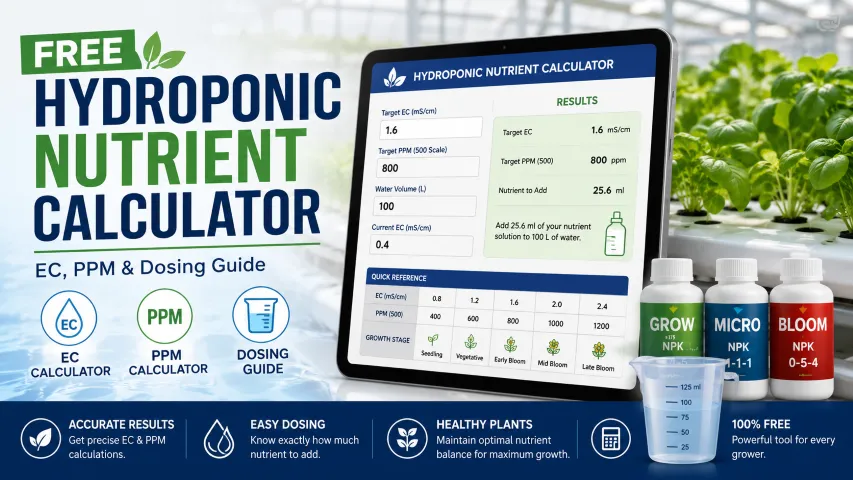
The Complete Hydroponic Nutrient Calculator Guide: EC, PPM & Feeding Formulas by Crop
If you've ever stared at a bottle of hydroponic fertilizer wondering exactly how many millilitres to add per litre, you're not alone. Getting the hydroponics nutrients formula right is the single biggest factor separating thriving hydroponic crops from stunted, yellowing ones. Too weak and plants stay pale and slow; too strong and you get tip burn, root stress, and nutrient lockout. The Hydroponic Nutrient Calculator above takes the guesswork out of it — but understanding why the numbers work the way they do will make you a far better grower.
Why You Need a Hydroponic Nutrient Calculator
In soil, nutrients are buffered — the medium holds onto minerals and releases them slowly, forgiving small mixing mistakes. In hydroponics, there is no buffer. Every nutrient your plant gets comes directly from the water you mix, which means precision matters enormously. A hydroponic fertilizer calculator removes the manual math of scaling a feeding chart to your exact reservoir size, crop, and growth stage, so you're not eyeballing doses or copying a generic chart that was written for a completely different plant.
This is also why a single feed chart printed on a nutrient bottle rarely fits every crop. Lettuce and basil are happy at a gentle strength; tomatoes and peppers need two to three times that concentration once they start fruiting. A proper hydroponic solution calculator adjusts for both the crop and its current growth stage, which a static chart simply can't do.
Understanding EC, PPM and TDS
Before using any Hydroponic Nutrient Calculator, it helps to understand the three numbers growers throw around:
- EC (Electrical Conductivity) — measured in mS/cm (millisiemens per centimetre), this is the direct, physical measurement of how much dissolved salt (nutrient) is in your water. It's the most reliable number because it doesn't depend on a conversion factor.
- PPM (Parts Per Million) — an estimate of total dissolved solids, calculated from the EC reading using a conversion factor. This is where confusion creeps in.
- TDS (Total Dissolved Solids) — essentially the same idea as PPM, often used interchangeably.
The catch is that PPM meters don't all agree, because they use different conversion factors:
- 500 scale (common in North America): PPM = EC × 500
- 640 scale (used by some Hanna and UC-standard meters): PPM = EC × 640
- 700 scale (common in Europe): PPM = EC × 700
This is exactly why the EC to PPM converter tab in the calculator above lets you switch scales — a reading of 2.0 EC is 1000 ppm on the 500 scale but 1400 ppm on the 700 scale, even though the nutrient strength is identical. If you've ever compared your meter's reading to an online ec chart for hydroponics and thought the numbers looked "off," a scale mismatch is almost always the reason. When in doubt, work in EC — it's the one number that never changes based on which meter you own.
How to Mix Hydroponic Nutrients Step by Step
- Pick your crop and growth stage in the calculator — target EC and pH shift significantly as a plant moves from seedling to full fruiting.
- Fill your reservoir with pH-adjusted water first. Never add concentrated nutrients to an empty reservoir.
- Add nutrient parts one at a time, stirring thoroughly between each — especially with two-part or three-part formulas like MasterBlend or General Hydroponics Flora Series, where concentrated parts can precipitate (form solid clumps) if mixed together undiluted.
- Measure your actual EC with a calibrated pen and compare it to the calculator's target. Adjust with small additions of nutrient or plain water until you're within range.
- Check and correct pH last, after the nutrients are fully mixed — nutrient salts themselves shift pH, so adjusting pH before adding nutrients is wasted effort.
- Re-check EC and pH daily. As plants drink water faster than they drink nutrients, EC tends to rise over time; top off with plain, pH-adjusted water between full reservoir changes.
When scaling your setup, focus on maximizing container farming energy efficiency to boost your total return on investment.
Hydroponic Nutrient Targets by Crop
Use this as a companion to the interactive chart above. Ranges represent the seedling-to-fruiting spread; use the low end for young plants and the high end once a crop is actively flowering or fruiting.
Leafy Greens (Lettuce, Spinach, Kale, Arugula, Swiss Chard)
Leafy greens are light feeders and the easiest starting point for a first-time grower. Lettuce in particular sits at the low end of the EC scale — mixing it too strong is the most common beginner mistake, and shows up as dark, curled, "burnt-tip" leaves within days.
Herbs (Basil, Mint, Cilantro, Parsley)
Herbs run a touch richer than lettuce but are still forgiving. Basil especially responds well to slightly warmer solution temperatures and rewards consistent EC over sporadic heavy feeding.
Fruiting Vegetables (Tomato, Pepper, Cucumber, Eggplant, Zucchini)
This is where the hydroponics nutrients formula changes the most dramatically across a plant's life cycle. A tomato seedling wants a gentle solution around 1.0 EC; the same plant in full fruit production can take 3.0–3.5 EC. Ramping up too fast is a common cause of blossom-end rot in tomatoes and peppers, since rapid EC swings interfere with calcium uptake even when calcium levels are technically adequate.
Fruits (Strawberry, Watermelon, Melon)
Strawberries prefer a moderate, steady EC rather than large swings between stages. Watermelon and melon are heavier feeders once vines are actively producing fruit, and both benefit from slightly warmer root-zone temperatures than leafy crops.
Other Vegetables (Broccoli, Cauliflower, Celery, Beans, Peas, Okra)
Brassicas like broccoli are surprisingly heavy feeders for a "vegetable" crop — broccoli in particular needs EC levels closer to fruiting crops than to other greens. Okra, a heat-loving crop well suited to hydroponic setups in Pakistan's warmer regions, performs best with steady moderate feeding and consistently warm solution temperatures.
Learn why Coconut Coir is a great material to use in hydroponics.
Common Nutrient Deficiency Symptoms to Watch For
Even with a correct EC reading, deficiencies can appear if pH drifts out of range and locks nutrients out of solution:
- Yellowing between leaf veins on older leaves — usually magnesium or nitrogen deficiency
- Dark, brittle, curled leaf tips — typically over-fertilization (EC too high)
- Pale, stunted new growth — often iron deficiency, common when pH climbs above 6.5
- Blossom-end rot on tomatoes/peppers — calcium uptake issue, frequently caused by inconsistent EC or overly rapid strength increases rather than an actual shortage of calcium in the mix
Frequently Asked Questions
What's a safe EC to start beginners on?
Start any crop at the low end of its range and increase gradually over 1–2 weeks. It's far easier to correct underfeeding than to recover from nutrient burn.
How often should I change my reservoir?
For fast-growing leafy greens and herbs, every 1–2 weeks. For longer-cycle fruiting crops, every 2–3 weeks once the system is stable, topping off with plain pH-adjusted water in between.
Can I use the same nutrient mix for all my plants?
Only if their target EC ranges overlap significantly — lettuce and basil can often share a reservoir, but running tomatoes and lettuce together means compromising: underfeeding the tomato or burning the lettuce.
Do I need separate calculators for General Hydroponics vs MasterBlend vs other brands?
No — the calculator above scales any formula proportionally to your target EC, so switching between a general hydroponics calculator setup and a MasterBlend-style two/three-part mix just means selecting the right preset.
Helplines & Further Support
- For crop-specific growing questions on your setup, browse our hydroponics section and vegetable farming guides (update these links to match your live site's actual category URLs).
- For general soil and fertilizer background that complements hydroponic feeding logic, see our fertilizer and soil health guide.
- For further reading on hydroponic nutrient science, see Cornell University's Controlled Environment Agriculture program and Penn State Extension's hydroponics resources, both research-backed, non-commercial sources.