Turkey Farming Calculator – Profit, Feed, FCR & Housing
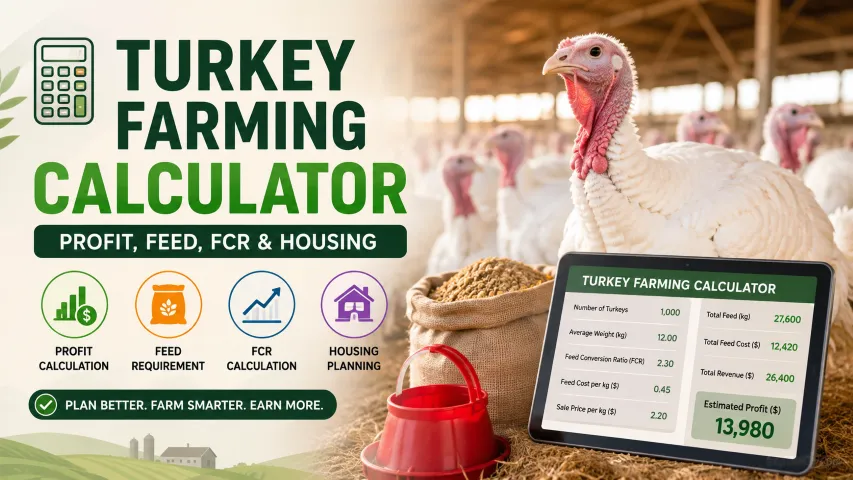
Turkey Farming Calculator
Calculate profit, feed requirements, FCR, and flock costs — USA, Brazil, Germany & more
| Cost / Revenue Item | Per Bird | Total Flock |
|---|
Calculate total feed quantities and costs for your entire turkey flock from day-old to marketing age.
| Feed Phase | Age (weeks) | Protein % | kg/bird | Total kg | Cost |
|---|
Calculate your flock’s actual FCR and compare against breed targets. FCR measures feed efficiency — lower is better.
Calculate shed dimensions, floor space requirements, feeder and drinker needs for your turkey flock.
| Requirement | Specification | Standard Reference |
|---|
Recommended protein and energy levels for turkey feed across all production stages. Adjust for breed and production system.
| Age (weeks) | Phase | Protein % | ME (kcal/kg) | Key Focus |
|---|---|---|---|---|
| 0–4 | Starter | 28% | 2,800 | High protein for rapid early growth |
| 4–8 | Grower 1 | 26% | 2,900 | Skeletal and muscle development |
| 8–12 | Grower 2 | 22% | 3,000 | Sustained growth — reduce protein gradually |
| 12–16 | Finisher 1 | 19% | 3,100 | Muscle development and fat deposition |
| 16–20 | Finisher 2 | 16% | 3,200 | Efficient weight gain — finishing phase |
| 20–24 | Heavy Tom | 14% | 3,200 | Large tom finishing — monitor FCR carefully |
| Breeder | Breeder | 14% | 2,900 | Reproductive support — add vitamins E and D3 |
Complete Guide to Turkey Farming Calculator:A Complete Guide to Planning Profit, Feed, and Flock Costs
Turkey farming looks straightforward on paper — buy poults, feed them, sell them at market weight. In practice, profitability depends on a tight interaction between feed costs, mortality rate, breed performance, housing density, and local market prices. Getting any one of these wrong can turn a promising flock into a break-even operation. That’s the gap the Turkey Farming Calculator on Fasal Bachao is built to close: a free, data-driven tool that lets farmers model their flock economics before committing money to poults, feed, and housing.
This guide walks through how each section of the calculator works, the formulas behind it, and how to use the numbers to make better farming decisions. If you’re new to turkey production itself — breed selection, brooding, disease management — our companion guide, Turkey Farming: How to Start and Manage a Profitable Turkey Farm, covers that in depth. This article focuses specifically on using the calculator to plan and evaluate your operation.
Why Use a Calculator Instead of Estimating by Hand
Turkey production numbers don’t scale in a straight line. Feed intake rises steeply between 8 and 16 weeks, mortality compounds against a shrinking flock, and feed conversion ratio (FCR) shifts by growth stage rather than staying constant across the cycle. Manually tracking this across a 5,000-bird flock, multiple breeds, and different country-specific feed prices is time-consuming and error-prone. The calculator automates these interactions across four connected modules, so a change in one input — say, mortality rate — automatically adjusts your feed cost and profit projections.
Module 1: Profit Calculator
This is usually the starting point. You enter:
- Number of birds starting the flock
- Turkey breed (7 breeds supported, including commercial varieties like White Holland and heritage breeds)
- Sex ratio (males typically reach heavier market weight than females, so ratio affects total saleable weight)
- Expected mortality rate (%)
- Production system (intensive shed-based vs. free-range/extensive)
- Country (USA, Brazil, Germany, France, UK, Canada)
The calculator applies your mortality rate to determine surviving birds at market age, multiplies by expected market weight for your chosen breed and sex ratio, and nets that against total production costs (feed, housing, poult cost) to output a profit estimate. Country selection matters here because feed prices, currency, and typical market weights vary meaningfully by region.
Practical use: Run the same flock size through two or three mortality-rate scenarios (say, 3%, 5%, and 8%) to see how sensitive your profit margin is to bird losses. This is often more useful than a single “best case” number, since mortality is the variable most farmers underestimate going in.
Module 2: Feed Calculator
Feed typically accounts for 65–70% of total production cost in turkey farming, so getting this estimate right matters more than any other input. The Feed Calculator projects total feed consumption across the production cycle based on:
- Flock size and breed
- Growth stage (starter, grower, finisher — protein and intake requirements shift at each stage)
- Expected duration to market weight
Because turkey feed requirements roughly double in absolute terms between the brooding phase and the finishing phase, a flat “average daily feed” estimate tends to undercount total feed needed. The calculator accounts for this stage-by-stage curve, giving you a more accurate total feed budget for ordering and cash-flow planning.
Module 3: FCR Calculator (Feed Conversion Ratio)
FCR measures how efficiently your flock converts feed into body weight — calculated as total feed consumed divided by total liveweight gain. A typical commercial turkey FCR falls between 2.7 and 2.8, meaning roughly 2.7–2.8 kg of feed produces 1 kg of liveweight.
Enter your actual feed consumption and resulting bird weight, and the calculator returns your real FCR — which you can then compare against breed benchmarks. A higher-than-expected FCR usually points to one of a few causes: feed wastage, disease stress, poor water access, or overcrowding limiting normal feeding behavior. Tracking FCR across multiple flocks over time is one of the most reliable ways to catch management problems early, before they show up as a bigger loss on the balance sheet.
Module 4: Housing Calculator
Stocking density directly affects growth rate, mortality, and disease pressure — overcrowded birds convert feed less efficiently and are more prone to respiratory disease and pecking injuries. This module calculates required shed floor space based on your flock size and target age bracket, using standard space allowances that increase as birds mature (young poults need roughly 1 sq ft/bird, while birds nearing market weight need 3.5+ sq ft/bird, with breeders requiring even more).
Running your flock size through this module before construction — rather than after — avoids the common mistake of building housing sized for day-old poults and then facing overcrowding by week 12.
How the Four Modules Work Together
The real value of the calculator is that these aren’t isolated numbers. A lower mortality rate increases surviving bird count, which increases total feed required (Module 2), which affects your FCR interpretation (Module 3) and your housing space needs (Module 4), which together determine your final profit (Module 1). Running your flock plan through all four modules — in that order — gives a realistic, connected picture rather than four disconnected estimates.
A Worked Example
Suppose you’re planning a 5,000-bird White Holland flock in the USA, 50/50 sex ratio, 5% expected mortality, intensive housing:
- Profit module estimates surviving birds (~4,750) and projects total revenue against feed, poult, and housing costs
- Feed module breaks down total feed tonnage needed across starter, grower, and finisher phases
- FCR module lets you benchmark your actual conversion once feeding begins, flagging early if you’re trending above the 2.7–2.8 breed standard
- Housing module confirms your shed can support 4,750 birds at each growth stage without exceeding recommended density
This sequence turns a single “how many birds should I raise” question into a full operational and financial plan.
Frequently Asked Questions
What is a good FCR for turkey farming?
Commercial turkey flocks typically achieve an FCR between 2.7 and 2.8 across the full production cycle. Lower is better — it means less feed is needed per kilogram of bird weight gained.
How accurate is the profit calculator?
It’s a planning and estimation tool based on standard breed performance data and the inputs you provide. Actual results depend on local feed prices, disease pressure, and management quality, so treat it as a planning baseline rather than a guaranteed outcome.
Does mortality rate significantly affect profit?
Yes — mortality compounds against your total saleable weight at market age. A jump from 3% to 8% mortality on a 5,000-bird flock removes 250 additional birds from your revenue base while your fixed costs (housing, some feed already consumed) stay largely the same.
Can I use this calculator for free-range turkey production?
Yes, the Production System field lets you select free-range/extensive systems, which typically show lower feed costs (due to foraging) but should be modeled with higher mortality assumptions to reflect predator and environmental risk.
Is the calculator free to use?
Yes, all four modules are free with no signup required.