Farm Battery Storage System Cost – Complete Guide for Modern Agricultural Operations 2026
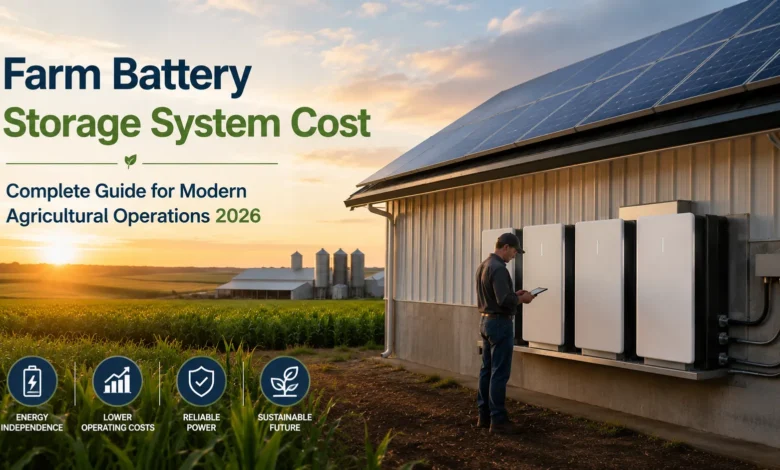
Introduction: Why Farm Energy Storage is Now an Agricultural Priority
Modern farming runs on electricity. Irrigation pumps, grain dryers, cold storage facilities, greenhouse climate systems, livestock ventilation, precision agriculture sensors, electric tractors, and farm office technology all depend on a reliable, affordable, and uninterrupted power supply.
For decades, most farms simply connected to the utility grid and accepted whatever power quality, reliability, and pricing that connection delivered. That approach worked reasonably well when electricity was cheap, grid outages were rare, and farm energy demands were modest.
That reality has changed dramatically. Energy prices have risen sharply across agricultural regions worldwide. Grid outages — increasingly driven by extreme weather events linked to climate change — threaten cold storage contents, livestock welfare, and irrigation schedules at exactly the moments when farm operations are most vulnerable. Meanwhile, the rapid expansion of on-farm solar generation has created both an opportunity and a challenge — how to capture and use solar energy most effectively throughout the day and night.
Farm battery storage systems are the answer that a growing number of agricultural operations are adopting. But understanding what these systems actually cost — and what drives those costs — is essential before making one of the most significant infrastructure investments your farm can make.
This complete guide breaks down every factor that determines farm battery storage system cost, helping farm owners make informed, well-planned decisions that deliver long-term value for their agricultural operations.
Modern farm decision-making combines energy planning with financial modeling. The Agriculture Income Calculator at fasalbachao.com helps farm managers calculate production costs and projected income — providing the financial framework within which energy investment decisions make most sense.
The Real Components of Farm Battery Storage System Cost
Why Two Farms Get Very Different Quotes
Two farms can purchase the same battery storage unit and receive dramatically different installation quotes. This is not always a pricing inconsistency or a markup mystery. Farm battery storage system cost depends on a combination of factors that vary significantly between agricultural properties.
A complete farm battery storage installation typically includes:
| Component | What It Covers |
|---|---|
| Battery modules | The core energy storage cells and housing |
| Inverter system | Converts DC battery power to AC farm power |
| Backup gateway or switchgear | Isolates farm from grid during outages |
| Wiring and conduit | Electrical connections throughout the installation |
| Mounting and housing | Physical installation — indoor barn or outdoor weatherproof |
| Permits and utility paperwork | Local agricultural electrical compliance |
| Installation labor | Certified electrical and battery installation work |
| Panel or service upgrades | Where existing farm electrical systems need updating |
| Monitoring and control systems | Smart energy management software and hardware |
The battery price is only one component of this complete picture. A quote that excludes backup hardware, permits, or electrical corrections may appear attractive initially — until the missing work appears later as unexpected additional costs.
This is particularly important for farm operations where electrical infrastructure may be older, spread across multiple buildings, or subject to specific agricultural code requirements that differ from residential installations.
Capacity — The Primary Cost Driver for Farm Battery Systems
Understanding Kilowatt-Hours in an Agricultural Context
More storage capacity means more energy available — but it also means more equipment, more installation complexity, and higher upfront investment. For farm operations, understanding exactly what capacity you need requires mapping your specific agricultural energy demands rather than selecting a number based on general guidelines.
Different farm operations have dramatically different energy storage requirements:
| Farm Operation Type | Typical Priority Loads | Recommended Storage Approach |
|---|---|---|
| Small mixed farm | Irrigation pump, lighting, basic cold storage | Entry-level system — essential loads only |
| Commercial vegetable farm | Refrigeration, pack shed equipment, irrigation | Mid-range system — critical operations |
| Dairy or livestock farm | Ventilation, milking equipment, water heating | High capacity — welfare-critical loads |
| Grain storage operation | Dryers, conveyors, aeration fans | High capacity — seasonal peak demand |
| Greenhouse horticulture | Climate control, lighting, CO2 systems | Very high capacity — continuous operation |
| Solar-integrated farm | Solar self-consumption optimization | Sized to solar generation output |
According to research from the National Renewable Energy Laboratory (NREL), installed storage costs for agricultural and commercial operations include both hardware costs and soft costs — permitting, labor, engineering, sales, and project overhead. The battery cells themselves represent only a portion of the total investment.
Usable Capacity vs Rated Capacity — What Farm Buyers Must Understand
Farm owners comparing battery storage quotes must ask a critical question that is often overlooked: is the quoted capacity the rated capacity or the usable capacity?
Most battery storage systems reserve a portion of their total capacity to protect battery chemistry and maintain long-term performance. A battery with a rated capacity of 20 kWh may deliver only 16 to 18 kWh of usable energy under normal operating conditions.
For farm planning purposes:
- Usable capacity determines how long your priority farm loads can run during a grid outage or overnight solar gap
- Continuous power output determines how many farm loads can operate simultaneously
- A battery with generous energy capacity may still be limited in how many pieces of farm equipment it can power at once
Capacity affects duration. Output affects operational coverage. Both matter for agricultural applications — and both should appear clearly in any farm battery storage quote.
Backup Design — The Factor That Changes Everything
Essential Farm Load Backup vs Whole-Farm Backup
The single biggest cost variable in farm battery storage system design is the scope of backup coverage. A battery system designed purely for solar self-consumption — storing daytime solar generation for evening farm use — is fundamentally different from a system designed to maintain farm operations through extended grid outages.
A residential battery storage system approach applied to agricultural properties typically falls into two distinct design philosophies:
Essential Load Backup
Focuses backup power on the farm loads that are most critical — refrigeration for perishable crops, livestock ventilation, irrigation pump control systems, security and lighting, and farm office communications. This approach uses lower power output requirements, simpler electrical switchgear, and typically lower total system cost.
Whole-Farm Backup
Maintains full farm operational capacity during grid outages — including grain dryers, pack shed equipment, milking systems, climate control, and all agricultural processing loads. This approach requires significantly higher power output ratings, more sophisticated load management, and more complex electrical installation work.
The cost difference between these two approaches on a commercial farm can be very substantial:
| Backup Approach | Typical Coverage | Relative Cost | Best For |
|---|---|---|---|
| Essential loads only | Refrigeration, irrigation, lighting, livestock basics | Lower | Small to medium farms, budget-conscious operations |
| Critical operations | Processing, pack shed, milking, climate control | Medium | Commercial farms with specific high-value processes |
| Whole-farm backup | All farm loads maintained during outages | Higher | Large commercial operations, farms with perishable high-value crops |
Farm managers should request two separate quotes from any battery storage supplier — one for essential backup and one for expanded whole-farm coverage. Seeing the cost difference side by side makes the backup scope decision significantly clearer than debating abstract specifications.
Installation Factors That Affect Farm Battery Storage Cost
Site-Specific Variables on Agricultural Properties
Farm battery storage installations are rarely straightforward. Agricultural properties present a unique combination of site-specific variables that directly affect installation cost — and that differ significantly from residential or commercial building installations.
Electrical Infrastructure Age and Condition
Many working farms operate with electrical infrastructure installed decades ago — single-phase supply, undersized distribution boards, aged wiring, and limited earthing systems. Integrating modern battery storage into older farm electrical infrastructure may require service upgrades, new distribution panels, or rewiring that adds significantly to total project cost.
Multiple Building Complexity
Unlike a residential installation where battery storage typically serves a single dwelling, farm battery systems often need to serve multiple buildings — barns, pack sheds, grain stores, processing facilities, and farm offices spread across a large property. Longer cable runs, multiple distribution points, and inter-building wiring add both material and labor costs.
Outdoor Placement Requirements
Farm buildings may not provide suitable indoor installation space for battery systems. Outdoor installation requires weatherproof enclosures, protection from agricultural dust and chemical exposure, flood risk assessment, temperature management, and physical security. These requirements add cost but are often unavoidable on working farm properties.
Permitting and Agricultural Electrical Compliance
Permitting timelines and documentation requirements vary significantly between jurisdictions. Some agricultural regions process farm electrical permits quickly. Others require detailed engineering documentation, agricultural inspector sign-offs, and utility interconnection agreements that extend project timelines and add to soft costs. These are not glamorous project elements, but they are real budget factors that should appear in any honest farm battery storage quote.
Grid Connection Point Distance
The distance between your farm’s primary grid connection point and the planned battery installation location directly affects wiring costs. Long cable runs on large agricultural properties can add meaningful amounts to total installation cost.
Smart Controls — The Feature Farm Owners Underestimate
Why Farm Energy Intelligence Matters More Than Raw Capacity
It is tempting to compare farm battery storage systems purely on kilowatt-hours per unit of cost. That comparison misses the most practically valuable layer of modern battery storage — the control and energy management system that determines how intelligently the stored energy is used across your agricultural operation.
A farm battery system with sophisticated energy management can:
- Automatically shift charging to periods of lowest electricity tariff rates — reducing farm energy costs even when the grid is operating normally
- Optimize solar generation capture — prioritizing battery charging from on-farm solar panels before drawing grid power
- Manage irrigation pump start sequences to avoid demand charge spikes that significantly inflate farm electricity bills
- Maintain pre-set backup reserves for weather events — automatically preparing the system before forecast storms
- Coordinate electric farm tractor charging with solar generation peaks and battery state of charge
- Provide real-time farm energy monitoring — giving farm managers visibility into exactly where energy is being used and what it costs
The U.S. Department of Energy has noted that energy storage can support both resilience and energy cost shifting, but local conditions and system configuration fundamentally shape the value delivered. In practical agricultural terms — the same battery capacity can generate dramatically different financial returns depending on the quality of its control system and how well it is configured for specific farm energy patterns.
For farms already using precision agriculture approaches — GPS field management, variable rate application, yield mapping, and soil monitoring — smart energy management represents a natural extension of the data-driven farming philosophy. Explore free Precision Agriculture Tools at fasalbachao.com to see how technology-driven approaches are transforming farm productivity across every operational dimension.
Incentives and Financial Support for Farm Battery Storage
Agricultural Energy Incentives — What to Verify Before Planning Your Budget
Financial incentives can meaningfully reduce the net cost of farm battery storage investment, but eligibility conditions are specific and programs change. Farm owners should treat incentives as potential savings to be confirmed — not as guaranteed reductions to be assumed in initial budget planning.
Common incentive types available for agricultural battery storage in various regions include:
| Incentive Type | Typical Conditions | Agricultural Relevance |
|---|---|---|
| Federal investment tax credits | System installation date, pairing with solar, capacity minimums | High — most farm solar-plus-storage systems qualify |
| State agricultural energy programs | Farm size, location, energy use profile | Variable by state and region |
| Utility demand response programs | Grid service participation, smart meter requirements | Growing opportunity for large farm loads |
| Rural energy grants and loans | Farm business status, rural location, project size | Specifically designed for agricultural operations |
| Carbon and sustainability programs | Emissions reduction documentation, certification | Increasing relevance for sustainability-focused farms |
When requesting quotes from battery storage suppliers, ask them to provide three separate cost figures:
- Gross system cost — total installation cost before any incentives
- Incentive assumptions — specific programs assumed and their eligibility conditions
- Net cost — the realistic expected cost after confirmed applicable incentives
This structure makes honest comparison between different supplier quotes significantly easier — and prevents budget surprises when assumed incentives turn out to have conditions the project does not meet.
Farm Battery Storage Financing — Separating Equipment and Finance Decisions
Many battery storage suppliers offer financing options alongside equipment quotes. Farm owners should evaluate these carefully and separately from the equipment decision itself.
A low monthly payment can obscure a high total repayment cost, substantial dealer finance fees, or a repayment period that extends well beyond the most financially productive years of the battery system’s life. For farm business financial planning purposes:
- Compare total repayment cost against upfront purchase cost
- Consider whether farm loan facilities offer more favorable terms than supplier financing
- Evaluate the tax treatment of capital purchase versus financed equipment in your agricultural tax position
- Assess cash flow impact across seasonal farm income patterns — battery storage financing should align with farm revenue cycles
The equipment decision and the financing decision deserve completely separate attention. Choosing the right battery system and choosing the right way to pay for it are two distinct farm business decisions.
Planning for Farm Energy Future Growth
Expandability — Why It Matters for Growing Agricultural Operations
Farm energy demands rarely stay static. Farms that install battery storage today are often the same farms that will add solar capacity, electric farm tractors, heat pump grain drying, precision irrigation expansion, or additional processing facilities in the coming years.
A battery storage system that cannot be expanded cost-effectively — or that requires complete replacement to accommodate growth — can make the cheapest upfront option the most expensive long-term choice.
When evaluating farm battery storage options, ask specific questions about expandability:
- Can additional battery modules be added to the existing system without replacing the inverter or control hardware?
- Does the control system support integration with additional solar panels, EV charging for electric farm tractors, or new farm loads?
- Is the communication architecture compatible with future precision agriculture and farm energy management platforms?
- What is the realistic upgrade pathway if farm energy demands grow significantly over the next five to ten years?
For agricultural operations considering integrated energy management platforms, the SigenStor integrated battery storage system represents one example of a platform approach that combines battery modules, power conversion, energy management software, and expansion capability within a single cohesive design — potentially relevant for farm operations planning for long-term energy infrastructure growth.
Practical Farm Battery Storage Comparison Guide
What a Good Farm Battery Storage Quote Should Include
The best farm battery storage quotes explain clearly what the system will do across three critical operational scenarios:
On a Normal Farm Day
How does the system optimize solar generation, manage peak demand charges, reduce energy costs, and monitor farm energy use? What does a typical 24-hour energy management cycle look like for your specific farm operation?
During Peak Agricultural Demand Periods
How does the system handle planting and harvest season energy demand peaks? What happens when irrigation, grain drying, refrigeration, and processing loads all operate simultaneously? Does the system manage load priorities automatically?
During a Grid Outage
Which farm loads continue operating immediately and automatically? How long can critical loads run on stored energy? What is the reconnection process when grid power is restored? How does the system protect sensitive farm equipment during transition?
Farm Battery Storage Decision Checklist
Use this practical checklist when evaluating farm battery storage proposals:
| Decision Factor | Questions to Ask Your Supplier |
|---|---|
| Capacity | What is the usable capacity? What is continuous power output? |
| Backup scope | Which farm loads are covered? Can scope be expanded later? |
| Installation complexity | What electrical upgrades are included? What is excluded? |
| Permits and compliance | Are permits included? Who handles utility paperwork? |
| Incentives | Which incentives are assumed? What are the eligibility conditions? |
| Controls and monitoring | What smart management features are included? Is there a monitoring app? |
| Expandability | Can modules be added? Is the inverter scalable? |
| Warranty | What is covered? What is the degradation guarantee? |
| Service and support | Who services the system? What are response time commitments? |
| References | Are there comparable farm installations you can speak with? |
Frequently Asked Questions — Farm Battery Storage Systems
How much does a farm battery storage system cost?
Farm battery storage system costs vary enormously based on capacity, backup scope, installation complexity, and site-specific factors. Small essential-load systems for modest farm operations start at lower price points, while large whole-farm backup systems for commercial agricultural operations represent substantially larger investments. Always request detailed itemized quotes covering all components — not just battery hardware.
Is farm battery storage worth the investment?
For farms with on-farm solar generation, high electricity tariffs, frequent grid outages, or perishable crop and livestock welfare requirements — farm battery storage typically delivers strong financial and operational returns. The value calculation depends on your specific energy costs, outage frequency, solar generation, and the financial impact of power interruptions on your particular agricultural operation.
Can farm battery storage integrate with existing solar panels?
Yes — most modern farm battery storage systems are designed to integrate with existing solar installations, either at the time of battery installation or as a retrofit addition. Compatibility depends on your existing solar inverter type and the battery system selected — your installer should confirm compatibility before purchase.
How long do farm battery storage systems last?
Most quality farm battery storage systems carry performance warranties of 10 years, with expected functional lifespans of 15 to 20 years depending on usage patterns, cycling frequency, and operating temperature management. Agricultural environments — with dust, temperature variation, and vibration — make installation quality and enclosure protection important longevity factors.
What farm loads should be prioritized for backup?
Priority farm backup loads typically include: livestock ventilation and water systems (animal welfare critical), cold storage and refrigeration (perishable crop protection), irrigation pump control systems (crop survival), farm security systems, and essential farm office communications. High-draw processing loads like grain dryers are typically included only in whole-farm backup designs.
Conclusion: Farm Battery Storage Investment — Planning for Long-Term Agricultural Value
Farm battery storage systems represent a significant infrastructure investment — but for the right agricultural operation, the combination of energy cost reduction, grid outage resilience, solar optimization, and operational independence delivers compelling long-term value.
Understanding what drives farm battery storage system cost — from capacity and backup scope to installation complexity, site-specific electrical requirements, smart controls, and incentive eligibility — is the foundation of making a well-informed investment decision that genuinely serves your farm’s operational and financial needs.
The cheapest headline number is rarely the most valuable proposition. The best farm battery storage investment is the one that keeps your agricultural operation running productively and cost-effectively across every day of its working life — through normal operations, peak seasonal demand, and unexpected grid outages alike.
For farms committed to building data-driven, technology-integrated agricultural operations — energy storage is a natural complement to the precision farming tools, equipment management systems, and crop optimization approaches that define modern sustainable agriculture. Explore the complete range of Free Farm Management Tools at fasalbachao.com to support smarter decision-making across every dimension of your farm operation.