Integrated Pest Management (IPM): The Best Methods for Contemporary Farms in Pakistan
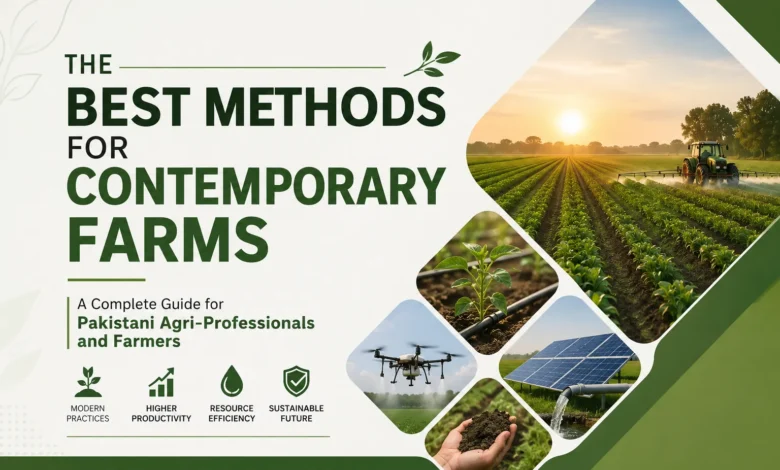
Integrated pest management (IPM) is the system the FAO describes as the careful consideration of all available pest control techniques, integrated into measures that discourage pest populations from developing in the first place. Instead of spraying by the calendar, an IPM farmer prevents what can be prevented, watches the crop, protects the insects that eat pests, and uses chemicals only when a measured pest level justifies them. The stakes in Pakistan are high: agriculture contributes roughly a fifth of national GDP, yet insects, diseases and weeds together take an estimated 15–25% of potential crop output every season — much of it from fields already locked into a cycle of resistance, resurgence and rising spray costs. IPM is how that cycle is broken.
European plant-protection policy sets the same approach out as eight principles (Barzman et al. 2015, Agronomy for Sustainable Development), and they work as a checklist for any farm:
- Prevention and suppression
- Monitoring
- Threshold-based decisions
- Non-chemical methods preferred
- Target-specific pesticide selection with the least side effects
- Reduced doses, frequency and partial-area application
- Anti-resistance strategies
- Evaluation
The five steps every IPM programme follows
Whatever the crop, an IPM programme runs the same repeating loop. It begins with monitoring, because no sound decision can be made about a pest nobody has counted, and it ends with evaluation, because a treatment whose result is never checked teaches the farm nothing. The goal throughout is management, not eradication: wiping out a pest population entirely is usually impossible, and the attempt is expensive, unsafe and self-defeating, since the few survivors are the ones that breed the next, harder-to-kill generation.
| Step | What happens | Why it matters |
|---|---|---|
| 1. Monitor | Scout fields and record pest types, numbers and damage | Decisions rest on field evidence, not on a spray calendar |
| 2. Identify | Name the pest and the host accurately; learn the pest’s life cycle | A wrong identification wastes money on the wrong response |
| 3. Assess | Compare counts with the economic threshold for that pest and crop | Sub-threshold pests are tolerated; natural enemies keep working for free |
| 4. Implement | Apply cultural, mechanical, biological or — last — chemical controls, alone or combined | Using several methods together makes control durable |
| 5. Evaluate | Check the result and record what worked | Records turn one season’s lesson into next season’s plan |
Pillar one: prevention and cultural control
Prevention is the first and cheapest layer of IPM, because a pest problem that never starts needs no cure. Cultural control means running the farm so the crop is a poor place for pests to live: healthy, unstressed plants withstand and outgrow damage better, and many pests can be starved of their host or their hiding places by simple changes in routine. The core practices are:
- Crop rotation — many pests overwinter in the soil or in crop litter, so planting the same crop family in the same field year after year feeds them. In Punjab, rotating cotton with wheat breaks the cycle of the bollworm Helicoverpa armigera; as a rule, a crop family should return to the same site only once every three to four years.
- Resistant varieties and clean seed — choose cultivars bred to tolerate local pests and diseases, and certified, disease-free seed, so problems such as seed-borne diseases are not planted along with the crop.
- Sanitation — remove or bury infested residues, quarantine or destroy diseased plants, and clean tools and machinery so infections are not carried field to field.
- Timing and spacing — adjust sowing dates so the crop misses a pest’s peak, and space plants for airflow that discourages fungal disease.
- Soil care — test the soil, feed the crop rather than over-fertilising it (soft, overfed growth attracts sap-sucking pests), and manage weeds that shelter pests.
Pillar two: monitoring, identification and thresholds
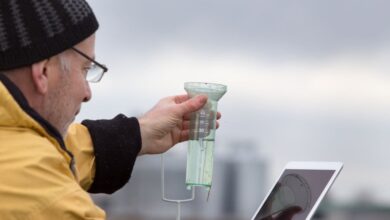
IPM is an information system before it is a spray system. Fields should be scouted at least twice a week at critical growth stages, recording which pests are present, in what numbers, and what damage is appearing. Pheromone traps and sticky cards give early warning of pests such as fruit flies, pink bollworm and fall armyworm before their larvae are entrenched. Accurate identification is what separates IPM from guesswork: damage from over-watering, for instance, is easily mistaken for fungal infection, and virus problems such as the potato virus diseases cannot be cured with a fungicide spray at all. Provincial departments in Pakistan are backing scouting up with satellite crop monitoring and mobile pest reporting, but the trained eye in the field remains the foundation.
Counts only become decisions when they are compared with a threshold:
| Term | Meaning | Example |
|---|---|---|
| Economic injury level (EIL) | The pest density at which the damage the pest will cause costs more than the treatment itself | Set by research for each pest–crop pair |
| Economic threshold (ET / ETL) | The lower density at which action must start so the population never reaches the EIL | Wheat aphid: intervention is generally considered only above roughly 20–25 aphids per tiller |
Thresholds are specific to the pest, the crop and even the site, and local advisories update them — but the principle never changes: below the threshold, the correct treatment is no treatment. Leaving a small pest population alive also protects the farm’s future, because those susceptible survivors dilute any resistance genes in the pest population and slow the day the chemistry stops working.
Pillar three: biological control — recruiting natural enemies
Every field already contains a free pest-control workforce: ladybirds, lacewings, spiders, parasitic wasps and insect-killing microbes. Biological control works with them in three ways. Conservation comes first — avoiding broad-spectrum sprays, keeping flowering field edges and not spraying while parasitoids are active preserves the enemies already present. Augmentation adds more: in Pakistan, the Pakistan Agricultural Research Council and provincial departments mass-rear Trichogramma wasps for release against the egg masses of lepidopteran pests in cotton and sugarcane. Microbial products form the third arm: Bacillus thuringiensis (Bt) preparations are registered in Pakistan for caterpillar pests, and Beauveria bassiana fungal formulations for whitefly. Because these agents target specific pests, they suppress the outbreak while leaving the wider web of beneficial insects intact to handle the next one.
Pillar four: chemical control, strictly as the last resort
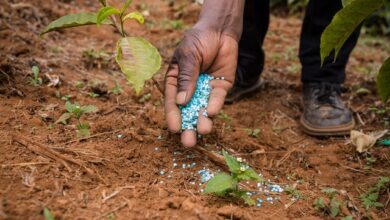
Chemicals remain part of IPM — but they are the last tool reached for, used only when monitoring shows a threshold has been crossed and gentler methods cannot hold the line. Used this way, a spray is a precision instrument rather than a routine:
- Choose selective products that hit the target pest and spare beneficial insects, and time them against the pest’s most vulnerable stage — usually young larvae or nymphs.
- Protect pollinators — never spray a crop in bloom; the bees in crop pollination are worth more than a mistimed application saves.
- Calibrate the application — correct pressure, nozzle choice and forward speed put the dose on the target and cut drift onto neighbouring crops, water and field margins; see our guide to spray techniques and machinery calibration.
- Rotate modes of action — alternate products from different IRAC groups so the same chemistry is never selected against twice in a row.
- Observe the pre-harvest interval (PHI) printed on the label, and follow the safety measures for chemical spraying — protective equipment, safe mixing and safe disposal — every time.
Land preparation and equipment: the IPM toolbox
IPM starts before the seed is sown. Thorough land preparation disrupts the soil-dwelling stages of pests — pupae, eggs and overwintering adults — exposing them to sun, drying winds and predators, and good drainage removes the wet conditions fungal pathogens favour. Deep ploughing to 20–25 cm before the kharif season buries cotton bollworm pupae; laser levelling eliminates the low patches where standing water rots roots; green manuring with Sesbania or sunhemp suppresses soil-borne pathogens, and well-rotted farmyard manure builds the soil microbe communities that compete with them. With average Pakistani farms of roughly 2.6–5 acres, compact mechanisation fits this work well: a Power Tiller gives timely, thorough seedbed preparation and incorporates the crop residues that carry pest inoculum into the soil. When a threshold-based spray is justified, the same logic applies to application: a calibrated Power Sprayer delivers even droplet size and adjustable pressure, reaching tall crops such as sugarcane, maize and orchard trees inside the short window in which a threshold-timed intervention works.
IPM calendars for Pakistan’s main crops
The pillars become practical when they are laid over a crop’s season. The calendars below condense the standard programme for Pakistan’s four big cases. Product names and field rates change as registrations and advisories are updated, so treat every specific below as a starting point and verify it against the current product label and your provincial agriculture department’s latest advisory before acting.
Cotton in Punjab and Sindh
The cotton season opens with prevention: deep ploughing, certified Bt seed and treated seed against early sucking pests. Through the vegetative stage, scout twice a week for whitefly, thrips and jassid, and conserve the lacewings and parasitoids that work the crop. From flowering into boll formation, hang pink bollworm pheromone traps at about one per hectare and spray only when a threshold is crossed. At the end of the season, remove stalks promptly and plough deep to kill the bollworm pupae that would otherwise overwinter into the next crop.
Wheat in Punjab and Khyber Pakhtunkhwa
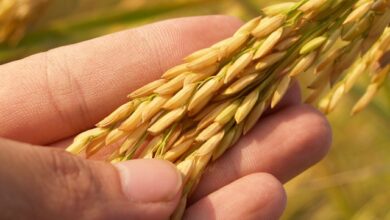
Wheat IPM begins in the seed bag: a fungicidal seed treatment such as carboxin + thiram, or tebuconazole, guards against Karnal bunt and loose smut. At tillering, the watch is for aphids, judged against the threshold of roughly 20–25 aphids per tiller given above — below it, ladybirds and parasitoid wasps usually finish the job unaided. At heading, inspect flag leaves for yellow rust (Puccinia striiformis); treatment is warranted when about 5% of the flag-leaf area is affected, because the flag leaf fills the grain.
Rice in Sindh and Punjab
For rice, the programme starts with a clean, blast-managed nursery and healthy seedlings. After transplanting, stem borers are the central threat: pheromone traps track yellow stem borer flights, Trichogramma releases at egg-laying peaks (commonly around 1.5 lakh parasitoids per hectare) attack the eggs before they hatch, and napier grass borders can be used as a push-pull element drawing borers away from the paddy. Balanced nitrogen matters here too, since lush, overfed rice is the most borer- and planthopper-prone.
Orchards and vegetables
Perennial and high-value crops lean on physical and biological tools: sticky traps and bait stations for fruit fly, canopy pruning for light and airflow, neem-based botanical formulations, and kaolin clay particle films that make fruit and foliage unrecognisable to pests. For a deeper treatment of perennial plantings, see our guide to pest and disease control methods in plantations.
| Crop | Watch for | Core IPM actions |
|---|---|---|
| Cotton | Whitefly, thrips, jassid, pink bollworm | Bt seed, twice-weekly scouting, pheromone traps, threshold-only sprays, stalk destruction |
| Wheat | Aphids, yellow rust, Karnal bunt, loose smut | Fungicidal seed treatment, aphid threshold checks, flag-leaf rust inspection at heading |
| Rice | Stem borers, blast, planthoppers | Clean nursery, pheromone trapping, Trichogramma releases, balanced nitrogen |
| Orchards & vegetables | Fruit fly, borers, fungal rots | Sticky traps, canopy management, neem formulations, kaolin particle films |
Frequently asked questions
Does IPM mean never using pesticides?
No. IPM keeps pesticides available but moves them to the end of the queue: they are used only when scouting shows a pest has crossed its economic threshold and cultural, mechanical and biological methods cannot hold it. The result is fewer, better-timed applications rather than none.
How often should a field be scouted?
At least twice a week during critical growth stages — emergence, flowering and grain or boll filling — and after any weather that favours pests. Each visit should record pest numbers and damage, because thresholds can only be applied to counted pests.
What is the difference between the economic injury level and the economic threshold?
The economic injury level is the pest density at which damage costs more than control. The economic threshold is the lower density at which you act, timed so the population is stopped before it climbs to the injury level. Acting at the threshold, not at first sight of a pest, is the core IPM habit.
Is IPM practical on a small farm of a few acres?
Yes — IPM was built for exactly that scale. Its main inputs are knowledge and labour: rotation, sanitation, scouting and conserving natural enemies cost little, and compact equipment such as a power tiller handles the land-preparation work. The money saved on unnecessary sprays is the first return.
Where can Pakistani farmers get official IPM advice?
Start with the federal and provincial bodies listed in the references below — the Ministry of National Food Security & Research, PARC and the Punjab and Sindh agriculture departments publish pest warnings, thresholds and seasonal advisories for the major crops.
Conclusion
IPM replaces the spray calendar with a decision system: prevent first, monitor always, let natural enemies work, and spend on chemicals only when a counted threshold says the crop will lose more than the treatment costs. For Pakistani farms facing resistant pests and rising input prices, that shift lowers costs, protects pollinators and beneficial insects, keeps produce within food-safety limits, and keeps the chemistry working for the seasons when it is genuinely needed. The measured evidence supports the shift: a meta-analysis by Sekabira et al. (2022, Agriculture) found that IPM adoption improves crop yields by about 41% and reduces pesticide use by about 31%.
Key references and official resources
Government of Pakistan and research organisations:
- Ministry of National Food Security & Research (MNFSR)
- Pakistan Agricultural Research Council (PARC)
- Department of Agriculture, Government of Punjab
- Agriculture Department, Government of Sindh
- National Locust Control Centre, Pakistan
Agricultural equipment:
Disclaimer: Pesticide products and their registered uses differ by crop, pest and region. Always follow the product label and local regulations, use the recommended protective equipment, and take product choices from your local extension service or agriculture department.