Wheat, Corn and Feed Barley Imports: A Buyer’s Guide on Grain Imports
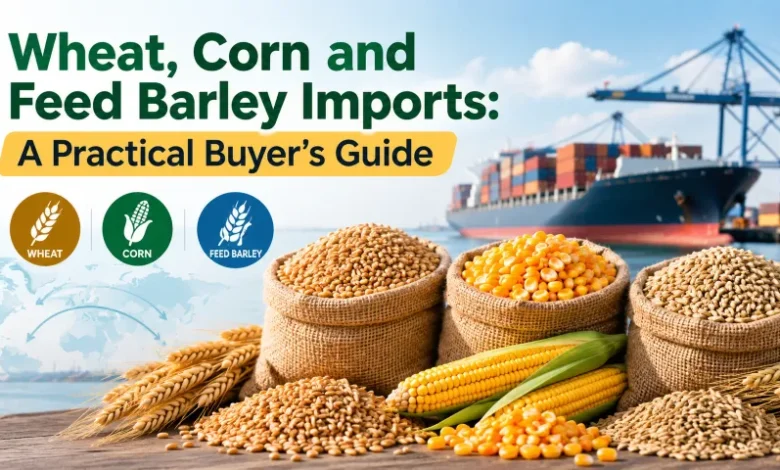
International grain imports, wheat, corn and feed barley alike, involves much more than comparing a price per metric ton. For importers, feed manufacturers, flour mills and agricultural distributors, the final commercial result depends on a combination of product specification, shipment size, freight, delivery terms, inspection procedures and documentation.
Wheat, corn and feed barley are among the most widely traded agricultural commodities. However, each product has its own technical and commercial characteristics. A clear request for quotation allows suppliers to prepare a more accurate offer and helps buyers compare proposals on a like-for-like basis.
Wheat: Define the Grade Before Requesting a Price
Not all wheat is commercially interchangeable. Milling wheat may be supplied in different protein ranges, while feed wheat is evaluated according to a different set of requirements.
Important parameters commonly reviewed in wheat contracts include:
- protein content;
- moisture;
- test weight;
- gluten characteristics;
- falling number, where applicable;
- foreign matter;
- damaged kernels;
- sanitary and phytosanitary condition.
A request stating only “wheat required” is normally insufficient for a reliable commercial quotation. The buyer should specify the required grade, quantity, destination and shipment period from the beginning.
Corn: Moisture and Mycotoxin Requirements Matter
Feed corn is a major raw material for poultry, dairy and livestock production. Commercial buyers normally evaluate several quality parameters before confirming a purchase.
- moisture content;
- broken kernels;
- damaged kernels;
- foreign matter;
- test weight;
- protein content where required;
- mycotoxin limits;
- absence of prohibited contaminants.
Moisture is particularly important for storage and transportation. Excessive moisture can reduce storage stability and increase the risk of quality deterioration during long-distance shipment.
Mycotoxin requirements should also be clearly defined because regulatory limits may differ between destination markets.
Feed Barley: Quality Consistency Is Important
Feed barley is widely used as an energy source in livestock feed formulations. Its commercial value depends not only on price but also on the consistency of the delivered specification.
Typical parameters may include moisture, test weight, purity, foreign matter, damaged grains, protein content and pest condition.
Feed manufacturers may evaluate barley differently depending on the type of livestock, formulation strategy and availability of alternative feed ingredients. Buyers should therefore define the required specification before requesting a firm price.
Why This Matters for Farmers and Local Grain Traders
For readers on the supply side — farmers, aggregators, and regional grain traders — understanding how international grain imports are evaluated is just as useful as it is for overseas buyers. When wheat, corn, or barley is grown with eventual export in mind, meeting the moisture, protein, and foreign-matter thresholds described above from the start reduces rejection risk at the port and improves the price a shipment can command. Growers who track these parameters at harvest, rather than discovering them only after a buyer’s inspection, are in a far stronger negotiating position.
Feed barley imports deserve particular attention from smaller producers, since barley feeds into livestock markets that prize consistency over volume. A feed mill importing barley is usually less concerned with one excellent harvest than with a supplier who can deliver the same test weight and moisture range shipment after shipment. Local growers and cooperatives who standardize their post-harvest handling — drying, cleaning, and storage — are better positioned to enter feed barley imports supply chains, even well below the 25,000–50,000 MT cargoes described in a typical RFQ.
Comparison Table: Wheat vs. Corn vs. Feed Barley
| Parameter | Wheat | Corn | Feed Barley |
|---|---|---|---|
| Primary Use | Milling (flour) or feed | Livestock feed, industrial use | Livestock feed (energy source) |
| Typical Moisture Limit | ~12–14% | ~14–15% | ~12–13% |
| Typical Test Weight | ~76–78 kg/hl | ~72 kg/hl | ~60–65 kg/hl |
| Key Quality Focus | Protein, gluten, falling number | Moisture, mycotoxins, broken kernels | Purity, test weight, pest condition |
| Regulatory Sensitivity | Sanitary/phytosanitary condition | Mycotoxin limits (varies by market) | Foreign matter, pest infestation |
| Common Shipment Sizes | 5,000–50,000 MT | 5,000–50,000 MT | 3,000–25,000 MT |
Note: These are typical industry reference ranges, not values from any single contract — actual limits are always set between buyer and seller. Worth a quick sanity-check against current trade sources before publishing, since I generated these from general commodity-trade knowledge rather than the source article.
FOB, CFR and CIF Prices Are Not Directly Comparable
One of the most common mistakes in agricultural commodity procurement is comparing quotations prepared on different delivery bases.
Under FOB terms, the seller generally delivers the cargo on board the vessel at the agreed loading port. As for CFR terms, the seller also arranges and pays the ocean freight to the named destination port. Under CIF terms, the seller additionally provides marine insurance according to the agreed contractual conditions.
A price quoted FOB should therefore not be compared directly with a CFR or CIF quotation without accounting for freight and insurance. A lower commodity price at the loading port does not always result in the lowest delivered cost.
Freight Can Significantly Affect the Final Price
Ocean freight is an important component of the delivered cost of bulk agricultural commodities.
Freight rates depend on several factors:
- loading port;
- destination port;
- vessel size;
- cargo volume;
- port restrictions;
- bunker costs;
- seasonal vessel availability;
- loading and discharge conditions.
The economics of a 3,000 MT shipment may be significantly different from those of a 25,000 MT or 50,000 MT bulk cargo. Larger vessels can improve freight economics per metric ton, but they also require suitable port infrastructure and sufficient storage capacity at destination.
Shipment Size and Contract Structure
The buyer should clearly indicate whether the requirement concerns a trial shipment, a one-time spot cargo, a monthly supply programme, a seasonal contract or a long-term annual agreement.
A supplier evaluating a one-off 5,000 MT request may calculate availability and logistics differently from a 50,000 MT monthly programme. Clear information about expected volume and shipment schedule allows both parties to assess the transaction realistically.
Inspection and Quality Verification
Independent inspection is commonly used in international grain trade to verify cargo quality and quantity.
The contract should clearly define:
- the inspection company or acceptable alternatives;
- the inspection location;
- the parameters to be tested;
- the party responsible for inspection costs;
- the certificate considered final for contractual purposes.
Inspection arrangements should be agreed during contract preparation rather than introduced informally after shipment planning has already started.
Documentation Requirements
Agricultural commodity shipments may require several commercial, shipping and regulatory documents depending on the product, origin and destination.
These may include:
- commercial invoice;
- bill of lading;
- certificate of origin;
- phytosanitary certificate;
- quality or analysis certificate;
- weight certificate;
- fumigation certificate where applicable;
- insurance certificate for CIF transactions.
Import requirements differ between destination countries, so the buyer should confirm the applicable regulatory requirements before finalizing the contract.
Preparing a Better Grain Imports RFQ
A professional request for quotation should contain enough information for a supplier to calculate a realistic commercial offer.
At minimum, the buyer should specify:
- Product name
- Required grade or specification
- Quantity
- Trial or contract volume
- Delivery basis: FOB, CFR or CIF
- Loading or destination port
- Required shipment period
- Bulk or packed cargo requirement
- Inspection requirements
- Required shipping and quality documents
For buyers comparing international agricultural commodity supply options, MOSTAGRO grain supply provides information on wheat, corn, barley and other bulk agricultural products for international markets.
When these details are provided from the beginning, buyers can compare quotations on a proper commercial basis and avoid unnecessary delays caused by incomplete specifications.
Conclusion
Successful international grain procurement depends on much more than finding the lowest quoted price.
Product quality, delivery terms, freight, shipment size, inspection, documentation and destination-market requirements should be evaluated together as one commercial package.
Whether the requirement is wheat, corn or feed barley, a precise RFQ and clearly defined commercial terms make the procurement process easier to evaluate and allow both buyer and supplier to assess the real delivered value of the cargo.
FAQ Section
1. What’s the difference between milling wheat and feed wheat?
Milling wheat is graded primarily on protein content and gluten quality for flour production, while feed wheat is evaluated more on general nutritional value and cost-efficiency for animal feed, with less strict protein requirements.
2. What moisture level is acceptable for corn imports?
Buyers typically require corn moisture in the 14–15% range, since higher moisture increases the risk of spoilage and quality loss during long-distance shipping and storage.
3. What’s the difference between FOB, CFR, and CIF grain pricing?
Under FOB, the seller’s responsibility ends once cargo is loaded on the vessel. Under CFR, the seller also pays ocean freight to the destination port. While under CIF, the seller additionally arranges marine insurance — so these three prices should never be compared directly without adjusting for freight and insurance.
4. Does shipment size affect the price of grain imports?
Yes. Larger vessels generally lower the freight cost per metric ton, but they require adequate port infrastructure and storage capacity at destination — so a 5,000 MT trial shipment and a 50,000 MT annual contract are priced and negotiated very differently.
5. What inspection is required for wheat, corn, or feed barley imports?
Most international grain contracts rely on independent inspection to verify quality and quantity. The contract should specify the inspection company, location, tested parameters, who pays for inspection, and which certificate is considered final.
6. What documents are needed for feed barley imports?
Typical documentation includes a commercial invoice, bill of lading, certificate of origin, phytosanitary certificate, quality/analysis certificate, weight certificate, and — for CIF shipments — an insurance certificate. Exact requirements vary by destination country.