Carbon Credits in Agriculture | Complete Guide for Farmers to Earn from Carbon Markets 2026
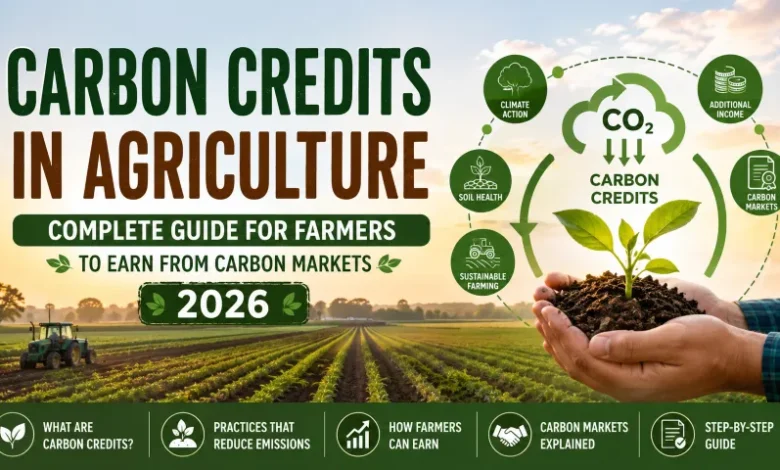
Farming has always been about working with the land. But a growing number of farmers worldwide are discovering that the land does something else valuable beyond producing crops and livestock — it stores carbon. And in today’s market, stored carbon has a measurable, tradeable, and increasingly significant financial value.
Carbon credits in agriculture represent one of the most important emerging income opportunities available to farmers across every continent. Whether you grow grain, raise cattle, manage pasture, or practice regenerative agriculture, understanding how carbon markets work and how to participate in them could add meaningful revenue to your farming operation — often from practices you may already be implementing or considering. Every farm has a carbon footprint but many farms also have the capacity to generate carbon offsets that exceed their own emissions, turning agriculture from a net emitter into a net carbon sink
This complete guide covers everything farmers need to know about agriculture carbon credits, how they work, what programs are available, which farming practices generate credits, how to sell them, and what the realistic income potential looks like for different types of farm operations.
What Are Carbon Credits and Why Do They Matter for Farmers
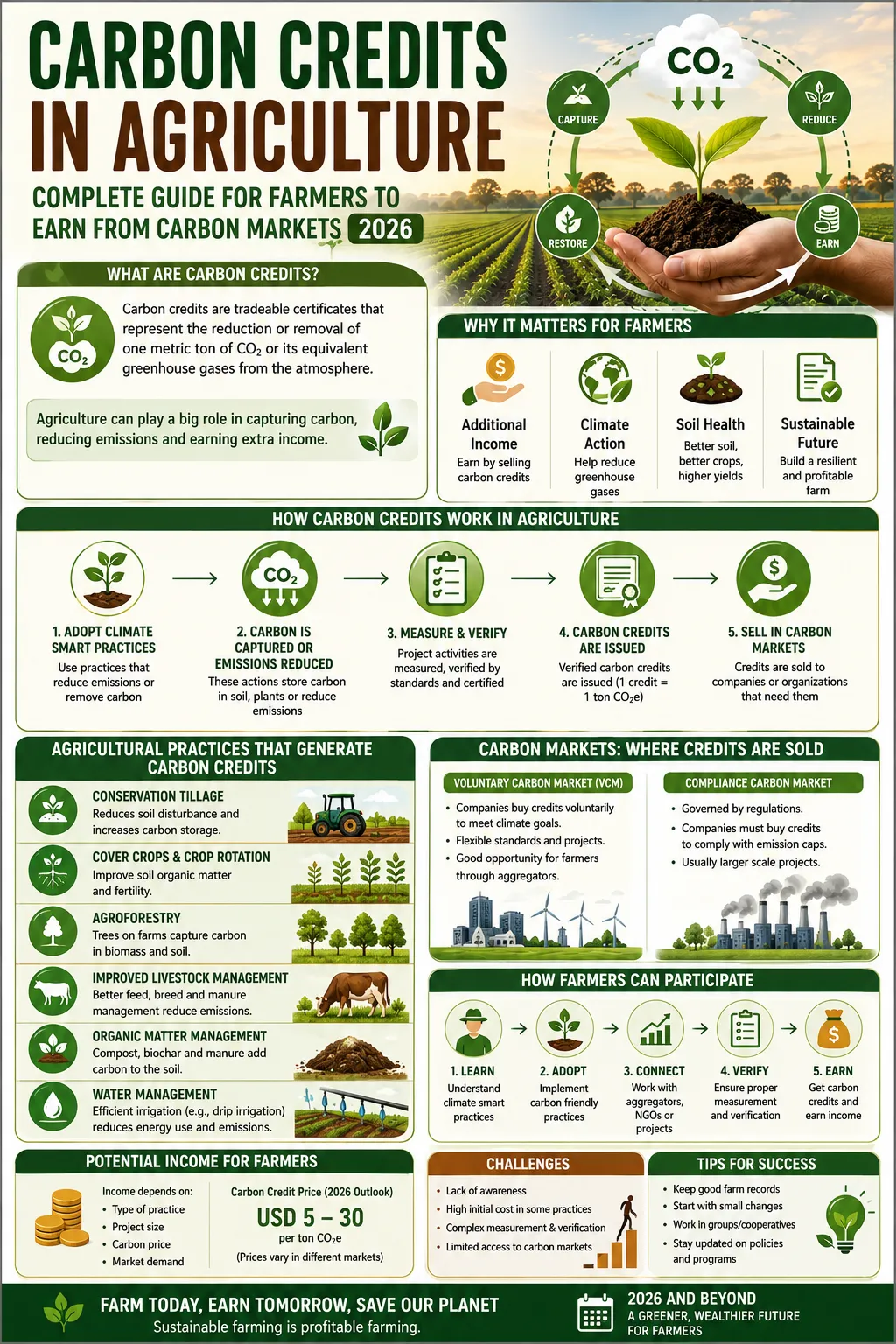
A carbon credit represents one metric tonne of carbon dioxide or its equivalent in other greenhouse gases either removed from the atmosphere or prevented from entering it. Businesses, corporations, and governments that produce greenhouse gas emissions can purchase these credits to offset their carbon footprint as part of voluntary or regulatory climate commitments.
Farms are uniquely positioned in this system. Agricultural land has an enormous natural capacity to sequester carbon through soil organic matter accumulation, tree planting, cover cropping, improved grazing management, and reduced tillage practices. Every tonne of carbon that healthy, well-managed farmland pulls from the atmosphere and locks into the soil or biomass represents a carbon credit that farmers can potentially sell to carbon markets.
The global voluntary carbon market was valued at over four billion dollars in recent years and continues to grow as corporate net-zero commitments drive demand for high-quality agricultural carbon credits. For farmers the opportunity is genuine but navigating the carbon market landscape requires understanding both the potential and the practical realities involved.
How Carbon Credits Work in Agriculture — The Basic Mechanics
The process of generating and selling agriculture carbon credits follows a broadly consistent pathway regardless of which program or market a farmer participates in:
A farmer adopts or continues specific land management practices that sequester carbon or reduce greenhouse gas emissions. An approved third-party verifier measures and quantifies the carbon impact of those practices using established scientific methodologies. Verified carbon reductions are issued as tradeable carbon credits. The farmer sells those credits to buyers through voluntary carbon markets, brokers, or direct corporate partnerships.
The key variables that determine how many credits a farm generates and their market value, are the farming practices adopted, the baseline carbon status of the soil before the program begins, the verification methodology used, the length of commitment required, and the additionality of the practice meaning whether the farmer would have adopted it anyway without the carbon payment.
Understanding how your farm’s overall financial performance connects to these new income streams is important. Farmers who already use tools to calculate production costs and income are better positioned to evaluate whether carbon credit income meaningfully improves their overall farm economics before committing to a multi-year program.
Which Farming Practices Generate Carbon Credits
Not every farm activity generates carbon credits — but the range of qualifying practices is broader than most farmers realize.
Soil Carbon Sequestration
Healthy soil chemistry is the foundation of effective carbon sequestration — baseline soil organic matter accumulates most efficiently when pH is within the optimal range for the farming system, making soil pH management a practical first step before enrolling in any carbon credit program.
This is the foundation of most farmland carbon credit programs. Healthy soils with high organic matter content store significantly more carbon than depleted or degraded soils. Practices that build soil organic matter — cover cropping, reduced or no-till farming, compost application, and diverse crop rotations — all contribute to measurable soil carbon increases over time.
Soil carbon sequestration credits typically require a multi-year commitment of usually five to ten years minimum because meaningful carbon accumulation takes time to develop and verify. Farmers must agree to maintain the practices for the contract period to retain credit eligibility.
Regenerative Agriculture Carbon Credits
Regenerative agriculture has moved from a niche concept to a mainstream farming movement with direct financial implications for participating farmers. RA carbon credits specifically reward farming systems that go beyond simply sustaining existing resources to actively rebuilding degraded soil health, biodiversity, and ecosystem function.
Practices that qualify under regenerative agriculture frameworks include integration of livestock and cropping systems, elimination or dramatic reduction of synthetic inputs, use of diverse cover crop mixes, rotational and adaptive grazing management, and restoration of degraded land areas within farm boundaries. Premium carbon credit prices are increasingly available for verified regenerative agriculture projects because of their multiple co-benefits beyond carbon alone.
Carbon Credits for Cattle Farmers
Livestock — particularly cattle — have historically been characterized primarily as a source of agricultural greenhouse gas emissions through methane from enteric fermentation and manure management. The carbon credit landscape for cattle farmers is more nuanced than this simple picture suggests.
Carbon credits for cattle farmers are available through several pathways. Improved grazing management, particularly adaptive multi-paddock rotational grazing builds soil carbon in pasture systems at rates that can generate meaningful credits over time. Feed additive programs that measurably reduce methane emissions from cattle digestion are generating a new category of livestock emission reduction credits. Methane capture from large-scale manure management systems provides another pathway for qualifying livestock operations.
The specific credit volumes and values available to cattle farmers vary significantly by region, herd size, management system, and verification methodology — making program-specific due diligence essential before committing to any carbon agreement.
Cover Crops and Reduced Tillage
Cover crops are among the most accessible entry points into carbon farming credits for grain and row crop producers. Planting cover crops between cash crop seasons keeps living roots in the soil year-round, builds organic matter, prevents erosion, and sequesters meaningful quantities of carbon relative to bare fallow ground.
Reduced tillage and no-till systems preserve soil structure, reduce carbon loss from soil disturbance, and improve water infiltration — all of which contribute to carbon sequestration and qualify for credit programs in most major carbon markets.
Cover crops planted between wheat seasons are among the most accessible entry points into carbon farming. Farmers who already follow best practice guides for wheat cultivation are often already implementing rotation practices that qualify for credit programs.
Agroforestry and Tree Planting
Before enrolling in any carbon credit program, farmers should understand how much carbon their trees and land are already storing. Use the free carbon sequestration calculator to estimate the carbon stored in your existing trees as a practical starting point for understanding your farm’s sequestration potential. Integrating trees into agricultural landscapes through agroforestry systems generates some of the highest carbon sequestration rates available to farmers. Trees store carbon in woody biomass above and below ground over decades — providing long-duration carbon storage that commands premium prices in compliance and high-quality voluntary carbon markets.
Carbon Markets for Farmers — How to Sell Carbon Credits
Understanding the market structure is essential for farmers who want to monetize their carbon sequestration activities effectively.
Voluntary Carbon Markets
The voluntary carbon market is where most agricultural carbon credits are currently bought and sold. Corporations with voluntary net-zero commitments purchase credits to offset their residual emissions. Agricultural credits are particularly valued in this market because they offer co-benefits — biodiversity improvement, water quality protection, rural community support — alongside carbon reduction.
Major voluntary carbon market platforms that aggregate and sell agricultural carbon credits include Verra, Gold Standard, American Carbon Registry, and Climate Action Reserve. Each has specific methodologies and requirements for agricultural projects.
Carbon Aggregator Programs
Most individual farm operations are too small to engage directly with carbon markets cost-effectively. Carbon credit program aggregators solve this problem by pooling credits from multiple farmers, handling the verification and registration process, and selling combined credit volumes to buyers at scale.
Companies including Indigo Ag, Nori, Truterra, Soil Carbon Initiative, and various regional programs provide aggregation services to farmers — simplifying market access in exchange for a portion of the credit revenue. Farmers receive payment per tonne of verified carbon stored, with contract terms, payment structures, and revenue shares varying significantly between programs.
Government Carbon Tax Credit Programs
Beyond voluntary markets several governments have established or are developing regulatory carbon frameworks that include provisions for agricultural carbon tax credits. These compliance market opportunities vary enormously by country and region — farmers should consult their national agricultural department or a qualified carbon advisor for country-specific program availability.
Corporate demand for agricultural carbon credits is driven largely by Scope 3 emission reduction commitments — companies counting farming supply chain emissions in their net zero targets are actively seeking verified farmland carbon credits to offset agricultural footprints they cannot directly control.
Carbon credit programs specifically designed for different farming systems continue to emerge. Resources that help farmers research and compare available programs in their region — such as the agricultural knowledge library at fasalbachao.com — provide a useful starting point for understanding which practices and programs align with specific farm operations.
What Farmers Can Realistically Earn from Carbon Credits
Realistic income expectations vary considerably based on farming practice, location, program, and carbon market conditions.
| Practice | Typical Carbon Sequestration | Credit Price Range | Estimated Annual Income per Acre |
|---|---|---|---|
| No-till / reduced till | 0.1 – 0.5 tonnes CO₂/acre | $10 – $50/tonne | $1 – $25/acre |
| Cover cropping | 0.2 – 0.5 tonnes CO₂/acre | $10 – $50/tonne | $2 – $25/acre |
| Improved grazing management | 0.3 – 1.0 tonnes CO₂/acre | $15 – $60/tonne | $5 – $60/acre |
| Agroforestry systems | 1.0 – 5.0 tonnes CO₂/acre | $15 – $100/tonne | $15 – $500/acre |
| Regenerative agriculture (full system) | 0.5 – 2.0 tonnes CO₂/acre | $20 – $100/tonne | $10 – $200/acre |
These figures represent broad ranges across different programs, regions, and market conditions. Individual farm results depend on baseline soil carbon levels, the specific practices adopted, the verification methodology, and current market pricing at the time of credit sale.
Carbon credit income should be viewed as a supplementary revenue stream rather than a primary income replacement. But for large acreage operations adopting qualifying practices, the cumulative income over a multi-year program can be genuinely significant.
Key Considerations Before Joining a Carbon Program
Before signing any carbon credit agreement farmers should carefully evaluate several important factors.
Contract length and permanence requirements are critical as most soil carbon programs require five to ten year commitments, and some impose penalties or credit reversal obligations if practices are discontinued before the term ends.
Measurement and verification costs can significantly reduce net income — some programs cover these costs while others deduct them from farmer payments. Always clarify the full cost structure before signing.
Additionality requirements mean that practices a farmer was already planning to adopt may not qualify for credits under some program methodologies. Understanding what counts as additional action is essential for evaluating genuine income potential.
Land use restrictions in some programs limit what farmers can do with enrolled land during the contract period — reviewing these restrictions against your operational plans is important before committing.
Finally, the carbon market itself carries price risk. Credit prices fluctuate with corporate demand, regulatory developments, and market sentiment. Programs that lock in fixed prices per tonne provide more income certainty than those that expose farmers to spot market pricing.
A well-informed decision about carbon program participation starts with understanding your current farm economics clearly. Finding a reliable agricultural resource that you return to season after season for production planning, cost calculation, and decision support is exactly the kind of foundation that makes evaluating new opportunities like carbon markets straightforward. You can read more about that concept here.
Frequently Asked Questions
The most practical starting point for most farmers is contacting an established carbon aggregator program — companies like Indigo Ag, Nori, or Truterra in North America, or regional equivalents in other markets. They handle the complexity of verification and market access while providing straightforward per-acre payment structures.
Agroforestry and regenerative agriculture full-system approaches generate the highest carbon sequestration rates per acre. For grain farmers, combining no-till or reduced till with diverse cover crop rotations provides the most accessible combination of practices with meaningful credit potential.
Yes — particularly for operations adopting improved rotational grazing management. Pasture carbon sequestration under well-managed grazing systems can be meaningful, and methane reduction programs are creating new credit opportunities for livestock producers willing to engage with feed management programs.
Most programs require one to three years of verified practice adoption before initial credits are issued and payments made. Some programs offer advance payments or annual installments — this varies by program and should be confirmed before signing any agreement.
This varies by country and program. In most cases carbon credit income is separate from existing agricultural support schemes — but farmers should confirm this with their agricultural advisor or relevant government department before enrolling.
Summary