Textured Soy Protein: From the Soybean Crop to Usable Yield
A soybean crop does not end at the farm gate
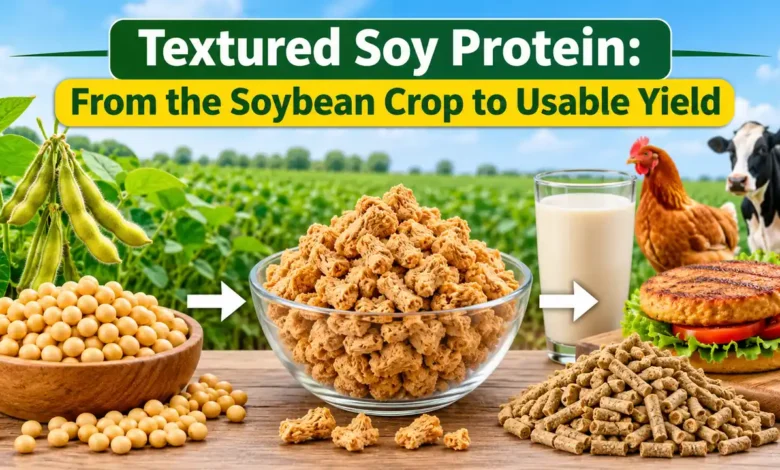
Textured soy protein begins as a soybean crop, and what a food buyer eventually pays for is decided twice: once in the field, where the bean’s protein is formed, and once in the factory, where that protein is turned into an ingredient. Soybean is one of the world’s great protein and oilseed crops, and beyond the oil press and the feed mill, a growing share of the harvest is processed into textured soy protein — the dry granules, flakes and chunks that food manufacturers hydrate and use in place of, or alongside, meat.
The trap for everyone along that chain is the name. Two suppliers can both offer “textured soy protein” and deliver ingredients that differ in protein content by twenty points, in piece size by a factor of four, and in the yield they give a food plant by a third. A crop buyer can identify beans by variety and grade; a prepared-food plant needs to know what is in the finished ingredient, what form it takes, and how much of it survives water, heat and mixing in a usable condition. This guide follows the bean from the field to the buyer’s spreadsheet: what the ingredient is, how it is graded, and how a careful buyer measures the only number that finally matters — usable yield. The wider market this trade sits in is covered in our analysis of the evolving role of the oilseeds sector in the global economy.
What textured soy protein actually is
Textured soy protein is a dry, shelf-stable ingredient made by extruding defatted soy flour or soy protein concentrate so the protein sets into fibrous, meat-like pieces. Inside the extruder, the soy feed is mixed with water and subjected to heat, pressure and mechanical shear; the protein denatures and restructures, is shaped as it leaves the die, then cut and dried into granules, flakes, chunks or strips. Codex Alimentarius caps the moisture of soy protein products at 10%, which is why the finished pieces keep without refrigeration and ship like a dry commodity rather than a fresh food.
Extrusion runs in two broad styles. Low-moisture extrusion (below roughly 30% moisture) produces the expanded, sponge-like dry pieces that must be rehydrated before use — the form most buyers meet. High-moisture extrusion (above roughly 50%, through a long cooling die) produces dense, fibrous, ready-textured product. Within the dry form, size is a commercial language of its own: one major supplier’s range runs from a 3 mm irregular granule through a 6 mm flake and 8 mm chunks to a 12 mm cubed chunk, and its specification sheets fix not just a size range but a minimum of 85% of pieces inside it. Colour is a grade too: pieces are sold uncoloured, in their natural light tan, or caramel-coloured in shades from light caramel to dark “beef” tones. A fuller overview of textured soy protein in food manufacturing walks through the process from the manufacturer’s side; the buyer’s task starts where that description ends, with the question of what a specific coded product will do in a specific food.
The protein ladder: flour, concentrate, isolate
The single biggest difference hidden inside the name “textured soy protein” is which rung of the soy protein ladder the product was made from. Codex standard CXS 175-1989 grades every soy protein product by its protein content, measured as nitrogen × 6.25 on a dry basis, and the textured product inherits its feedstock’s level.
| Codex grade | Protein (dry basis) | How it is made | What the buyer gets |
|---|---|---|---|
| Soy protein flour | 50% to under 65% | Defatted soy flakes, ground | The standard TVP feedstock; textured product at about 50% protein |
| Soy protein concentrate | 65% to under 90% | Defatted flakes washed with aqueous alcohol to remove soluble carbohydrates | Textured product at about 70% protein; milder flavour |
| Soy protein isolate | 90% or more | Alkaline extraction, then precipitation at acid pH | The premium protein source, used in high-protein formulations and blends |
Protein quality is not the weak point: soy protein isolate scores a PDCAAS of 1.00, the maximum in the FAO/WHO system, so the buyer’s question is quantity and behaviour, not completeness. One caution belongs in every costing, though. Hydration dilutes concentration, not amount: dry textured soy protein at about 50% protein becomes a hydrated ingredient of roughly 17% protein once it has taken up its water, because the absorbed water roughly triples the weight. Nutrition panels and costings for the finished food must be calculated on the hydrated weight actually used.
Why two quotes for the same ingredient are not the same product
A price comparison between two offers of “textured soy protein” is meaningless until four differences have been pinned down, because each one moves the real cost of the ingredient in the finished food.
- Feedstock grade. A flour-based product at about 50% protein and a concentrate-based product at about 70% protein are different ingredients wearing one name; the cheaper quote per kilo may be the dearer one per kilo of protein.
- Form and size. Fine granules disperse through a dumpling filling or a sauce; the same pieces cannot be loaded onto a skewer line. Piece size, and the share of pieces actually inside the stated range, decide where the product can be used at all.
- Colour grade. Uncoloured and caramel-coloured pieces are separate commercial grades; a stew and a pale sauce do not want the same one, and the colour must be agreed, not assumed.
- The full ingredient list. Blends are common — research formulations routinely mix soy isolate with wheat gluten — so the declaration for the exact product code, not the product family, is what the buyer must hold. A blend also changes the allergen file, as the labelling section below explains.
The practical habit that prevents most disputes is simple: request the current declaration and specification for the exact code under discussion, ask for a photograph or description of the customer’s finished product, and agree where in that food the soy should be visible.
Give incoming inspection a question it can answer
“Good texture” cannot be inspected on arrival, so a professional receiving check replaces adjectives with measurements the two sides have agreed in advance. For a chunky product, the workable instruction is to retain a reference sample from the approved trial and compare each delivery against it: spread a representative portion on a tray, photograph it beside a scale, and check the distribution of piece sizes against the specified range and its minimum in-size percentage.
Breakage needs the same treatment. Buyer and supplier should agree how broken pieces are collected and weighed, and — more important — which fragments can still enter the finished dish and which will be screened out. The same breakage percentage can mean lost yield to one plant and perfectly usable material to another, so the number only means something once the customer’s definition of “usable” is written beside it.
For a fine granule, start from the defect the customer actually reports. If a sauce feels gritty, check the centre of the prepared pieces and record exactly how they were hydrated. If a filling loses definition, inspect samples before and after mixing, and keep the mixer, batch weight and mixing time in the record. That discipline narrows the next trial to one specific change and gives the supplier feedback worth acting on, instead of a general complaint about softness.
Build a mass balance both sides can reproduce
Usable yield is measured at three weighing points — dry on receipt, after hydration and draining, and after the customer’s own process — with each weight recorded separately. The worked example below uses round numbers to show why the distinctions matter; the arithmetic is the method, and any buyer can rerun it with their own figures.
| Step | Weight | Figure it gives |
|---|---|---|
| Dry product weighed on receipt | 500 g | The quantity paid for |
| After hydration and draining | 1,250 g | Drained yield: 2.5 kg per dry kg |
| Broken wet pieces that must be discarded | 150 g | The loss the drained yield hides |
| Usable material remaining | 1,100 g | Usable yield: 2.2 kg per dry kg |
| Cost at a delivered quote of $4.40 per dry kg | $4.40 ÷ 2.2 | $2.00 per usable kg (dividing by 2.5 instead gives $1.76 — and understates the cost) |
Two refinements complete the method. If the plant can route the broken pieces into a second product, report that use separately and credit it at an agreed value; a recovery route changes the economics only when a real production schedule can absorb the material. And every yield figure must travel with its method — soak time, water temperature and draining procedure — because, as the research in the next section shows, the method moves the number. Keeping avoidable loss visible in this way is the same discipline that agricultural supply chain resilience work applies between the farm and the market.
What published hydration research adds
There is no single “correct” hydration ratio for textured soy protein, and published research shows why: measured water uptake depends on the product’s raw materials and on the test method used. That is not a weakness in the data — it is the strongest argument for the mass-balance method above, run on the buyer’s own line with the buyer’s own draining procedure.
| Measured finding | Result | What it means for a buyer |
|---|---|---|
| Water absorption capacity of TVP, standardised lab method (Samard & Ryu, 2019) | 2,173.84 g per kg dry (about 2.17 g/g) — significantly above beef, pork and chicken measured the same way | A realistic benchmark for a drained-weight test |
| Water-holding capacity by raw-material blend (Foods, 2023) | 4.2 g/g for high cold-swelling blends vs 2.9 g/g for low cold-swelling blends | The blend alone moved uptake by about 45% — feedstock questions are yield questions |
| Solids lost to the soak water (extrusion trials, 2023) | Total soluble matter from 12.32% down to 6.45%, depending on die temperature | Part of the dry weight paid for can leave in the drain water |
| Rehydration dynamics (NMR study) | Water temperature changed the RATE of rehydration; pH changed the final CAPACITY in long soaking | Soak time, temperature and water chemistry all belong in the written method |
The manufacturer’s settings sit behind all of these numbers. In low-moisture extrusion trials, raising die temperature from 180 °C to 200 °C increased the expansion ratio from 1.43 to 3.44 — a lighter, more absorbent sponge — while 210 °C collapsed the structure and reduced absorption again. A buyer cannot see those settings in the bag, which is precisely why the specification, not the sales sheet, has to carry the yield figure and its method.
Put the trial under the conditions of the first sale
A sample that behaves in a spoon-stirred bowl may fail in a pump or a production mixer, so the trial must include the operation most likely to damage the pieces. Take labelled portions before and after that operation and set them side by side on a white plate. In a sauce line, examine portions from the first containers filled and again near the end of the run: if the solids settle, an acceptable average for the whole kettle can hide a run of underfilled or overfilled packs.
For a product sold chilled or frozen, the customer should assess the sample after its intended handling and reheating procedure, and record what changed in the food itself — liquid weeping around the edge of the tray, pieces splitting when lifted. Retain the sample, its code and its lot for the next discussion. Neither company benefits from trying to reproduce a successful trial after the bag has been discarded and the grade forgotten.
Allergen and labelling: the paperwork is part of the product
Soy is a regulated major allergen in the world’s two largest food-law systems, so the documentation is not an administrative extra — it is part of what is being bought. In the United States, soybeans are one of the nine major food allergens under the FALCPA law, and the source must be declared in the ingredient list or in a “Contains” statement. In the European Union, soybeans are one of the 14 allergens in Annex II of Regulation 1169/2011 and must be emphasised in the ingredient list whenever present. Neither system offers a de minimis escape: if the grade contains soy, it is declared, and a blended grade containing wheat gluten carries that second allergen with it.
Codex adds the naming discipline that ties the paperwork to the physical product. The name of the food must match the grade — soy protein flour, concentrate or isolate — and may carry the form (“granules”, “bits”) and, for texturised product, the word “textured” or “structured”. For bulk supply, the container or its documents must carry the product name, the lot identification and the manufacturer’s name and address. That lot ID is the thread that connects a delivery to its certificate of analysis and to the retained sample on the inspection shelf.
Translate a successful sample into a purchase specification
A purchase specification converts a successful trial into a document both sides can be held to, with a test method written beside every tolerance. The same discipline serves any agricultural commodity purchase — our buyer’s guide to grain imports applies it to wheat, corn and barley — and for textured soy protein the document should fix:
- Identity: manufacturer, product code, Codex grade and feedstock, and the approved reference sample the deliveries will be compared against.
- Physical properties: form, particle-size range in millimetres with a minimum percentage in-size, colour grade, and the agreed breakage limit with its collection method.
- Chemical limits: protein, moisture (Codex ceiling 10%), ash and fibre against the grade’s Codex bands.
- Preparation behaviour: the hydration method in full — water ratio, temperature, soak time, draining procedure — with the drained and usable yield figures measured by that method.
- Safety and paperwork: microbiological limits with their test methods, the ingredient declaration and allergen statement for the exact code, and a certificate of analysis for each shipped lot, keyed to the lot identification on the container.
- Packing, storage and shelf life: pack size and packaging standard, storage conditions, and the shelf life claimed for that product — dry TVP is marketed on the strength of its stability, and the same storage discipline covered in our guide to reducing post-harvest losses protects the value of any stored agricultural commodity.
The first commercial delivery is the moment to repeat the trial on a small part of the lot and compare it with the retained sample. If the result differs, keep the dry pieces and the finished-food observations together: purchasing can then distinguish a specification problem from a change on the production line.
What this means back at the farm
Every figure in the buyer’s specification travels upstream. Protein content starts with the crop — variety choice and growing conditions set the bean’s protein long before a crusher or extruder sees it — and the premium grades in the Codex ladder can only be built from suitable raw material. A supplier who understands usable yield, and can show a food customer exactly what a tonne of beans becomes in their plant, is selling something a price-per-tonne quote cannot express. Published market estimates disagree on the exact size of the textured soy protein trade, but they agree on the shape of it: a global market in the low single-digit billions of US dollars, growing at roughly 6–8% a year, supplied largely by major agricultural processors such as ADM, Cargill and Wilmar. For the grower and the country trader alike, the lesson of the buyer’s spreadsheet is that value in this chain is created by meeting a specification, not by moving volume — the same farm-to-shelf logic traced in our look at how food travels from farm field to certified shelf.
Frequently asked questions
What is textured soy protein made from?
From defatted soy flour or soy protein concentrate — occasionally isolate — extruded under heat, pressure and shear so the protein sets into fibrous pieces, then cut and dried. Flour-based product carries about 50% protein; concentrate-based product about 70%, per the Codex grading bands.
How much water does textured soy protein absorb?
It depends on the product and the test. Published laboratory figures run from about 2.2 g of water per gram of dry product under a drained-weight method to over 4 g/g for high-swelling blends, and supplier claims reach 1:4. Any ratio quoted without its soaking and draining method cannot be compared between suppliers.
Is textured soy protein a complete protein?
Yes. Soy protein isolate scores a PDCAAS of 1.00, the maximum in the FAO/WHO protein-quality system, though its sulphur amino acids (methionine and cysteine) are the limiting ones under the newer DIAAS method, which scores the isolate at about 0.90.
Why can the cheapest quote per kilo be the most expensive ingredient?
Because the plant does not use dry kilos; it uses usable hydrated kilos. A quote divided by the drained yield flatters the cost — in the worked example above, $1.76 per kilo instead of the true $2.00 per usable kilo once broken pieces are excluded. Grade differences widen the gap further: a cheaper flour-based product also delivers less protein per kilo than a concentrate-based one.
Sources
Codex Alimentarius CXS 175-1989, General Standard for Soy Protein Products (protein grades, moisture, labelling). Lyu et al., Food Science and Biotechnology (2023), low-moisture extrusion die-temperature trials (PMC10050532). Samard & Ryu, Journal of the Science of Food and Agriculture (2019), water absorption capacity of TVP. Flory et al., Foods (2023), water-holding capacity of protein blends. US FDA, Major Food Allergens (FALCPA). Regulation (EU) No 1169/2011, Annex II. IMARC Group and Fortune Business Insights, textured soy protein market reports (2025 editions; estimates differ by category definition). ADM textured soy ingredients product sheet (size grades and in-size minimums).