How AI Is Improving Weed Control in Sugarcane Fields
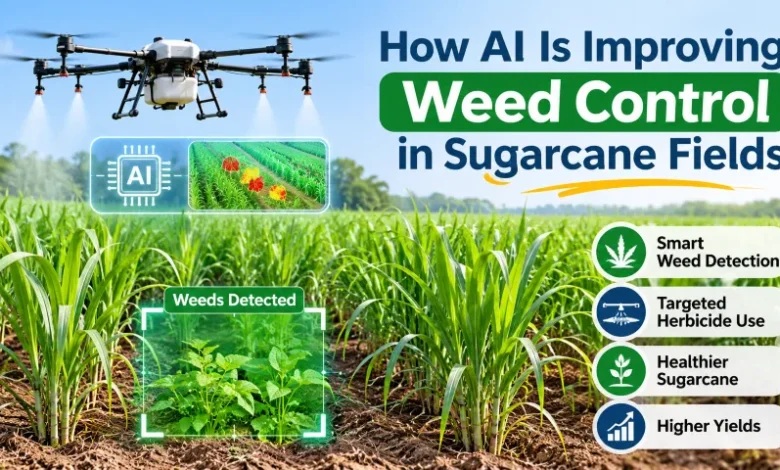
Treating every square meter of a sugarcane field the same way can mean spraying areas with little weed pressure alongside heavily infested patches. Yet reducing treatment indiscriminately creates another problem: weeds that survive among the cane can continue competing with the crop. The challenge is to apply control where it is needed without sacrificing reliability. This is where AI Weed Control in Sugarcane plays its role.
AI is improving weed control in sugarcane fields by helping cameras distinguish target weeds from the crop and connecting those observations with selective treatment. Field trials demonstrate that this approach can reduce herbicide use, but performance depends on weed density, visibility, model training, and spraying equipment. It is a developing management tool, not proof that every sugarcane field is ready for fully autonomous weeding. Weed control is one of many areas where machine vision is changing farm decisions, as covered in our guide to how AI is transforming agriculture and food production in 2026.
Why Sugarcane Requires More Than Simple Vegetation Detection
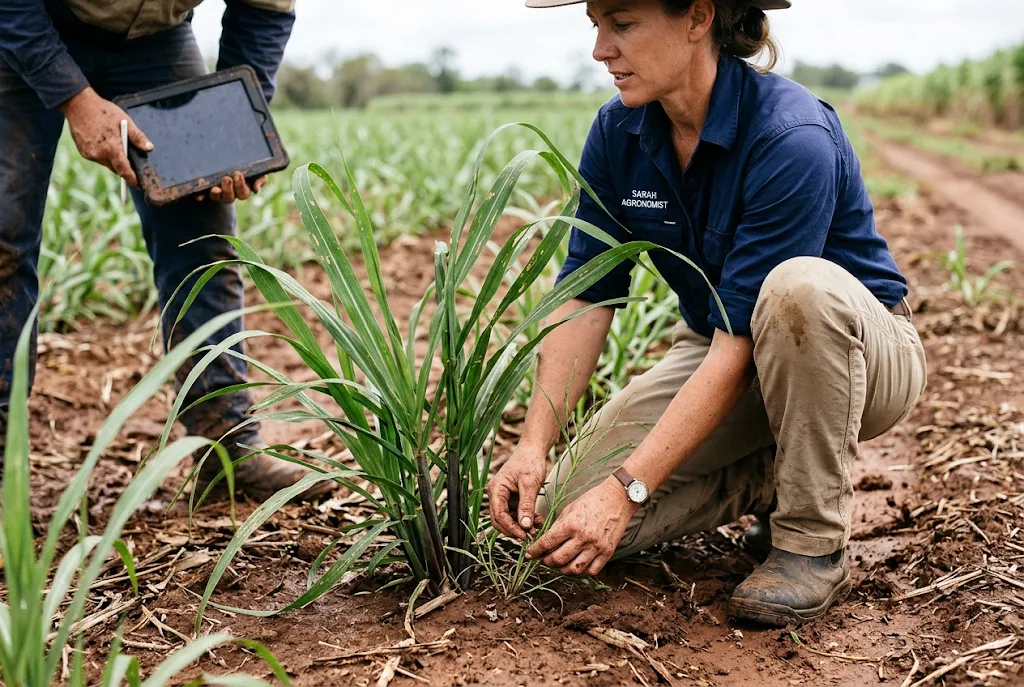
Sugarcane creates a demanding setting for machine vision. The crop is itself a grass, and some grass weeds share its color and narrow-leaf characteristics. As foliage develops, crop leaves and weeds overlap, making it harder to identify both the presence and location of a target plant.
That distinction separates two types of sensing. Green-on-brown systems detect vegetation against soil or other non-crop backgrounds. Green-on-green systems must distinguish unwanted vegetation from a living crop. In-crop sugarcane spraying needs the latter capability, or another validated method of protecting the crop while targeting weeds.
Early crop development is particularly important because weeds compete for light, moisture, nutrients, and space. However, a useful detection system must work during the actual treatment window, not merely identify large weeds once they stand out clearly in photographs.
A system demonstrated against isolated plants on bare soil therefore needs further evaluation before use among overlapping cane leaves. The relevant question is whether it can recognize the farm’s target weeds at the growth stage when effective control is required.
How AI Turns Field Images Into Selective Treatment
The process combines plant recognition with application control. Each stage must work correctly for the system to deliver a useful result.
Learning What to Treat
Deep learning, a form of machine learning that learns patterns from examples, can be trained using labeled images of sugarcane, weeds, and background material. Labels tell the model which images or image regions contain the targets of interest.
Training data need to reflect field diversity. Weed growth stage, leaf shape, lighting, crop cover, and soil appearance all affect what the camera sees. In a documented Australian sugarcane-farming project, researchers collected local imagery before trials and trained site-specific models for the weeds and conditions involved.
This is why a long list of supported crops is less informative than evidence from representative sugarcane fields. Ask whether the model was trained and tested on the weeds, crop stages, and camera arrangement proposed for the operation.
Finding Weeds, Not Just Recognizing Images
AI outputs can serve different purposes:
- Classification determines whether an image or image region contains a target category.
- Detection locates targets within the image, commonly using bounding boxes.
- Segmentation identifies the pixels belonging to a target, describing its visible shape more precisely.
These are not interchangeable performance measures. A model that correctly classifies a selected image as containing weeds has not necessarily located every weed well enough to guide a sprayer.
A 2026 sugarcane study illustrates the distinction. Its strongest scene-classification result was approximately 99% accuracy, while its best object detector achieved 44.2 on the AP50 metric. AP50 assesses detection performance using a defined overlap threshold between predicted and annotated boxes; it is not a percentage of weeds killed or a directly comparable classification score. The study concluded that precise detection under realistic conditions remained challenging.
Connecting Recognition With Nozzles
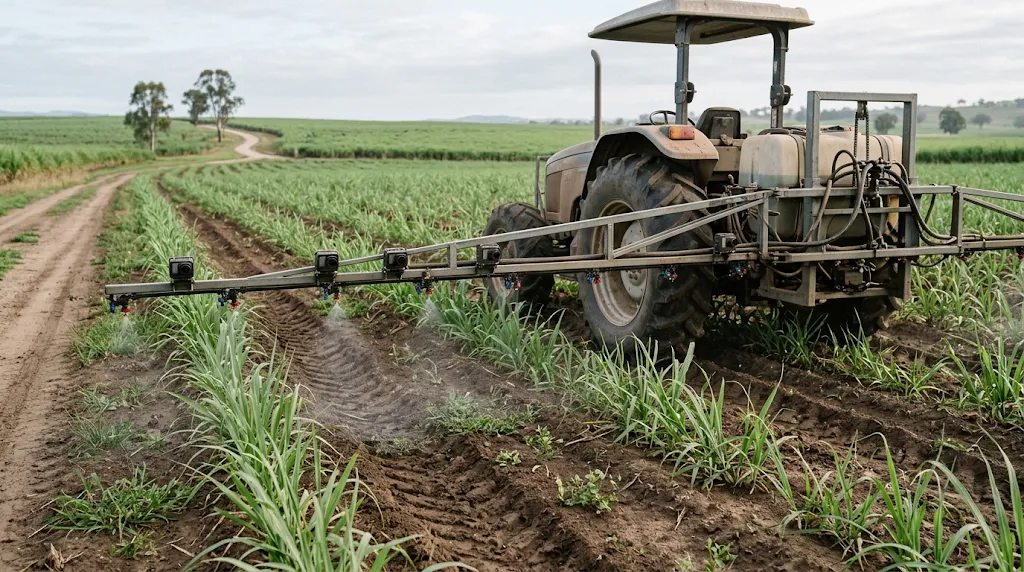
In real-time spot spraying, cameras observe the area ahead of the nozzles. An onboard processor analyzes the imagery and triggers selected nozzles when a target is recognized.
One Australian research system divided camera images into regions and activated the corresponding nozzle when a target weed was present. Cameras and control units were mounted on existing spraying machinery, demonstrating that AI-assisted treatment does not inherently require a completely autonomous robot.
Recognition is only part of this chain. Camera placement, processing delay, vehicle movement, and nozzle execution must align so that the treatment reaches the detected area. Evaluate the assembled system in motion, not just the model’s performance on stored photographs.
What Sugarcane Field Trials Actually Show
Real field evidence supports the potential of selective spraying, but the conditions and measurement methods matter.
A research case study made available as a preprint in 2024 described six trials conducted during 2021 and 2022 in Queensland’s Burdekin region. The program covered approximately 25 hectares within sugarcane-farming systems. Four trials involved sugarcane, while two involved mung bean grown as a rotational crop.
Across the complete trial program, researchers reported an average 35% reduction in herbicide use. That combined result should not be presented as a sugarcane-only average. Reported reductions in the individual sugarcane trials ranged from 8% to 65%, showing how strongly the opportunity varied between applications.
Control outcomes also require careful interpretation. Across the five trials with usable follow-up imagery, the average observed weed knockdown hit rate was approximately 95% for spot spraying and 99% for broadcast spraying. The authors expressed the relative efficacy as approximately 97%. This was a short-term knockdown comparison, not proof of equal season-long weed suppression or equal harvested yield.
The evidence is useful because it evaluates spraying rather than image recognition alone. It is also limited: the work used site-specific training, selected trial conditions, and a research team that included the technology developer. Treat it as a documented demonstration, not an independent guarantee of commercial performance everywhere.
The results support a practical proposition: selective treatment can reduce herbicide use where weed distribution permits, but the financial and agronomic outcome must be verified locally.
Choosing Between Mapping and Real-Time Spraying
AI can inform weed management before application or during the spraying pass. These approaches answer different operational needs.
| Approach | What it contributes | Potential use in sugarcane | Main question before adoption |
|---|---|---|---|
| AI-assisted imagery review | Identifies suspected weed presence in field images | Directing scouting toward problem areas | Does it recognize the relevant weeds under representative conditions? |
| Aerial weed mapping | Describes the spatial distribution of visible weed patches | Planning inspections or a compatible targeted application | Is the imagery detailed enough, and can the prescription be executed? |
| Real-time camera-guided spraying | Links weed recognition directly with nozzle activation | Treating detected targets during a machinery pass | Does the full system maintain control at the intended operating speed? |
Mapping and spot spraying sit alongside other tools in the wider field of smart farming technology reshaping agriculture, such as sensors, drones and automated machinery. Aerial imagery and ground-mounted cameras view the crop differently. Sugarcane research has highlighted that models developed for one image-acquisition method may not generalize to another. Do not assume that an algorithm validated on drone images can be transferred unchanged to a camera mounted beneath a spray boom.
Mapping also separates observation from treatment. Before selecting that workflow, establish how quickly analysis will arrive and how the resulting map will translate into a practical action. For real-time systems, focus on reliable recognition and application while the machinery moves through the crop.
Neither route is inherently best for every farm. A scouting requirement may justify a mapping service, while a repeatable post-emergence application may warrant testing an integrated spot sprayer.
What Can Limit Performance in the Field
The most important limits are often ordinary field conditions rather than the sophistication of the AI architecture.
Overlapping Leaves and Hidden Targets
A weed partly concealed by sugarcane may not present enough visible information for reliable recognition. Research in realistic sugarcane scenes identifies overlap and visual similarity as major obstacles, particularly for grass weeds.
Testing should include weeds near the stool and within difficult foliage, not only exposed plants between clean rows. Document where failures occur so the grower can judge whether the remaining risk is acceptable.
Shadows and Changing Exposure
The Australian field case study linked reduced performance in one trial to underexposed images caused by machinery shadows. Exposure adjustments did not always keep pace with changing scene brightness.
A convincing demonstration should therefore include ordinary transitions between sun and shade. Ask how cameras are protected, how image quality is monitored, and what happens when the system cannot make a dependable prediction.
Unfamiliar Fields and Weed Populations
A model may perform well at its development site without proving reliable elsewhere. The 2026 detection study explicitly noted that its images came from one location and that cross-site performance remained untested.
Request testing on separate fields rather than relying entirely on a random split of similar images from the same collection. Include representative weed sizes, soil backgrounds, crop stages, and machinery configurations.
Recognition Without Effective Treatment
AI decides where a supported system should apply treatment; it does not establish that every product will control every weed. Species identification, growth stage, treatment selection, and application requirements still need agronomic review.
Keep the broader weed-management program intact until evidence supports a specific change. A trial demonstrating selective post-emergence spraying does not establish that residual treatments or other management practices can be removed.
Evaluating the Investment Without Overstating Savings
Start with an eligible application, not the total farm area. Identify which treatment could change, the current cost of that treatment, and the proportion of expenditure that selective application might avoid.
Then include the complete additional cost: equipment or service charges, installation, software, maintenance, training, local image collection where needed, and extra operating time. Include follow-up treatment if control falls short.
A useful planning relationship is:
Annual net benefit = avoided treatment expenditure + other verified savings − additional annual costs
Data access and record-keeping matter when you test these systems, and the same questions of data ownership and traceability come up in our look at how AI and blockchain technology in agriculture could reshape the industry.
Do not count a removed machinery pass unless it actually disappears. Likewise, do not count higher yield merely because detection improves. The base case should use measured benefits, while uncertain benefits belong in a separate scenario.
A representative pilot should compare selective treatment with the existing program under similar conditions. Record actual product use, working time, weed distribution before treatment, surviving weeds, and later escapes. Confirm whether apparent chemical savings persist after corrective work.
Ask suppliers to document supported weeds, operating conditions, failure procedures, data access, and total charges. A local demonstration should establish reliability, not simply produce the lowest sprayed-area percentage.
Make Precision Earn Its Place in the AI Weed Control in Sugarcane
AI is moving sugarcane weed control toward more selective decisions: recognizing weeds among crop foliage, directing inspection, and activating treatment where targets are detected. The strongest evidence shows meaningful opportunities alongside persistent recognition and application challenges. Selective spraying is an early step in a larger shift, and you can read more about what the future of AI farming could look like.
Before committing across the farm, request a documented assessment of one representative treatment window. Combine local detection testing with a controlled application comparison and follow-up scouting. Expand only when the complete workflow delivers acceptable weed control and a defensible net benefit under the farm’s own conditions.
FAQs
Can AI really control weeds in sugarcane fields?
Yes, in a limited and developing way. AI can help cameras tell target weeds from sugarcane and trigger spraying only where weeds are detected. Trials show it works, but performance depends on weed density, visibility, model training and the spraying equipment. It is not yet proof that every field is ready for fully autonomous weeding.
How much herbicide can AI spot spraying save in sugarcane?
It varies widely. In Queensland trials, the full program averaged a 35% reduction in herbicide use, but that included mung bean trials. In the individual sugarcane trials, reductions ranged from 8% to 65%. Your savings will depend on how weeds are spread across your fields.
Is AI spot spraying as effective as spraying the whole field?
In the short-term trial results, spot spraying achieved roughly 95% weed knockdown compared with about 99% for broadcast spraying. That is a short-term comparison, not proof of equal season-long control or equal yield.
What is the difference between green-on-brown and green-on-green detection?
Green-on-brown systems detect green weeds against bare soil. Green-on-green systems must tell weeds apart from a living crop, which is what in-crop sugarcane spraying needs. It is harder because sugarcane is a grass, and some weeds look similar.
Why is weed detection harder in sugarcane than in other crops?
Sugarcane leaves overlap with weeds as the crop grows, and many grass weeds share its color and narrow leaves. Shadows and changing light can also reduce camera accuracy.
Do I need a fully autonomous robot to use AI for weeding?
No. In one Australian research system, cameras and control units were mounted on existing spraying machinery, so AI-assisted treatment does not require a completely autonomous robot.
Can drone images be used for weed control in sugarcane?
Drones can map weed patches to guide scouting or targeted application. However, a model trained on drone images may not work on ground-mounted cameras, so each setup needs its own validation.
How should I test AI weed control before investing?
Run a pilot on one representative field or treatment window. Compare selective spraying with your current program, and record product use, working time, surviving weeds and later escapes. Expand only if the net benefit holds up under your own conditions.
Does AI replace the rest of my weed management program?
No. A trial showing selective post-emergence spraying does not mean residual treatments or other practices can be dropped. Species identification, treatment choice and timing still need agronomic review.