Simbal Tree (Bombax ceiba): Red Silk Cotton Tree Guide

The simbal tree (Bombax ceiba) is a large, fast-growing deciduous tree grown across the tropics of Asia for one of the finest flower displays of any tree: in late winter, its bare branches cover themselves in huge, waxy red blooms before a single leaf appears. It is known in English as the red silk-cotton tree, and it finishes its season by releasing clouds of silky seed floss from woody capsules — the floss that gave the whole genus its name, from the Greek word for silk. It is a tree that needs room, sun and a frost-free climate, and it repays all three with spring colour, summer shade and almost no maintenance. This profile covers how to recognise the tree, how big it grows, where it belongs, how to plant one, and what its flowers, floss and wood are used for.
What is the simbal tree?
The simbal tree is Bombax ceiba, a member of the mallow family, Malvaceae. English speakers also call it the red silk-cotton tree, the Malabar silk-cotton tree or simply the red cotton tree. Across South Asia it answers to local names instead — sumbal in Urdu and Punjabi, semal in Hindi and shimul in Bengali. Botanists rate it the most ornamental of the nine species in the genus Bombax, and its conservation status is Least Concern, so it is in no danger in the wild. One naming trap is worth clearing up at the start: simbal is sometimes described as a “kapok” tree, but true kapok comes from a different species, Ceiba pentandra. The two are relatives, and both pack their seeds in silky fibre, yet they are separate trees — and it is the red-flowered Bombax that gardeners plant for spring colour.
How to identify a simbal tree
Identification starts with the trunk. A young simbal has a straight, light-grey trunk studded with stout, conical spines; the spines blunt and disappear as the tree ages, and old trunks often flare into buttress roots at the base. The branches leave the trunk in distinct tiers, like stacked umbrellas, which gives the crown its layered, columnar-to-rounded outline even from a distance. In summer, look at the leaves: each one is a fan of five to seven smooth, pointed leaflets carried on a long stalk, and a single leaf can measure up to 24 inches across. In flower, the tree gives itself away completely — no leaves, just hundreds of fleshy red cups clustered near the branch tips. Gardeners who like that late-winter blaze often pair it with other spring bloomers such as the dhak tree. The table below pulls the key identification points together.
| Feature | What to look for |
|---|---|
| Trunk and bark | Straight and light grey; stout conical spines on young trees; buttressed base on old trees |
| Branches | Grow in tiered whorls; crown columnar to rounded |
| Leaves | Palmately compound — a fan of 5–7 smooth leaflets; whole leaf up to 24 in long |
| Flowers | Cup-shaped and fleshy, 5 red to orange-red petals, about 6–8 in across, on bare branches |
| Fruit | Woody capsule about 13 cm (5 in) long, splitting open to release seeds in white silky floss |
| Season clue | Leafless in mid-winter; flowers before the leaves; new foliage follows the bloom |
Flowers, leaves and fruit through the year
The simbal runs on a strict calendar. In January and February it drops its leaves and stands bare, and it is on those bare branches that the flowers appear, from February through April and in some accounts into early May. Each waxy bloom lasts only about a day, but the flowers open in quick succession over three to four weeks, so the whole display lasts roughly a month. The flowers are rich in nectar and draw in birds and bees while the tree is otherwise asleep. Only after flowering does the fresh green canopy open. Later in the season the fertilised flowers swell into woody capsules that turn from green to brown and split open, letting the wind carry the small brown seeds away on their silky parachutes. Use the calendar below to know what the tree should be doing in any given season.
| Season | What the tree is doing |
|---|---|
| Mid-winter (Jan–Feb) | Leaves fall; the tree stands bare and rests before flowering |
| Late winter to spring (Feb–Apr, into early May) | Large red flowers open on the bare branches, visited by birds and bees |
| Spring | New palmate leaves unfold after flowering, building the summer canopy |
| Later in the season | Woody capsules ripen, turn brown and split, releasing seeds in silky floss |
How big does a simbal tree get?
Plan for a giant. A mature simbal typically stands 60–75 feet tall — about 20 metres — and spreads 40–60 feet wide, carried on a straight trunk two to five feet thick. In the wet tropics, exceptional old trees push far beyond the typical size, reaching 150 feet or more. It gets there quickly, too: botanical gardens describe the simbal as fast-growing in warm climates, so the mature size arrives sooner than most planters expect. That combination of height, spread and speed settles the planting question by itself — this is a tree for parks, avenues and very large grounds, where a 60-foot canopy has room to develop. In a small garden it will simply outgrow its welcome within a few years. The figures below sum up the space and conditions it needs.
| Simbal at a glance | Details |
|---|---|
| Height | Typically 60–75 ft (about 20 m); exceptional trees 150 ft or more |
| Spread | 40–60 ft |
| Growth rate | Fast in warm climates |
| Sun | Full sun — six or more hours of direct light |
| Soil | Well-drained; deep, sandy soil suits it best |
| Water | Dry to medium moisture; drought-tolerant once established |
| Hardiness | USDA zones 10–12 — frost-free climates only |
| Bloom | February to April, into early May in some areas |
| Maintenance | Low once established |
Where does the simbal tree grow naturally?
The simbal is a tree of tropical Asia. Its native range runs from India through Southeast Asia to northern Australia, and more widely across tropical Asia and Oceania, including Pakistan, southern China and the Philippines. In the wild it grows in monsoon forests, along river valleys and in open savannas, and it climbs into hills up to roughly 4,000–4,500 feet. Within that range it shares its riverbanks and open woodland with other big native trees, among them the kikar tree. Its fame has travelled further than its range: in China the simbal is the official flower of the city of Guangzhou, where its spring bloom is a seasonal landmark. Outside the frost-free tropics, though, it cannot survive winter cold, which is why it stays a warm-climate tree.
How to grow a simbal tree
Give the simbal the conditions it evolved for, and it asks for very little else. Start with the site: it needs full sun, meaning six or more hours of direct light a day, and open ground with at least 60 feet of clear room for the mature canopy. If your plot cannot offer that space, plant a smaller tree instead — the bakain tree gives shade on a far more modest scale. The soil should drain freely; deep, sandy soils suit it best, and once established it is content with dry to medium moisture and shrugs off drought. New trees are raised from seed, and cuttings also work. Keep a young tree growing steadily through its first dry seasons; after that, maintenance is low and the tree largely looks after itself. The checklist below summarises the essentials.
- Choose a frost-free site in full sun, with 60 ft or more of open room around it.
- Plant in deep, well-drained soil — sandy soil is ideal; avoid ground that stays waterlogged.
- Raise new trees from seed, or propagate from cuttings.
- Water young trees through dry spells until they are established; mature trees tolerate drought.
- Once established, leave it alone — pruning and feeding routines are not needed.
What is the simbal tree used for?
First and foremost, the simbal is planted as a flowering shade and specimen tree — for the spring display and the summer canopy. Beyond the garden, almost every part of the tree has found a job somewhere in its range. The seed floss is the best known product: it is too short and lignified to spin into ordinary cloth, so instead it is carded and used as a soft filling and insulation. The wood sits at the opposite end of the value scale — it is soft and of low worth, too soft for timber, which is why nobody grows simbal for lumber the way they grow a shisham tree. The main uses are:
- Shade and ornament: a specimen and avenue tree for parks and large open spaces, planted for its flowers and canopy.
- Silk floss: the capsule fibre stuffs mattresses, pillows and lifejackets and serves as insulation and packaging material.
- Food: in parts of Asia the flowers are eaten — dried flowers flavour Thai soups and curries, and fallen flowers are gathered for teas and soups.
- Traditional uses: various parts serve in local medicine, the bark yields a gum, the seeds give an oil, and the tree also provides fuel and animal fodder.
Problems and pests: a mostly trouble-free tree
Problems are the shortest part of this profile. Extension services and botanical gardens that catalogue the tree list no serious insect pests or diseases for landscape simbals, which is one reason it is recommended so freely for parks and public ground. The single caution comes from forestry practice rather than gardens: the original Punjab forestry brochure written for this tree warns growers to keep young plants healthy and growing vigorously, because weak, checked plants are the ones damaged by shoot borer. The practical takeaway is simple — site the tree well, water it through its first dry seasons, and do not let weeds choke a young plant. A simbal growing strongly is a simbal that pests leave alone.
سیمبل — اردو خلاصہ
سیمبل، جس کا سائنسی نام Bombax ceiba ہے، ایک بڑا اور تیزی سے بڑھنے والا درخت ہے۔ اسے اردو اور پنجابی میں سمبل اور ہندی میں سیمل کہا جاتا ہے۔ محکمہ جنگلات پنجاب کے شعبہ تشہیر و توسیع کی شائع کردہ معلوماتی کتابچے کے مطابق یہ گرم اور مرطوب آب و ہوا میں اچھی نشوونما پاتا ہے۔ اس کا قد چالیس میٹر تک ہو سکتا ہے، تنا سیدھا ہوتا ہے اور نوجوان درخت کے تنے اور شاخیں بڑے کانٹوں سے بھری ہوتی ہیں۔ اس کے پتے پانچ سے سات چھوٹے پتوں پر مشتمل ہوتے ہیں اور موسم خزاں میں جھڑ جاتے ہیں۔ جنوری اور فروری میں بغیر پتوں والی شاخوں پر بڑے گہرے سرخ پھول کھلتے ہیں۔ اس کا پھل دس سے پندرہ سینٹی میٹر لمبا اور پانچ خانوں والا ہوتا ہے، جس کے اندر چھوٹے بیج سفید روئی میں لپٹے ہوتے ہیں۔
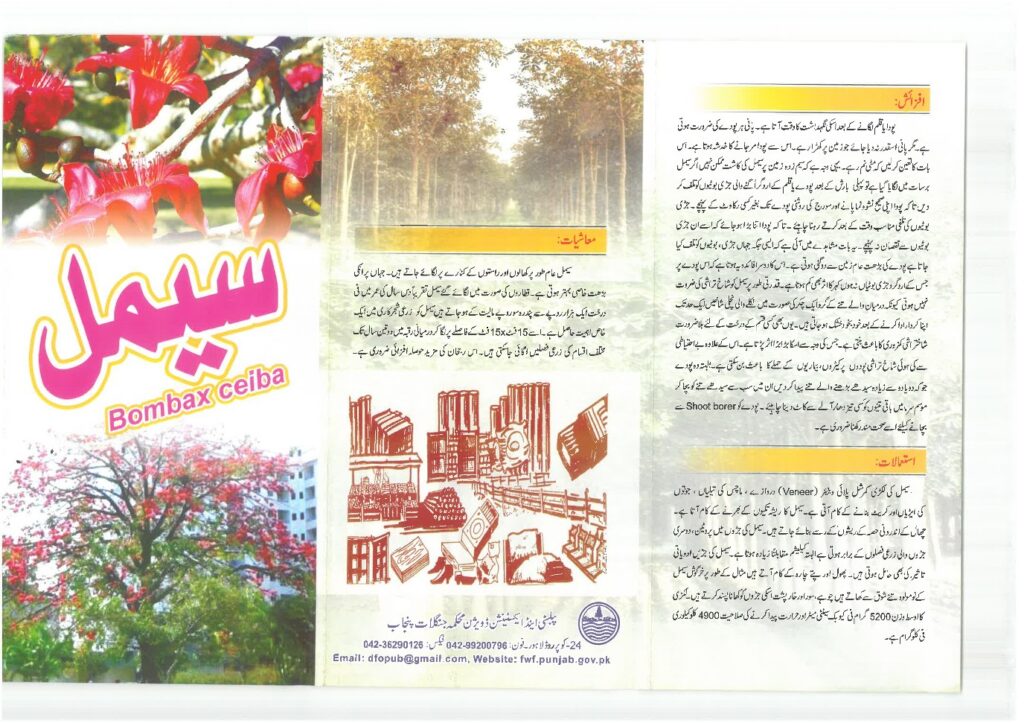
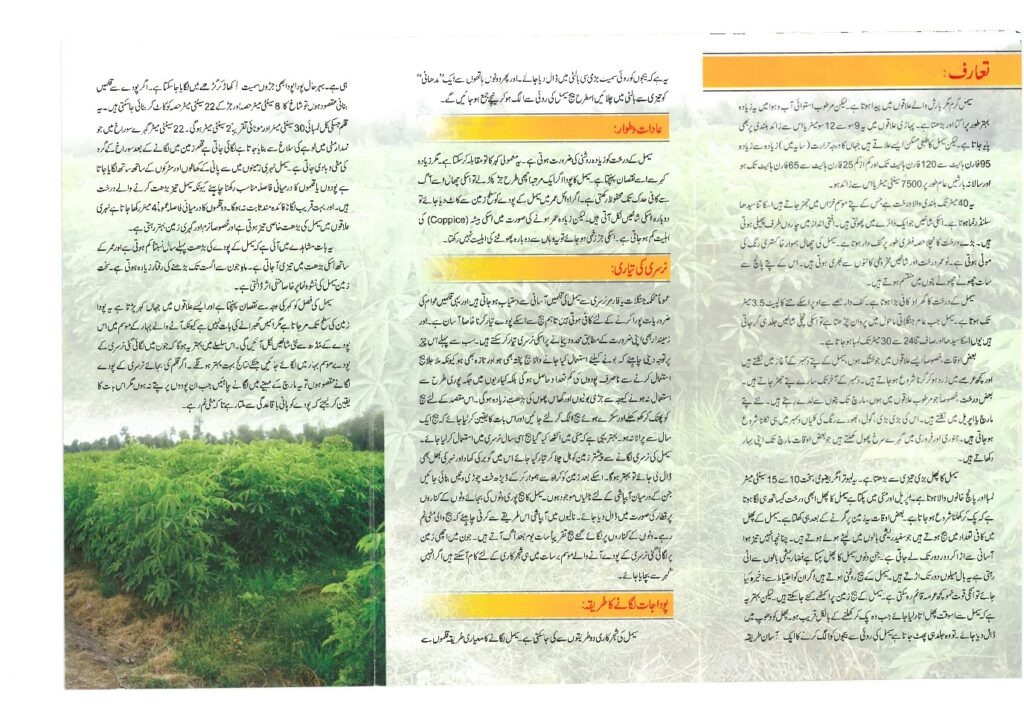
افزائش اور دیکھ بھال کے لیے پودے کو مناسب پانی دینا چاہیے مگر پانی کھڑا نہ رہے، اور جوان پودے کے اردگرد جڑی بوٹیاں صاف رکھنی چاہئیں تاکہ اسے پوری دھوپ ملے۔ کتابچے کے مطابق پودے کو شوٹ بورر (Shoot borer) سے بچانے کے لیے اسے صحت مند رکھنا ضروری ہے۔ سیمبل عام طور پر راستوں اور کھالوں کے کنارے لگایا جاتا ہے۔ اس کی لکڑی وینیر، دروازے، ماچس کی تیلیاں اور جوتوں کی ایڑیاں بنانے کے کام آتی ہے، جبکہ اس کے پھول اور پتے مویشیوں کے چارے کے طور پر بھی استعمال ہوتے ہیں۔ ذیل میں اصل کتابچے کے صفحات دیکھے جا سکتے ہیں۔
Frequently asked questions
Is Bombax ceiba poisonous?
None of the extension or botanical-garden references behind this profile lists the simbal as a poisonous tree, and several of its parts have a long history of traditional use — the flowers are even eaten in parts of Asia. Treat it as what it is, an ornamental and forestry tree rather than a food crop, but there is no recorded toxicity warning to worry gardeners or livestock owners in these sources.
How big do silk cotton trees get?
A typical mature simbal stands 60–75 feet tall (about 20 metres) and spreads 40–60 feet wide, on a trunk two to five feet thick. Exceptional trees in wet tropical conditions grow far larger — 150 feet or more — so always plant it where a genuinely big tree can be accommodated.
Is Bombax ceiba fast growing?
Yes — in a warm, frost-free climate the simbal is a fast-growing tree, which is why it is used so widely for avenues and park planting across the tropics. Growth slows outside its comfort zone, and it will not tolerate frost at all, so the speed only applies where winters stay warm.
Is the silk cotton tree edible?
Partly. The flowers are the edible part in the regions that use them: dried simbal flowers are an ingredient in Thai nam ngiao noodle soup and kaeng khae curry, young flowers go into local recipes, and fallen flowers are gathered for teas and soups in China. The famous “silk cotton” itself is not food — it is a stuffing fibre. That is the reverse of a fruit tree such as the jamun tree, which is planted for what you can pick and eat.
Is the simbal the same tree as kapok?
No. True kapok fibre comes from Ceiba pentandra, a different tree. The simbal’s floss looks and behaves similarly and is often used as a kapok substitute, which is how the shared name stuck — but if a label says kapok, it is describing the fibre’s job, not the simbal’s identity.