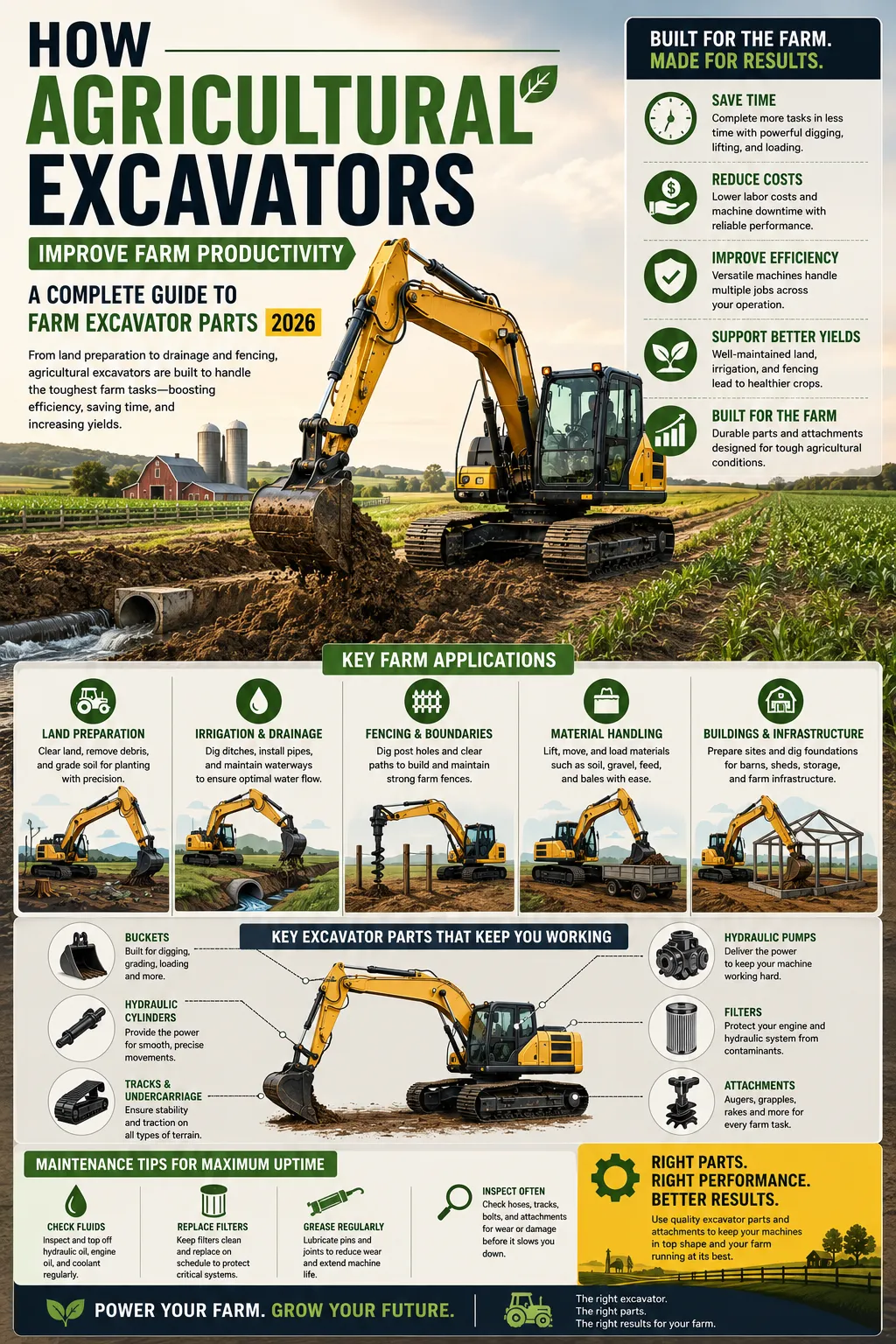
How Agricultural Excavators Improve Farm Productivity – A Complete Guide to Farm Excavator Parts 2026
Introduction: The Hidden Engine Behind Modern Farm Productivity
Walk across any large-scale commercial farm today and you will find something that might surprise you. Alongside the tractors, combine harvesters, and precision irrigation systems that define modern agriculture — you will almost certainly find an excavator.
Once considered exclusively a construction machine, the excavator has quietly become one of the most versatile and valuable pieces of equipment on productive farms worldwide. From digging irrigation trenches and drainage channels to leveling orchard land, constructing farm roads, and managing agricultural waste — Agricultural Excavators handle tasks that no other single piece of farm machinery can replicate efficiently.
But here is the reality that every farm owner eventually discovers: an excavator sitting idle in a field due to a broken component costs far more than the repair itself. When an excavator goes down during land preparation season, planting schedules slip. As drainage work stops mid-project, waterlogging threatens crop yields. When orchard leveling halts, new planting timelines collapse.
This is why partnering with a reliable excavator parts supplier has become as strategically important for modern farms as choosing the right seeds or fertilizers. Uninterrupted access to quality Excavator Parts is not a maintenance detail — it is a core farm productivity decision.
This guide covers everything farm owners and agribusiness managers need to know about agricultural excavators use, spare parts management, and why the right supply chain partnership makes the difference between a productive season and a costly one.
Precision agriculture tools already help farmers make smarter decisions about land use, crop management, and resource allocation.
The Growing Role of Excavators in Modern Agricultural Operations
Beyond Construction — Excavators as Essential Farm Machinery
The agricultural industry’s relationship with excavators has evolved dramatically over the past two decades. Where previous generations of farmers relied on manual labor or basic tractor-mounted implements for earthmoving tasks, today’s commercial farm operations demand the power, precision, and versatility that only a dedicated excavator can provide.
Modern farms use excavators across a surprisingly wide range of essential agricultural tasks:
Land Preparation and Leveling
Large-scale crop production requires precisely leveled fields for uniform irrigation, consistent seed depth, and efficient mechanical harvesting. Excavators equipped with laser-guided grading attachments achieve land leveling accuracy that tractor blades simply cannot match — directly improving crop uniformity and yield consistency across large acreages.
Irrigation Trench and Canal Digging
Efficient irrigation is the backbone of productive farming in both water-scarce and water-abundant regions. Excavators dig irrigation trenches, canals, and water distribution channels faster, deeper, and more precisely than any alternative method — enabling farm irrigation systems to be installed, expanded, or reconfigured with minimal disruption to surrounding crop areas.
Farm Drainage System Installation
Poor drainage is one of the most damaging and persistent problems in large-scale agriculture. Waterlogged soils reduce oxygen availability to roots, create disease-favorable conditions, and make fields inaccessible to farm machinery during critical planting and harvesting windows. Excavators install subsurface drainage pipes, open drainage channels, and retention ponds that protect crop investments across entire farming seasons.
Orchard and Vineyard Establishment
Establishing a fruit orchard or vineyard is a multi-decade investment that begins with precise land preparation. Excavators remove tree stumps, rocks, and deep-rooted vegetation, shape terrain for optimal water drainage, and prepare deep planting rows that give orchard trees and vines the best possible establishment conditions.
Farm Road and Infrastructure Construction
Year-round farm accessibility requires properly constructed internal roads, loading bays, and equipment storage foundations. Excavators build and maintain the infrastructure that keeps farm operations moving regardless of weather conditions.
Agricultural Waste and Pond Management
From lagoon construction for livestock waste management to deepening irrigation reservoirs and clearing drainage blockages — excavators handle the heavy earthmoving tasks that maintain farm environmental compliance and water management efficiency.
Compact vs Standard Excavators — Choosing the Right Machine for Your Farm
Not all agricultural excavators are the same. Farm operations typically work with two main categories:
| Excavator Type | Weight Range | Best Farm Applications |
|---|---|---|
| Compact Mini Excavators | 1 to 6 tonnes | Orchard work, greenhouse drainage, tight vineyard rows, small field irrigation |
| Standard Excavators | 6 to 30+ tonnes | Large field drainage, farm road construction, major land leveling, reservoir work |
| Long-Reach Excavators | 15 to 30+ tonnes | Canal dredging, large drainage projects, wide irrigation channel construction |
For most mixed commercial farms, a compact excavator in the 3 to 6 tonne range provides the ideal balance of power, maneuverability, and ground pressure — capable enough for serious earthmoving work while light enough to avoid damaging field drainage systems or compacting productive topsoil.
Why Excavator Parts Supply Chain Management is a Farm Productivity Issue
The Real Cost of Excavator Downtime on Working Farms
Farm machinery downtime is never just a maintenance problem. On a working farm, every hour of excavator downtime during critical operational windows translates directly into measurable productivity and financial loss.
Consider these real-world agricultural scenarios:
- An excavator breaks down mid-project during pre-planting irrigation trench installation. The planting window is fixed by climate and crop variety requirements. Every day of delay risks missing the optimal planting date — with yield consequences that last the entire growing season.
- A drainage excavation project halts due to a hydraulic component failure during a wet season. Fields remain waterlogged. Tractors cannot enter. Planting is delayed by weeks.
- Orchard land preparation stops when a bucket cylinder fails. The establishment timeline for a new orchard block — a multi-year investment decision — shifts by an entire season.
In each scenario the financial impact of the equipment failure vastly exceeds the cost of the replacement part. This is the fundamental reason why access to a reliable excavator parts supplier is not a procurement afterthought for serious agricultural operations — it is a farm risk management priority.
What Makes an Excavator Parts Supplier Right for Agricultural Operations
Not every Excavator Parts Supplier understands the unique demands of agricultural clients. Farm operations have specific requirements that distinguish them from construction or mining excavator users:
Seasonal Urgency
Agricultural excavator work is often concentrated in specific seasonal windows — pre-planting land preparation, post-harvest drainage work, dry-season irrigation construction. Parts availability during these windows is non-negotiable. An excavator parts supplier with deep inventory and fast fulfillment capability is worth significantly more to a farm operation than a cheaper supplier with long lead times.
Broad Parts Range
Agricultural Excavators are often older, mixed-fleet machines that have been purchased cost-effectively over many years. A supplier capable of covering a wide range of makes, models, and vintage years — from hydraulic seals and bucket pins to swing bearings and track components — provides the fleet coverage that keeps diverse farm machinery operational.
OEM-Equivalent Quality Standards
Agricultural machinery operates in abrasive, wet, and chemically challenging environments. Hydraulic systems are exposed to dust and fine soil particles. Undercarriage components operate in mud, gravel, and rocky terrain. Bucket and arm components experience constant impact and abrasion. Parts that meet or exceed original equipment manufacturer specifications are essential for reliability in these demanding conditions.
Technical Support and Compatibility Guidance
A quality excavator parts supplier provides more than components — they provide the technical knowledge to ensure correct part identification, compatibility confirmation, and installation guidance. For farm maintenance teams without dedicated excavator specialists, this support capability is genuinely valuable.
Competitive Pricing for Agricultural Budgets
Farm operations manage tight equipment maintenance budgets across entire fleets of tractors, harvesters, irrigation systems, and ancillary machinery. An excavator parts supplier offering competitive pricing without compromising on quality helps farm managers allocate maintenance budgets effectively across competing equipment needs.
Komatsu Excavators on the Farm – Why Parts Quality Matters
Komatsu’s Established Presence in Agricultural Earthmoving
Among the excavator brands found on commercial farms worldwide, Komatsu occupies a prominent position. Komatsu excavators have earned their place in agricultural fleets through a combination of proven reliability, fuel efficiency, and the availability of a comprehensive support network — qualities that align closely with what farm operators need from heavy equipment.
Komatsu’s compact and mid-range excavator models are particularly well represented in agricultural applications:
| Komatsu Model Range | Typical Farm Applications |
|---|---|
| PC26MR / PC35MR | Orchard maintenance, vineyard drainage, greenhouse work |
| PC50MR / PC55MR | Mixed farm irrigation, field drainage, small road construction |
| PC88MR / PC130 | Commercial farm drainage, land leveling, large irrigation projects |
| PC200 / PC210 | Major land preparation, reservoir construction, large canal work |
| PC300 / PC360 | Large-scale agricultural infrastructure, major drainage schemes |
Komatsu’s engineering philosophy — emphasizing fuel efficiency, operator comfort, and system reliability — translates directly into lower operating costs and higher utilization rates for farm operations where equipment runs long hours across demanding seasonal work cycles.
The Importance of Quality Komatsu Excavator Parts for Farm Fleet Management
For farms operating Komatsu excavators, the quality of replacement components is a direct determinant of fleet reliability and long-term operating cost. Komatsu Excavator Parts sourced from reputable suppliers fall into two main categories — genuine OEM parts and OEM-equivalent aftermarket components — each with appropriate applications in farm fleet maintenance strategy.
Genuine OEM Komatsu Parts
Original equipment manufacturer components are engineered and manufactured to Komatsu’s precise specifications. For critical systems — hydraulic pumps, final drive motors, control valves, and engine components — genuine OEM parts provide the highest assurance of compatibility, performance, and longevity. Farm operations where excavator reliability is mission-critical often prioritize OEM components for major system repairs.
OEM-Equivalent Aftermarket Komatsu Excavator Parts
High-quality aftermarket components manufactured to OEM-equivalent specifications provide a cost-effective alternative for wear items and maintenance components — undercarriage parts, bucket teeth, seals, filters, and hydraulic hoses. For farm operations managing tight maintenance budgets across multiple machines, premium aftermarket Komatsu Excavator Parts from established suppliers offer meaningful cost savings without compromising on component performance.
Key Komatsu Excavator Parts Categories for Farm Fleet Maintenance
Understanding which components require the most attention helps farm managers build smarter maintenance inventories and supplier relationships:
Undercarriage Components
Agricultural excavators operate in conditions that accelerate undercarriage wear — abrasive soils, rocky terrain, waterlogged fields, and constant track reversals during precision work. Track chains, track shoes, rollers, idlers, and sprockets require regular inspection and proactive replacement to prevent sudden failures during critical farm work periods.
Hydraulic System Components
The hydraulic system is the operational heart of any excavator. Seals, hoses, cylinders, pumps, and control valves are subject to continuous pressure cycling, temperature variation, and contamination risk from agricultural dust and soil. Maintaining a stock of critical hydraulic Excavator Parts — particularly seals and hose assemblies — minimizes hydraulic failure downtime.
Bucket and Attachment Components
Farm excavator buckets and attachments experience constant abrasion from soil, rock, and root material. Bucket teeth, side cutters, wear plates, and pin and bush assemblies are high-turnover wear items that benefit from bulk stocking through an established excavator parts supplier relationship.
Engine and Filtration Components
Agricultural dust environments accelerate engine filter wear and increase the risk of engine contamination. Air filters, fuel filters, oil filters, and coolant system components require more frequent replacement cycles on Agricultural Excavators than on construction site machines — making reliable filter supply an ongoing farm maintenance priority.
Electrical and Control System Parts
Modern Komatsu excavators incorporate sophisticated electronic control systems that manage fuel injection, hydraulic flow, and machine monitoring. Sensors, wiring harnesses, and control modules are increasingly important components in the spare parts planning of farms operating newer Komatsu models.
Connecting Excavator Maintenance to Precision Agriculture and Farm Mechanization
Farm Machinery Reliability as a Precision Agriculture Enabler
The precision agriculture revolution has fundamentally changed what farm equipment reliability means. Today’s data-driven farm operations use GPS field mapping, soil sampling grids, variable rate application systems, and yield monitoring technology to optimize every input across every acre.
But precision agriculture’s sophisticated planning tools are only as valuable as the machinery that executes them. A precision-planned irrigation expansion project depends entirely on the excavator that digs the distribution channels being operational when the installation window opens. GPS-optimized field leveling requires the excavator to be running when the weather and soil conditions align.
Farm equipment reliability — including excavator uptime supported by a dependable Excavator Parts Supplier — is therefore not separate from precision agriculture strategy. It is an essential enabling condition for it.
Understanding farm inputs and their financial impact is central to modern agricultural management. The Agriculture Income Calculator at fasalbachao.com helps farm managers calculate production costs and income projections — providing the financial framework within which equipment maintenance investment decisions make most sense.
Building a Farm Excavator Maintenance Strategy Around Parts Supply
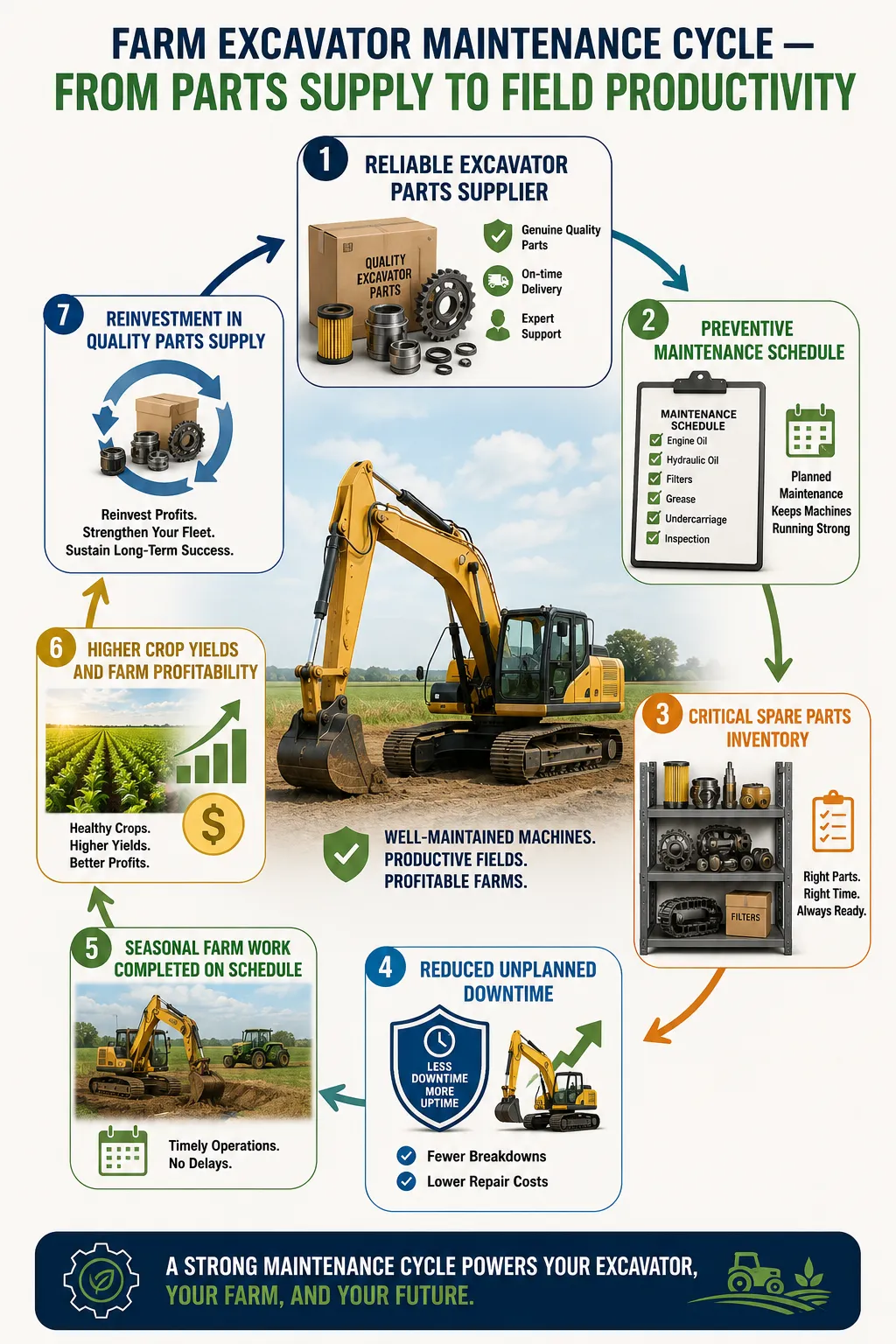
Smart farm managers approach excavator parts supply as a strategic relationship rather than a transactional purchase. Building the right supplier partnership involves:
Preventive Maintenance Scheduling
Rather than waiting for components to fail, professional farm excavator management follows manufacturer-recommended service intervals and proactively replaces wear items before they cause unplanned downtime. This approach requires predictable parts availability — making supplier reliability a core selection criterion.
Critical Spare Parts Inventory
Identify the excavator components most likely to cause operational downtime if they fail during peak agricultural seasons. Work with your excavator parts supplier to maintain a small on-farm stock of these critical items — hydraulic seals, track components, filters, and bucket wear parts — to enable immediate response to unexpected failures.
Supplier Relationship Investment
Farms that invest in developing strong relationships with their excavator parts suppliers gain access to faster response times, better pricing, technical support, and early notification of parts availability issues. Treating your parts supplier as a farm business partner rather than a vendor creates genuine operational resilience.
Fleet Standardization Where Possible
Where farm excavator fleet decisions allow, standardizing on a single manufacturer — such as Komatsu — simplifies parts inventory management, maintenance training, and supplier relationship building. A focused Komatsu Excavator Parts supply relationship is easier to manage and optimize than maintaining parallel supply chains for multiple excavator brands.
Long-Term Farm Economics of Quality Excavator Parts Management
Total Cost of Ownership Thinking for Farm Excavator Fleets
The purchase price of an excavator represents only a fraction of its true total cost of farm ownership. Operating costs — fuel, operator wages, insurance, and most significantly maintenance and parts — determine the true economic efficiency of farm excavator investment over a machine’s working life.
Quality Excavator Parts from a reliable supplier contribute to favorable total cost of ownership through several mechanisms:
| Cost Factor | Impact of Quality Parts Supply |
|---|---|
| Unplanned Downtime | Reduced through faster parts access and preventive maintenance |
| Repair Labor Costs | Lower when correct parts are available immediately |
| Component Longevity | Extended through OEM-equivalent quality standards |
| Secondary Damage Prevention | Quality parts prevent cascading failures from worn components |
| Resale Value | Well-maintained machines with documented parts history command higher resale prices |
| Seasonal Productivity | Maximized when machines are operational during critical farm windows |
Environmental and Sustainability Benefits of Proper Farm Excavator Maintenance
Modern agriculture faces increasing pressure to demonstrate environmental responsibility across all operational dimensions — including equipment management. Well-maintained excavators contribute to farm sustainability goals in measurable ways:
- Properly maintained engines consume less fuel and produce lower emissions per hour of productive work
- Hydraulic system integrity prevents fluid leaks that contaminate agricultural soil and waterways
- Extended machine lifespan through quality parts use reduces manufacturing resource consumption
- Efficient earthmoving operations minimize soil disturbance and compaction beyond target work areas
For farm operations pursuing environmental certification or sustainability reporting — excavator maintenance quality is a genuine contributor to measurable environmental performance metrics.
For farmers looking to optimize every aspect of their agricultural operation — from machinery management to crop planning and resource calculation — the Farm Management Tools at fasalbachao.com provide free, practical calculators covering everything from fertilizer requirements to farm income projections.
Conclusion – Excavator Parts Supply as a Farm Productivity Investment
Modern large-scale agriculture depends on reliable, well-maintained excavators for land preparation, irrigation construction, drainage management, orchard establishment, and farm infrastructure development. These machines are not peripheral equipment — they are operational enablers that directly determine whether critical seasonal work gets completed on schedule or slips into costly delays.
Partnering with a professional excavator parts supplier transforms excavator maintenance from a reactive cost into a proactive farm productivity investment. Consistent access to quality Excavator Parts — whether genuine OEM components for critical systems or OEM-equivalent aftermarket parts for regular wear items — keeps farm excavator fleets operational during the seasonal windows when their contribution to farm productivity is most valuable.
For farms operating Komatsu equipment, the quality and availability of Komatsu Excavator Parts is a specific strategic priority. Komatsu’s widespread agricultural adoption means that a strong Komatsu-focused supply relationship provides predictable, reliable parts access across a broad range of farm excavator models and vintages.
The financial logic is straightforward: the cost of maintaining a reliable excavator parts supply relationship is a fraction of the cost of a single season of excavator downtime during critical farm operations. For forward-thinking farm managers and agribusiness operators, building that supply chain resilience is not optional — it is one of the most practical investments available in modern farm equipment management.