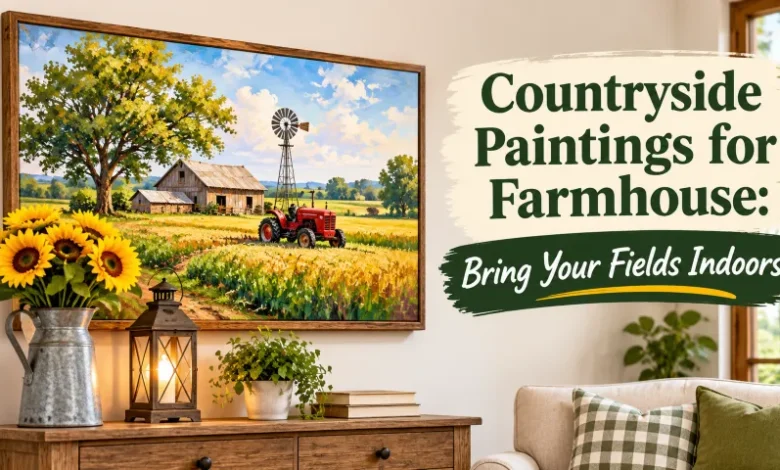
Countryside Paintings for Farmhouse: Bring Your Fields Indoors
Farming families give most of their energy to the land: the crops, the animals, the weather, the seasons. The house where they rest and eat often shows none of it. The walls stay bare, or they carry generic prints that could hang in any apartment anywhere.
Countryside paintings are one of the simplest ways to close that gap. This guide covers how to choose scenes that match your farm, which styles suit a working home, how to size and hang them, and how to look after them in a dusty, humid or smoky farm house.
Why Countryside Paintings Belong in a Farming Home
For many farmers, land is more than a business asset. Agricultural economists describe a deep attachment, sometimes called the “agrarian imperative,” in which a farmer’s identity is closely tied to the land. Research summarized by the American Agricultural Economics Association says this is why losing land can feel like the ultimate loss.
Farming is also demanding. A systematic review of 167 studies on farmers’ mental health found the most-cited pressures were pesticide exposure, financial difficulty, climate variability and drought, and poor physical health or past injuries. Nuffield International’s global report on farmer wellbeing, drawing on field research in seven countries, points to isolation and purpose-driven farming as key themes.
A painting will not solve any of that, and it is not a substitute for support when things get heavy. It can make the place where you recover feel like it belongs to the life you actually live. A harvest scene on the wall says this is who we are before anyone speaks.
What Research Says About Nature Art Indoors
This is where the idea has some evidence behind it. A 2025 study in Frontiers in Psychology used virtual reality and EEG to compare five indoor settings: nature-themed artwork, a blank foreground, an architectural window view, a natural window view, and a green plant wall. The nature artwork:
- significantly lowered systolic blood pressure,
- increased alpha-wave activity, which is linked to relaxed alertness,
- scored higher on restorative evaluations than the blank-wall setting.
It also showed no significant difference from the natural window view or the plant wall. In plain terms, a well-chosen nature painting performed about as well as a real view of nature in that experiment.
Two honest caveats. The rooms were simulated in VR, so real homes may differ. And the study tested artwork in general, not farm scenes specifically. Still, it matches the older findings on window views and fits biophilic design, the idea that people respond well to natural patterns, colors and imagery indoors. Since most of us spend the majority of our time inside, the wall in front of you is worth getting right.
Choosing Scenes That Match Your Farm
The strongest rule is also the simplest: hang what you actually recognize. A painting of your own crop, your own kind of light, your own kind of road will feel earned. A generic meadow will not.
| Farm type | Scene to look for | Palette | Mood |
|---|---|---|---|
| Grain and wheat | Wide harvest field, combine or cart in the distance | Amber, gold, pale blue sky | Abundance, open space |
| Orchard | Blossom rows or ripe fruit under heavy branches | Soft pink, leaf green, warm brown | Renewal, patience |
| Rice or paddy | Terraced or flooded fields at dawn | Silver-green, mist, soft yellow | Calm, rhythm |
| Dairy and livestock | Cattle by a water channel or on pasture | Fresh greens, earthy brown | Warmth, steadiness |
| Vineyard | Vine rows running to the horizon | Purple, olive, dusty gold | Heritage, craft |
| Vegetable and market garden | Raised beds, sunflowers, a farm stand | Bright greens, red, yellow | Energy, community |
| Mixed family farm | A country road lined with old trees | Muted greens, ochre | Home, continuity |
| Coastal and seaweed farms | Rope lines at low tide, harvesters working at dawn | Slate blue, sea green, silver | Tides, patience, resilience |
Not every farm sits on dry land. If your living comes from the shoreline, a harvest scene from the water is just as true to life, and with the commercial seaweed industry now supplying food, fertilizer and even biofuel, it is a story worth hanging on a wall. A scene with a human touch, such as a farmer, a fence, a barn or a distant village, reads as a story rather than scenery. That is usually what a farmhouse wall needs.
Oil, Watercolor or Print? Comparing Your Options
| Option | Look and feel | Best for | Care in a farm home | Budget |
|---|---|---|---|---|
| Oil painting (original) | Rich texture, deep color | Main living room wall | Keep from damp and smoke | Highest |
| Watercolor | Soft, misty, early-morning feel | Bedrooms, quiet corners | Needs glass and no direct sun | Moderate |
| Impressionist style | Loose brushwork, strong light | Dining areas | Fine if still recognizably countryside | Moderate to high |
| Canvas print | Textured, close to paint | Larger walls on a tight budget | Wipe dust gently | Low to moderate |
| Framed paper print | Clean, simple | Gallery groupings, farm office | Use glass or acrylic cover | Lowest |
Realistic or lightly impressionist styles tend to sit best in a working farmhouse. Very abstract pieces can work, but they rarely say “farm” at a glance.
Sizing, Color and Layout
- One statement piece first. Choose a large painting for the main wall above the seating. A common designer guideline is for art to span roughly two-thirds of the furniture width below it.
- Add smaller pieces second. Group two or three smaller paintings on a side wall or beside a window so they support the main piece instead of competing.
- Hang at eye level. Place the center of the artwork about 57 to 60 inches (145 to 150 cm) from the floor.
- Pull colors from the room. Amber in a wheat scene echoes wooden beams. Cooler greens pick up stone floors or painted doors.
- Flank the window. Hanging paintings beside a real window creates a pleasing conversation between the painted field and the actual one.
Frames, Hanging and Light
Skip ornate gilded frames, which belong in a formal drawing room. Raw or lightly waxed wood frames echo ceiling beams, wooden furniture and doors.
Brick and stone walls need proper fixings. Use heavy-duty anchors or a picture rail for larger canvases, and check the wall type before drilling.
Light matters as much as the painting. Soft natural daylight brings out warm tones. Direct sun fades pigments over time, so favor a spot with bright but indirect light, or add a gentle picture light for evening.
Protecting Paintings in a Working Farm Home
Farmhouses are harder on art than city apartments. A few habits help:
- Dust: Keep paintings away from mudrooms, entry doors and dusty work corners. Dust them lightly with a soft dry brush.
- Humidity: Avoid walls with damp patches, especially in monsoon or wet-season regions. Moisture can warp canvases and spot paper.
- Smoke and cooking fumes: Keep pieces out of the kitchen smoke zone, or choose framed prints behind glass there.
- Temperature swings: Avoid hanging directly above stoves, heaters or wood-burning fireplaces.
- Chemical storage: Keep artwork out of rooms where fertilizers, pesticides or fuels are stored, as fumes can affect surfaces and frames.
Where to Find Countryside Paintings
You have several routes, depending on budget and taste. Local artists and regional art fairs are ideal for originals that capture your area’s light and crops. A photo of your own field can also be commissioned as a custom oil or watercolor, which turns the painting into a family record. If you would like to preview styles and palettes before you commit, browsing a curated gallery of rural countryside painting prints is a quick way to see which tones translate well to real interiors.
Beyond the Living Room
Paintings are not only for the family room:
- Farm office: A calm landscape above the desk softens long hours of paperwork and planning.
- Farm stay and agritourism rooms: Guests respond to places that feel rooted in the land. A harvest painting tells the story of your farm before you do.
- Farm shop or tasting room: Local scenes strengthen your brand and make the space memorable.
- Dining area: A pastoral scene near the table connects the meal to where the food came from.
Frequently Asked Questions
What kind of paintings suit a farmhouse best?
Realistic or lightly impressionist landscapes in warm, earthy tones usually fit best, especially scenes of fields, livestock, country roads or harvest.
What size should the main painting be?
For a main wall above a sofa, a large piece of about 80 x 100 cm (roughly 32 x 40 inches) works well. Adjust to the wall and furniture width.
How high should I hang countryside paintings?
Center the artwork about 145 to 150 cm (57 to 60 inches) from the floor, which is roughly average eye level.
Do nature paintings really affect how we feel at home?
A 2025 VR and EEG study found nature-themed artwork lowered systolic blood pressure and produced restorative responses similar to a natural window view. The study was simulated, so treat it as encouraging rather than conclusive.
Can I hang paintings in a humid or dusty farmhouse?
Yes, with care. Choose spots away from damp walls and heat sources, use glass on watercolors and paper prints, and dust gently and regularly.
Should I choose originals or prints?
Both work. Originals add depth and story, while quality prints are practical for larger walls and tighter budgets.
Final Thoughts
Your farm already holds the most beautiful scenes you could ever hang. The aim is simply to bring a piece of them inside, so the home reflects the life being lived in it. Start with one large, well-placed painting of something you recognize, match its colors to your wood and stone, and give it good light. One strong countryside painting will do more for a farmhouse room than a dozen small generic ones.