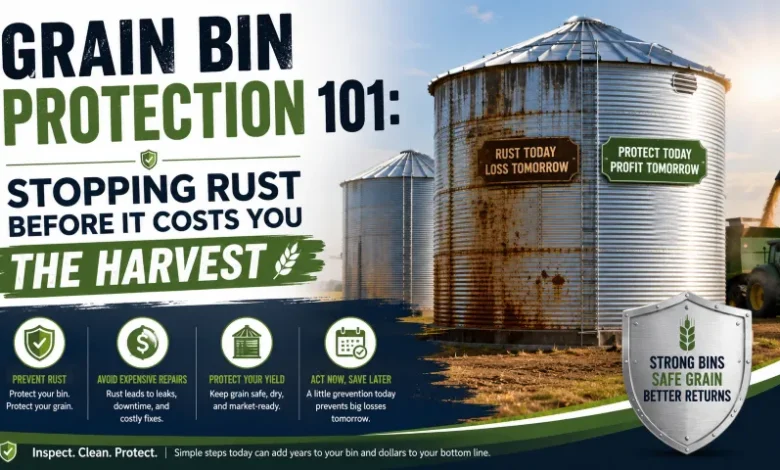
Grain Bin Protection 101: Stopping Rust Before It Costs You the Harvest
Every season, farmers invest months of labor into growing a crop — only to lose a share of it after it is already safely harvested. Not to weather. Not to pests. But to a leaking, corroding storage bin that nobody paid close enough attention to until the damage was already done.
Steel grain bins are one of the most significant infrastructure investments on any farm. Protecting that investment does not require complicated engineering — but it does require understanding what actually causes bins to fail and building a simple routine that stays ahead of the problem.
Why Steel Bins Deteriorate Faster Than Most Farmers Expect
Most grain bins are built from galvanized steel — a material that holds up well for the first several years. Over time the zinc coating that protects the underlying steel wears thin, particularly at seams, bolt heads, and the base ring where water naturally collects. Once bare steel is exposed, oxidation accelerates quickly — especially in humid climates, areas with heavy morning dew, or storage sites near rivers and irrigation canals.
A bin that looks structurally sound from a distance can already have active corrosion developing underneath grain residue, behind ladder brackets, or at points that are simply difficult to inspect during routine walkarounds. By the time a leak becomes visible from inside the bin, the corrosion has typically been progressing for months or years.
Climate significantly affects how quickly this deterioration occurs. In regions with extended monsoon periods or persistent morning condensation, bins can remain wet for several consecutive hours every single day. That repeated wet-dry cycling puts far more stress on steel than a single heavy rainstorm. Bins located near livestock sheds or fertilizer storage face additional challenges — ammonia and salt particles in the surrounding air actively accelerate the corrosion process.
The Most Vulnerable Points on Any Grain Bin
Understanding where bins fail first helps farmers prioritize inspections and preventive treatment effectively.
| Location | Why It Fails | What to Watch For |
|---|---|---|
| Base ring and foundation edge | Water pools here after rain | Rust staining, pitting, soft spots |
| Roof seams and eave area | Condensation collects at transitions | Discoloration, lifted seams, bubbling coating |
| Bolt heads and fastener points | Coating wears thin from expansion and contraction | Orange staining around bolt heads |
| Behind ladder brackets | Trapped moisture — rarely inspected | Rust spreading from contact points |
| Grain residue contact areas | Old grain traps moisture against wall | Pitting beneath residue lines |
Identifying these locations early — before rust penetrates the base steel — is the difference between a straightforward touch-up job and an expensive panel replacement.
Why a Quality Protective Coating Makes Commercial Sense
A properly applied protective coating is the single most effective long-term investment in grain bin longevity. Quality grain bin coatings based on polyurea or polyurethane chemistry form a seamless flexible membrane over the steel surface — sealing seams and fastener points that would otherwise be the first places to fail.
Unlike conventional paint, these coatings expand and contract with the metal rather than cracking during temperature cycles. They also resist the abrasion caused by grain being loaded and unloaded repeatedly across multiple seasons. For bins that are already a decade or more old, a properly applied coating can add many additional years of service life at a fraction of the cost of bin replacement.
The preparation work matters as much as the product itself. Surfaces must be thoroughly cleaned of grain dust, old residue, and loose scale before any coating is applied. Existing rust areas need to be properly treated rather than simply covered over. Reputable applicators typically pressure wash the entire structure, abrade problem areas, and verify moisture readings before starting — because a coating applied over damp or contaminated steel will begin lifting within one or two seasons regardless of product quality. Always confirm cure times before scheduling application around a harvest window — some modern formulations are ready to receive grain again within hours.
Secondary Containment — The Part Most Farmers Overlook
Farmers understandably focus on the visible bin walls and roof — but the ground beneath the structure deserves equal attention. If a bin ever develops a leak, or if runoff from cleaning and fumigation escapes the immediate area, proper secondary containment for grain bins prevents contaminants and grain byproducts from soaking into surrounding soil or reaching nearby water sources.
This consideration is increasingly important as environmental compliance expectations tighten across farming regions worldwide — and it is significantly cheaper to install proper containment before a spill than to manage remediation afterward.
Building a Practical Rust Prevention Routine
Coatings and containment systems work best as components of an ongoing maintenance routine rather than one-time fixes. Farmers who treat grain bin maintenance the same way they treat equipment servicing, with scheduled inspections and prompt attention to minor issues — consistently get significantly more service life from their storage infrastructure. A solid approach to grain bin rust prevention starts with regular inspections, ideally before and after harvest, checking the roof, eave area, and base ring where moisture collects.
Running the numbers on coating an existing bin versus replacing it almost always reveals that preventive maintenance costs a small fraction of replacement on an annual basis, before even accounting for the value of grain protected from spoilage.
A practical maintenance routine looks like this:
| Inspection Point | Frequency | Action if Problem Found |
|---|---|---|
| Full exterior visual inspection | Before and after each harvest | Document and schedule repair within 30 days |
| Base ring and foundation check | After every significant rainfall | Address pooling water and drainage immediately |
| Coating condition assessment | Every 2 to 3 years | Touch up chips and scratches before bare metal oxidizes |
| Vent and aeration fan check | Monthly during storage season | Clear blockages — condensation is a primary rust driver |
| Interior inspection for moisture | At bin opening each season | Investigate source of any condensation or wet spots |
Several habits make a consistent difference regardless of bin age or location.
- Walking the bin site after heavy rainfall to check for foundation pooling takes only a few minutes but catches drainage problems before they become structural ones.
- Cleaning grain residue completely between harvests — rather than leaving old grain against the walls removes the primary moisture trap that drives interior corrosion.
- Addressing small rust spots immediately rather than scheduling them for later prevents what would have been a minor touch-up from becoming a panel-wide remediation.
The Financial Case for Grain Bin Protection & Prevention
Budget is the most common reason farmers delay grain bin maintenance — and it is worth running the actual numbers rather than making assumptions.
Compare the cost of a quality coating application against the current replacement cost of the bin itself. Divide each figure by the realistic additional service life each option provides. In virtually every case the coating delivers dramatically lower annual cost than replacement — and that calculation does not yet include the value of grain protected from spoilage during those additional service years.
A well-maintained, properly coated grain bin also holds substantially more of its resale value if the farming operation ever changes hands. Buyers and lenders notice the difference between a bin that has received consistent preventive attention and one that has been allowed to deteriorate.
Bringing It Together
The difference between a grain bin that provides fifteen years of reliable service and one that delivers forty often comes down to a small number of preventive decisions made consistently over time. Applying the right protective coating, ensuring proper ground containment beneath the structure, and maintaining a simple inspection schedule costs far less than bin replacement — and far less than losing stored crop to moisture damage from a compromised structure.
Grain Bin Protection from rust works best when it is treated as routine farm maintenance rather than a response to visible failure. The earlier a farmer builds these habits into the seasonal calendar, the longer their grain storage infrastructure keeps delivering reliable, cost-effective service.
Fumigation and bin cleaning chemicals require precise dilution to be both effective and safe — the Spray Tank Mix Calculator at fasalbachao.com helps calculate exact product quantities before each application.