Solar Battery Storage for Farms: Systems, Sizing and Safety Guide
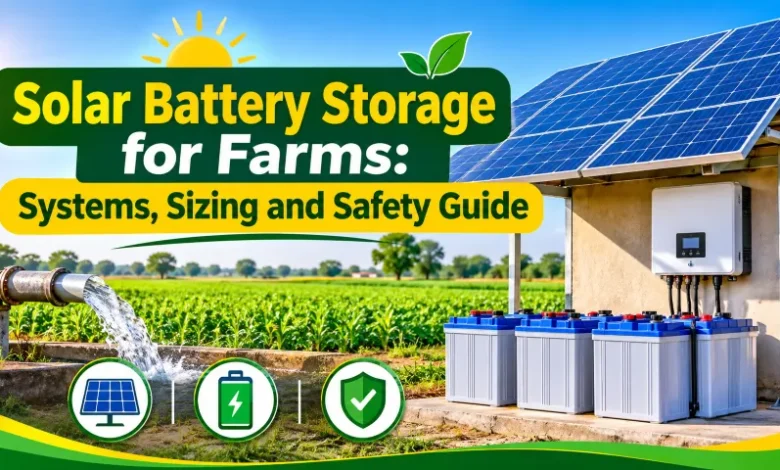
Solar battery storage for farms is a system that stores surplus solar electricity during the day and releases it when the farm needs it: at night, on cloudy days, during peak tariff hours or during a power cut. A typical solar battery storage system pairs solar panels with a battery bank, an inverter and a controller, so irrigation pumps, cold rooms, ventilation fans and lighting keep running without relying on a diesel generator or a weak grid.
This guide explains how battery farm energy storage works, how to size it, which battery type suits agriculture, where it pays off, and how to keep it safe. It is written to be practical and honest, because a battery is a great fit for some farms and an unnecessary expense for others.
Key takeaways
- Start with a load list (kW, hours per day, start-up surge), not a battery brochure.
- Loads that run only in daylight, like many irrigation pumps, often need no battery at all.
- Night-time and temperature-critical loads (cold rooms, poultry ventilation, milk cooling) benefit most.
- Size for both energy (kWh) and power (kW), and allow for motor start-up surge.
- LiFePO4 (lithium iron phosphate) is the most common choice for agricultural battery systems because of its safety and long cycle life.
- Plan site, ventilation, fire safety and maintenance before buying.
What does “battery farm” actually mean?
The phrase is confusing because it is used in several ways:
- Battery storage on a farm: an agricultural business using batteries to manage its own electricity. This is the meaning of this guide.
- Battery farm (energy sense): a large battery installation, often at a utility-scale solar or wind site, that stores power for the grid.
- Battery farming (agriculture, older meaning): an intensive, cage-based animal production system. It has nothing to do with energy storage.
- Biological energy storage: a different question entirely. Plants store long-term energy mainly as starch, animals store it mainly as fat, and animals use glycogen for shorter-term needs.
Solar farm battery storage vs farm battery storage
| Utility-scale solar farm battery storage | On-farm battery storage | |
|---|---|---|
| Main goal | Sell power, support the grid, reduce curtailment | Run farm loads reliably and cheaply |
| Typical size | Megawatt-hours and up | A few kWh to a few hundred kWh |
| Revenue | Energy arbitrage, grid services | Lower bills, avoided diesel, avoided losses |
| Key concerns | Grid connection, market rules | Load profile, surge current, backup |
Some large agricultural sites need both: they export or trade surplus power and also protect critical loads.
How a solar battery storage system works on a farm
A typical battery storage system for a farm includes:
- Solar panels
- A battery bank (usually LiFePO4)
- A hybrid inverter or power conversion system (PCS)
- A battery management system (BMS)
- A controller or energy management system (EMS)
- Grid connection and/or a backup generator
- Protection devices and a main isolator
The daily cycle is simple:
- Panels generate power during the day.
- Farm loads use part of that power directly.
- Surplus charges the battery.
- The battery discharges in the evening, overnight, or during an outage.
Do you actually need a battery?
Farms often overspend by storing electricity for loads that run when the sun is already shining.
| Situation | Best fit | Why |
|---|---|---|
| Pump runs only in daylight | Direct solar pumping plus a water tank | Storing water is cheaper than storing electricity |
| Cold room, milk chiller, incubator | Solar plus battery | Continuous, temperature-critical demand |
| Poultry or livestock ventilation | Solar plus battery, often with generator backup | Night and heat-wave reliability |
| Seasonal heavy loads (grain drying, processing) | Solar plus generator or grid for peaks | Peak power needed only briefly |
| Remote site, no grid | Off-grid solar plus battery bank | No alternative supply |
Benefits of solar battery storage for farms
- Reliable power: critical loads continue through outages.
- Better use of your own solar: less surplus is wasted or exported at low prices.
- Lower diesel use: the generator becomes a backup instead of the main source.
- Peak-demand control: the battery can cover short high-demand periods where tariffs or demand charges apply.
- Room to expand: a battery can act as a buffer when the local grid can’t support new loads.
Calculate your load profile and battery size
Every sizing decision starts with three numbers per device:
- Power (kW): how much it draws while running.
- Energy (kWh): power multiplied by hours. This is what the battery stores.
- Surge: induction motors can draw several times their rated current for a moment at start-up.
Illustrative example (replace with your own numbers):
| Load | Average power | Hours on battery | Energy |
|---|---|---|---|
| Cold room | 1.5 kW | 12 h (night) | 18 kWh |
| Poultry ventilation and lights | 0.8 kW | 12 h | 9.6 kWh |
| Total night demand | 27.6 kWh |
With a 20% reserve and about 90% usable depth of discharge for LiFePO4:
27.6 kWh × 1.2 ÷ 0.9 ≈ 37 kWh of battery capacity
A 3 kW irrigation pump that runs in daylight is powered directly by the solar array, so it adds nothing to the battery requirement. Remember that kWh tells you how long the battery can run a load, while kW tells you whether it can run everything at once.
Choose the right battery for agriculture
| Type | Strengths | Limits | Best for |
|---|---|---|---|
| LiFePO4 (lithium iron phosphate) | Long cycle life, high usable capacity, low maintenance, strong thermal stability | Higher upfront cost | Most farm systems |
| Other lithium-ion (NMC) | High energy density | Needs stricter thermal management | Space-limited sites |
| Lead-acid (flooded/AGM) | Low upfront cost | Shorter life, lower usable capacity, needs upkeep | Small or backup-only setups |
Compare cycle life, depth of discharge, temperature range and warranty, not just price. Heat is the biggest enemy of any battery on a farm, so a shaded, ventilated location extends its life more than almost any other single choice. For a broader look at components, costs and system types, see our complete guide to farm battery storage systems.
Match the inverter to pumps and motors
The inverter converts DC from the battery and panels into AC for your equipment. On farms, check:
- Surge rating, so motor start-ups don’t trip the system.
- Hybrid capability, to manage solar, battery, grid and generator together.
- Protection and cooling suited to dust, heat and humidity.
A soft starter or variable-frequency drive (VFD) on large pumps reduces start-up surge and may allow a smaller, cheaper inverter.
AC-coupled vs DC-coupled:
| AC-coupled | DC-coupled | |
|---|---|---|
| Setup | Battery has its own inverter | Battery connects on the solar side |
| Best for | Adding storage to existing solar | New systems |
| Advantage | Flexible, simple retrofit | Often more efficient |
Common farm applications
- Irrigation. Solar matches daytime pumping well. Add a battery only if you need to irrigate early morning or evening, and size the inverter for pump surge.
- Dairy. Milking machines, milk cooling and cleaning systems need stable power. A battery protects milk quality during outages.
- Greenhouses. Grow lights, heating, cooling and ventilation create high, steady demand, so storage helps shift solar power into the evening.
- Poultry and livestock sheds. Ventilation, lighting and feeding systems are time-critical. If you keep goats, as in our Boer goat farming guide, shed airflow and lighting are part of everyday animal welfare, which makes them a sensible first target for a small battery backup.
- Cold storage and processing. Temperature failure can destroy product value quickly, so this is one of the strongest cases for storage.
- Off-grid and remote farms. Solar, a battery bank, a hybrid inverter and a backup generator form a small microgrid. Size for cloudy periods and seasonal changes in sunlight.
- Agrivoltaics. Panels raised above crops let the same land produce both food and electricity, with a battery storing the surplus for later use.
Larger agribusiness sites and string-based storage
Packhouses, cold-chain hubs, dairies and cooperatives that combine many loads may need commercial-scale storage. Designers at that level often look at architectures such as Smart String ESS, where batteries are organised and monitored in smaller strings with coordinated control instead of one large block. Large sites may also add grid services or energy arbitrage to their business case, but those depend entirely on local market rules, so check them early.
Cut diesel use and track the climate benefit
Replacing generator hours with stored solar lowers fuel cost, noise and emissions. If you also plant windbreaks or orchards, you can estimate the carbon those trees store with our carbon sequestration calculator and see how solar and trees work together toward a lower-carbon farm.
Site assessment and permits
Before buying:
- Collect at least a year of electricity bills and, if possible, daily load data.
- Check your existing wiring, switchgear and grid connection capacity.
- Ask your utility and local authority what approvals, fire-safety rules and grid-connection agreements apply, as they vary widely by country and region.
- Start early, since approvals can take longer than installation.
Safety on the farm
Treat the battery like any other critical infrastructure.
- Location: keep it away from animal housing, fuel stores, and stored hay or straw.
- Environment: shade it, ventilate it, and raise it above flood level.
- Protection: use proper breakers or fuses, a labelled main isolator, and a BMS.
- Fire readiness: keep the area dry and clear of dry vegetation, and fit suitable extinguishers.
- Access: leave room to inspect, isolate and replace components.
For larger installations, the written specification should state the configuration, installation limits, commissioning checks and service responsibilities. A layered safety approach, from cell design through to isolation procedures, is what to look for when reviewing a larger system such as Smart String ESS or any comparable option.
Maintenance plan
- Clean panels and vents regularly, especially in dusty seasons.
- Inspect cables, connectors and enclosures for rodent damage, corrosion and heat marks.
- Update inverter and BMS firmware when the supplier recommends it.
- Keep key spares nearby, since farms are often far from service centres.
- Write down who does each task and what still works if one component is offline.
What affects payback?
Instead of trusting generic savings claims, calculate from your own situation. The main factors are:
- Electricity price and peak/off-peak tariff difference
- Demand charges
- Solar array size
- Battery capacity and daily cycling
- Diesel savings
- Value of outage losses avoided
- Installation and maintenance cost
- Local incentives and export rules
- Battery lifespan
Storage tends to pay back best where electricity is expensive, the grid is weak, diesel use is high, or a single outage could destroy stock or product.
Common mistakes to avoid
- Sizing without load data: guessing kWh leads to oversized or undersized systems.
- Ignoring start-up surge: the inverter must handle motors and compressors.
- Backing up everything: separate critical loads from non-critical ones to control cost.
- Ignoring the environment: dust, heat, humidity and flooding all matter.
- Forgetting growth: you may add a borehole, a bigger cold room or electric machinery. As electric tractors become the next big shift in agriculture, farms with solar and storage will already have part of the charging infrastructure in place. Ask for the upgrade path in writing.
Frequently asked questions
In energy terms, battery farms are installations that use large battery banks to store electricity and release it when needed. On an agricultural site, the term usually means a farm using battery storage to support solar power, backup power, irrigation or cold storage.
It is a battery system that stores electricity from solar panels and releases it when solar output is low, prices are high, or the grid needs support. On a working farm, it also powers irrigation, greenhouses and cold rooms.
It usually includes battery packs, an inverter or PCS, a BMS, a controller, protection equipment and grid-connection hardware.
Plants store long-term energy mainly as starch, and animals store it mainly as fat. Animals use glycogen for shorter-term energy. This is biological storage, which is separate from battery storage.
Yes, through peak shaving, using more of your own solar, and reducing diesel and grid purchases. The size of the saving depends on your tariffs and load profile.
LiFePO4 is widely chosen for its safety, long cycle life and low maintenance.
Not if the pump only runs in daylight. Direct solar pumping with a water tank is usually cheaper. Add a battery only for early-morning or evening pumping, and size the inverter for start-up surge.
Often yes, but it needs a larger solar array and battery for cloudy periods, and many farms keep a generator as a last-resort backup.
Most LiFePO4 batteries are rated for several thousand charge cycles. Real life depends on depth of discharge and temperature, and heat shortens battery life.
It depends on daily energy use, peak power, backup duration, solar size, tariffs and which loads are critical. Start with a load list and the sizing example above.