AIDC Infrastructure: Planning Power and Cooling Needs for Farm Regions
What Is AIDC Infrastructure and Why Should Agriculture Care?
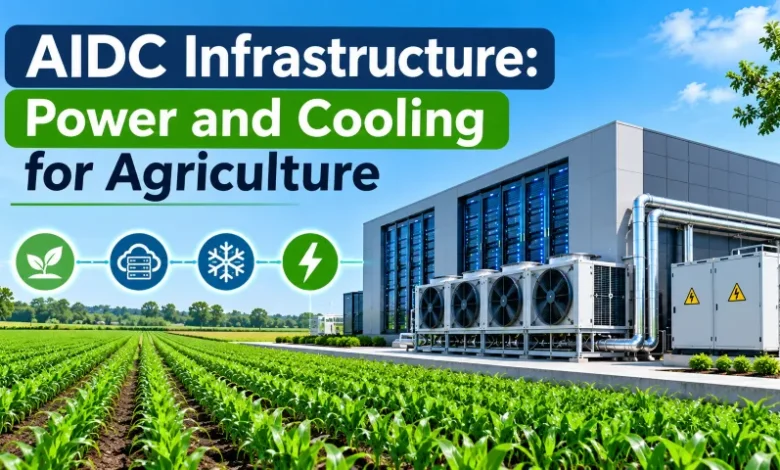
AIDC infrastructure is the power, cooling and building systems that keep an AI data center running, and agriculture should care because those systems draw on the same electricity and water that farms and nearby towns depend on. The International Energy Agency projects that data center electricity demand will more than double by 2030 to around 945 terawatt-hours, up from 415 in 2024, with AI-focused sites growing fastest.
Scale explains the concern. A conventional data center uses roughly 10 to 25 megawatts, while a large AI-focused site can reach 100 megawatts or more, which the agency compares with the yearly use of 100,000 households. Sites of that size are expanding into farming regions, where they share wells and power lines with growers.
Farmers sit on both sides of this story. AI is already working in the field, from AI weed control in sugarcane to the wider changes described in how AI is transforming agriculture and food production in 2026, and that software has to run somewhere. The same facilities can also help growers, because heat that a server hall would otherwise waste can warm a greenhouse and support year-round production.
How Much Power Does an AI Data Center Need?
An AI data center needs enough power for its peak demand plus losses and growth, and the most reliable way to size it is a load forecast built rack by rack. Rack density is the starting figure: the average rack still draws around 15 kW, but AI racks are pushing 60 to 120 kW.
Separate the workloads before adding them up. Training clusters and inference servers load the power system differently, so one blended number can hide the real peak. This is the same shift described in from AI for gaming to smart farming, where the hardware behind the AI decides what a farm-side service can afford to run.
Then follow the power path. Utility power arrives at a substation, passes through UPS battery systems that ride through short interruptions, and only then reaches the racks. Each stage loses some energy, so size the chain for peak demand at the end of the build plan and not for the first day’s load.
Why Is Cooling the Hardest Part of AIDC Planning?
Cooling is the hardest part of AIDC planning because AI accelerators concentrate far more heat in each rack than air can carry away. Current AI racks sit around 120 to 130 kW, while published sources put the practical upper limit for air cooling somewhere between 20 and 50 kW per rack.
Air cooling relies on fans, careful airflow and a sealed hot aisle, and it works well for ordinary racks of 10 to 20 kW. Beyond that, designers add rear-door heat exchangers as a bridge and then move to liquid cooling, which can handle 100 kW or more per rack.
Water enters the picture here. Evaporative cooling removes heat by evaporating water, so it trades electricity for water, which matters in farming regions. One agricultural analyst notes that closed-loop systems can sharply reduce water consumption, which is why the cooling choice is also a water decision.
| Cooling approach | Typical power per rack | Where it fits |
|---|---|---|
| Air with aisle layout | About 10–20 kW | Ordinary servers and small sites |
| Rear-door heat exchangers | About 25–40 kW | Transitional racks |
| Direct liquid cooling | About 60–150+ kW | Dense AI training and inference |
How Do AI Data Centers Affect Farm Water and Electricity?
AI data centers affect farms mainly through local water use and electricity costs, and the effect is strongest in rural areas where wells and power lines are shared. A typical data center may use about 300,000 gallons of water a day for cooling, while a hyperscale site can use as much as 5 million gallons a day.
Agriculture still uses far more water overall, but one large user beside farms can create real local pressure, particularly in a drought year when wells are already stressed. Electricity matters as well, because producers should watch the local tariff as new facilities add demand to the network.
Those pressures reach beyond the farm gate. Cold stores, pumps and processing plants all need steady power and water, which is why agricultural supply chain resilience now includes the neighbours on the same grid. A site survey should record well levels, drought history and nearby irrigation, and the plan should include separate metering for water and power so any shared impact can be measured.
| Resource | Question to ask the operator | Risk if ignored |
|---|---|---|
| Cooling water | What is the daily draw in peak summer? | Local wells and irrigation compete |
| Power | What is the planned peak, and who pays for upgrades? | Higher costs for nearby users |
| Land and access | Where will pipes, lines and roads run? | Disruption to farm operations |
Can Data Center Waste Heat Help Farms?
Data center waste heat can help farms by warming glasshouses, and several European projects are already doing it. In northern Sweden, a pilot sent about 500 kW of heat from a data container into a 300-square-meter glasshouse and grew vegetables through winter at minus 30 degrees Celsius.
For Denmark, a new campus will warm glasshouses built on adjacent land, with the first phase due in the third quarter of 2028, so heat supply and growing area expand together as a phased build. In the Netherlands, dozens of growers will share a heat network fed by residual heat from a data center, which receives cool water back for its servers.
Capturing usable heat is easier with liquid cooling, because a warm coolant loop carries heat in a form a heat exchanger can use, while good containment keeps hot and cold air from mixing in air-cooled halls. Commissioning should test the heat link as carefully as the servers, since a glasshouse depends on it.
How Do You Plan AIDC Power and Cooling Step by Step?
To plan AIDC power and cooling, estimate peak demand first, match cooling to power per rack, confirm the utility connection and water source, and then build in stages with a service plan from day one.
- Estimate peak demand from the planned racks and add room for growth.
- Visit the site and check wells, soil, flood history and the distance to the substation.
- Apply early for the grid connection and permitting, and talk with the local council about water and power disclosure.
- Match cooling to power per rack: air below about 20 kW, liquid above it.
- Choose modular blocks that can be added as demand grows, and retrofit an existing building only after confirming it can carry the power and cooling.
- Install monitoring for power, temperature and water, and keep spare parts for pumps, fans and filters on site.
Treat each step as a gate. If the water source or the utility connection is not confirmed, the build waits, because those two items are the hardest to fix after construction starts.
What Technical Checks and Service Plans Keep an AI Data Center Running?
An AI data center stays running through redundancy in power and cooling, regular service of every critical part, and a plan for the first outage and not the last. Redundancy means a duplicate path so that one failed component does not stop the hall.
One vendor’s published AIDC framework organises design around three goals: reliable, agile and sustainable. It also says AI-assisted upkeep can spot faults early, so teams prevent problems and do not just react to them. The same page claims that traditional builds take 18 months or more and that its battery-backup efficiency can reach 99.1% in one operating mode. Treat those as vendor figures to verify in a contract, not as guarantees.
If the site sells surplus heat to growers, the service plan must also cover the district heating connection and any chilled water return, because a fault there affects both the data center and the farm.
Can Air Cooling Handle AI Workloads?
Air cooling handles AI workloads only at low density; beyond roughly 20 to 50 kW per rack, direct-to-chip systems that mount a cold plate on each processor take over. Many sites use both, with air for ordinary racks and liquid for the dense AI rows.
Do Data Centers Really Compete With Farms for Water?
Data centers can compete with farms for water, mainly where groundwater is already declining and a large site sits near irrigated land. Agriculture uses more water overall, but a single user can strain local aquifers, and closed-loop cooling plus local rules can reduce the pressure. Farmers are advised to take part in local water decisions before a new site secures its supply.
Should Farmers Worry About Data Center Power Demand?
Farmers should watch data center power demand, because rising load can raise costs and crowd local networks, though the risk depends on how the local utility plans. Rural electric cooperatives have raised data center growth as a pressure point and asked for expanded loan programs. Ask operators whether they use predictive maintenance, since catching faults early keeps shared power supplies steadier.