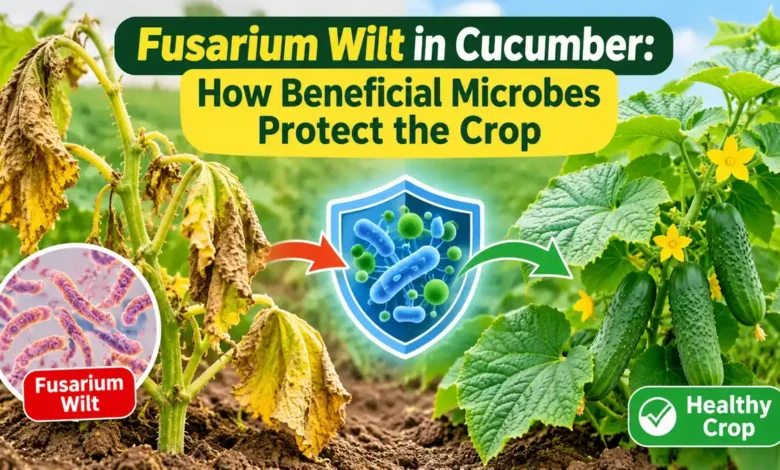
Fusarium Wilt in Cucumber: How Beneficial Microbes Protect the Crop
Why cucumber plants wilt even in wet soil
Fusarium wilt in cucumber is caused by a soil fungus that blocks the plant’s water pipes from inside, so the crop wilts even when the soil is moist and well watered. The pathogen, Fusarium oxysporum f. sp. cucumerinum, enters through the roots and grows upward through the xylem, the vessels that carry water from root to leaf. Once those vessels are colonised, no amount of irrigation can push water past the blockage.
This is why Fusarium wilt frustrates growers more than most cucumber diseases. The plant can look healthy for weeks, then yellow, wilt and collapse just as fruiting begins and water demand peaks. Because the infection sits underground and inside the stem, it cannot be sprayed away. The realistic defence is to stop the fungus reaching the xylem in the first place, and that is where beneficial microbes come in: living fungi and bacteria that occupy the root zone, attack the pathogen and prime the plant’s own defences before infection starts.
The pathogen behind Fusarium wilt in cucumber
The cucumber wilt fungus is a host-specialised form of Fusarium oxysporum, and that specialisation matters for control. Other forms of the same species attack melon, watermelon, bottle gourd and bitter gourd, while f. sp. cucumerinum is the one adapted to cucumber. Three races of it have been reported, which is why a variety resistant to one race is not automatically resistant to another.
Between crops, the fungus survives in soil as thick-walled resting spores called chlamydospores, and in infected plant debris. Extension sources describe this survival simply as “long periods”, and published reports on Fusarium wilt pathogens put it well over a decade, which is why the disease keeps returning to the same fields. It spreads mainly in infested soil: on machinery and tools, through tillage, in flood and irrigation water, and over long distances in infected transplants. Seed can also carry it, usually as contamination on the seed coat, one route covered in our guide to seed borne diseases and their control.
The disease is worst in warm, light, sandy and slightly acidic soils, with peak severity at soil temperatures of roughly 25–28 °C. Liming an acidic soil up to pH 6.5–7.0 can reduce it. Within a season there is little plant-to-plant spread: Fusarium wilt is essentially monocyclic, building up from soil inoculum season after season rather than racing through the crop.
Signs of Fusarium wilt in cucumber
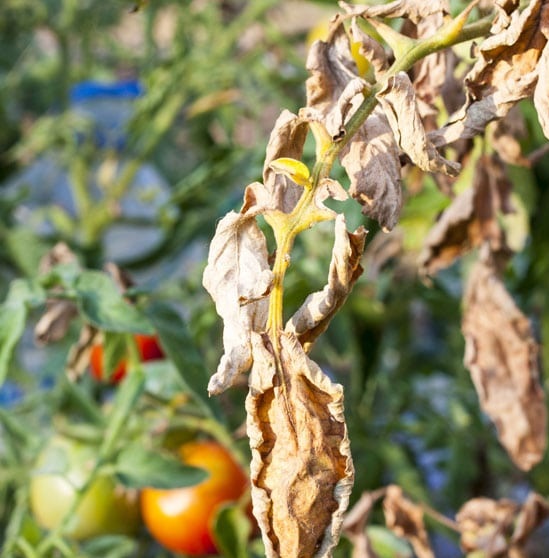
Fusarium wilt can strike at any growth stage, but its signature is a plant that wilts in the heat of the day despite wet soil, then dies within days. In seedlings, infection of the stem base causes damping-off before or just after emergence. In older plants the pattern is slower and easier to miss.
- Yellowing starts in the older, lower leaves and moves upward as the blockage grows.
- Plants may show nothing until fruiting begins, then wilt rapidly when water demand peaks; once wilting starts, death can follow in 3 to 5 days.
- Cut the lower stem lengthwise and the water-conducting tissue shows a brown discolouration, the most reliable field sign.
- The roots stay comparatively intact: root rot is not part of this disease, which separates it from the true root rots below.
- After the plant dies, a white mat of fungal growth may appear on the stem surface in humid weather.
One lookalike deserves a warning. A different form, F. oxysporum f. sp. radicis-cucumerinum, causes Fusarium stem and root rot of greenhouse cucumber, a rotting disease rather than a vascular wilt. The two are managed differently, so a firm identification is worth getting before money is spent.
Other soil-borne problems that look similar
Several soil-borne problems produce wilting, collapse or fruit damage in cucumber, and each has a different cause and weak point. The table below separates the main ones; our overview of soil-borne pest management covers the wider underground threat list.
| Problem | Cause | Key sign | Favoured by |
|---|---|---|---|
| Fusarium wilt | Fungus (F. oxysporum f. sp. cucumerinum) | Wilt in wet soil; brown vessels in the lower stem; roots intact | Warm soil (about 25–28 °C), light acidic soils |
| Pythium damping-off and root rot | Water moulds (Pythium spp.) | Seed rots in the soil; water-soaked stems; seedlings topple at the soil line | Wet, poorly drained soil; cool, wet conditions at emergence |
| Rhizoctonia damping-off and belly rot | Fungus (Rhizoctonia solani) | Seedlings collapse; fruit resting on soil rot on the contact side (belly rot) | Warm, humid weather |
| Phytophthora root, crown and fruit rot | Water mould (Phytophthora capsici) | Whole plant collapses; soft, water-soaked fruit lesions with white growth | Heavy rain, standing water, soil splash |
| White mold (Sclerotinia) | Fungus (Sclerotinia sclerotiorum) | Water-soaked stem lesions, white cottony growth, then hard black sclerotia | Humid conditions; survives as sclerotia in soil and debris |
| Root-knot nematodes | Microscopic roundworms (Meloidogyne spp.) | Swollen knots (galls) on roots; stunted, yellow, wilt-prone plants | Warm soils; common under greenhouse production |
The last row interacts with the first. Fusarium enters readily through root wounds, including the feeding damage of root-knot nematodes, so heavy nematode pressure and Fusarium wilt often compound each other in the same crop.
Why fungicide sprays disappoint
Fungicides cannot cure Fusarium wilt, because the fungus lives deep inside the plant’s water vessels where sprays cannot reach. Tellingly, the Pacific Northwest Plant Disease Management Handbook, a standard extension reference, lists no chemical control at all for cucumber Fusarium wilt: its management section is cultural practices plus biological products only. Extension experts give the same reason: wilt pathogens reside inside the tissue, and fungicides can only protect tissue they contact before infection, never rescue a colonised plant.
An infected plant is therefore a source of inoculum, not a patient. It should be pulled out and destroyed away from the crop, not composted. This hard fact shapes everything that follows: practical guides to fusarium wilt treatment in cucumbers are really guides to prevention, and prevention is exactly what beneficial microbes are built for.
How Trichoderma guards the root zone
Trichoderma fungi protect cucumber roots by attacking the pathogen directly, occupying the root surface first, and switching on the plant’s own defences. The best-studied species is trichoderma harzianum, the active ingredient in many commercial biofungicides; our separate guide to Trichoderma harzianum uses, strains and products covers its wider crop uses. Its recognised mechanisms are:
- Mycoparasitism: Trichoderma grows toward the target fungus, coils around its hyphae and secretes enzymes, chitinases, β-1,3-glucanases and proteases, that dissolve the pathogen’s cell walls.
- Competition: it colonises the rhizosphere and root surface fast, taking the space and nutrients Fusarium needs to reach the root.
- Antibiosis: it releases antifungal compounds, including peptaibols and gliotoxin, that suppress pathogen growth around the root.
- Induced resistance: signals from root colonisation prime the plant’s defence system, so infection attempts meet a prepared response; treated cucumber seedlings show measurably higher defence-enzyme activity and root vigour.
Note what this means in practice. Trichoderma is a living shield that has to be in place on the root before Fusarium arrives. Applied after a plant is already wilting, it has nothing left to protect.
Bacillus and Pseudomonas: the bacterial partners
Bacillus and Pseudomonas bacteria protect cucumber roots mainly by chemical warfare at low doses, iron starvation of the pathogen, and induced resistance. The model strain Bacillus amyloliquefaciens FZB42 devotes nearly a tenth of its genome to antimicrobial compounds, chiefly the lipopeptides bacillomycin D and fengycin, plus a siderophore that locks up iron. Because these compounds occur at low levels around real roots, researchers judge that their main field effect is triggering induced systemic resistance in the plant rather than poisoning the fungus outright.
Pseudomonas fluorescens works the same border differently: the best-performing isolate in one research programme also produced the most chitinase (the enzyme that attacks fungal walls) and the most siderophores, combining enzyme attack with iron competition. Both bacterial groups also promote growth directly; one cucumber-rhizosphere Bacillus strain produced the growth hormone IAA and solubilised phosphate while it antagonised the pathogen. These dual effects are one reason biopesticides help restore soil health beyond the single disease they target.
What the trials actually measured
Measured trial results show beneficial microbes can cut cucumber Fusarium wilt by half or more, but the numbers depend heavily on strain, formulation and setting. The table reports each result with the conditions it was measured under; pot and greenhouse figures are not promises of field performance.
| Treatment | Setting | Measured result |
|---|---|---|
| T. harzianum at 10⁶ cfu/g | Pot experiments | 83.98% control of wilt at seedling stage and 70.08% at adult stage; yield 50.19% above the infected control (Lian et al., 2023) |
| T. harzianum SQR-T037 in fermented organic fertiliser | Pot experiments | Disease index held to 0–8.9%, versus 25.6–78.9% for a plain spore suspension: the carrier changed the result (Huang et al.) |
| B. amyloliquefaciens Z2 + T. harzianum T22 in bio-organic fertiliser | Field trial | Disease index down 51.54% and yield up 21.02% versus the control (Luo et al., 2026) |
| P. fluorescens Pf6, seed + soil treatment | Field, two seasons | Lowest wilt incidence of all treatments: 10.0% and 13.33% across the two seasons (Punjab Agricultural University trials, 2025) |
| B. amyloliquefaciens B2, alone and with Pleurotus ostreatus P5 | Pots, 60 days | Wilt incidence cut 48.1% by B2 alone and 63.0% by the combination (Frontiers in Microbiology, 2021) |
| B. subtilis SQR9 | Greenhouse | Wilt incidence reduced by 49–61% through root colonisation (Cao et al., 2011) |
Two honest cautions belong with these figures. First, a 2026 review of Trichoderma commercialisation found its performance still varies with strain, host, environment and farm practice, so results are inconsistent across regions. Second, the Pacific Northwest handbook lists the registered biological products for this disease but states plainly that their efficacy in that region is unknown. Treat biocontrol as a strong layer of protection, not a guarantee.
How to apply beneficial microbes
Beneficial microbes only work if they are alive, established on the root and in place before the pathogen attacks. Formulated products such as HarzShield fungicide and other Trichoderma and Bacillus biofungicides are therefore used preventively, delivered to the seed and soil rather than sprayed on leaves. Extension listings for cucumber Fusarium wilt show the standard pattern:
| Product type (example) | Labelled delivery | Timing pattern |
|---|---|---|
| Trichoderma (RootShield WP) | Greenhouse soil drench at 3–8 oz/100 gal, or in-furrow spray at 16–32 oz/acre | At planting, before infection |
| Bacillus amyloliquefaciens D747 (Double Nickel LC) | Banded soil spray or drench | Repeated at 2–4 or 4–6 week intervals |
| Bacillus product (Stargus) | Soil drench | Repeated every 10–21 days |
| Bacillus product (Taegro 2) | Drench, in-furrow at planting, or through drip irrigation | From planting onward |
Rates above are examples from US extension listings; the label of the product in your hand always governs. The habits that separate successful programmes from wasted money are consistent:
- Combine seed treatment with a soil application. In the strongest field programmes found, neither alone won; the pairing did.
- Repeat through the season. Labelled intervals run from 10 days to 6 weeks; a single application at sowing is not the labelled pattern.
- Check compatibility before tank-mixing. Products that kill microbes, including oxidising sanitisers such as hydrogen peroxide and peracetic acid, must never be tank-mixed with living biocontrol products, and fungicide mixes need a label check first.
- Store products cold and in date. Living products lose viability at room temperature over time; refrigerated storage in the original container protects shelf life.
Grafting, resistant varieties and clean practice
Microbes work best as one layer in an integrated programme, alongside grafting, matched resistance and strict sanitation. Grafting is the strongest single partner: cucumber grafted onto figleaf gourd (Cucurbita ficifolia) rootstock shows enhanced resistance to this pathogen, and figleaf gourd outperformed seven commercial pumpkin rootstocks in a 2025 evaluation, protecting the scion with a stronger antioxidant defence response. Squash hybrid rootstocks (C. maxima × C. moschata) are the standard commercial alternative used against Fusarium wilt across cucurbits.
Resistant varieties help only when matched to the race present, and three races are reported, so local diagnosis matters more than the word “resistant” on a seed packet. Crop rotation, often the first suggestion, is the weakest tool here: extension guidance considers rotation ineffective for cucumber Fusarium wilt, because chlamydospores outlast any practical break from the crop. The remaining practices are unglamorous and effective: use clean, disease-free transplants, never move soil from infested fields, wash soil off equipment between fields, and solarise infested soil under clear plastic over wet ground for 4 to 6 weeks of hot weather to cut inoculum down. These basics sit inside the wider vegetable diseases and their management programme the rest of the crop needs anyway.
Building a disease-suppressive soil
A disease-suppressive soil keeps Fusarium wilt low even when the pathogen, a susceptible crop and suitable weather are all present, and that suppression is microbial. Research on suppressive soils credits the resident microbiota, acting through competition, antibiosis, parasitism and induced resistance, with genera such as Bacillus, Pseudomonas, Paenibacillus and Streptomyces doing much of the work. In other words, the applied products in this article are reinforcing a defence that healthy soils already run.
Farm practice can build that background defence. A review of compost studies found disease suppression in over half the cases examined, and in one pot experiment a high-cellulose vegetable-waste compost cut the cucumber Fusarium wilt severity index from 3.0 in the infected control to 1.1 while more than doubling shoot weight. Organic amendments feed the same microbial community that work on natural plant compounds and the soil microbiome is learning to steer deliberately. Suppressive soil is a seasons-long project, not a product, but it is the layer that makes every other measure in this article work better.
Frequently asked questions
Can beneficial microbes cure a cucumber plant that is already wilting?
No. Once Fusarium has colonised the xylem, neither microbes nor fungicides can reach it or reopen the vessels. Remove the wilting plant and destroy it away from the crop, then protect the remaining plants and the next crop preventively.
How long does Fusarium wilt survive in soil?
For many years. The fungus persists as chlamydospores in soil and debris; extension sources say “long periods”, and published reports on Fusarium wilt pathogens describe survival well over a decade, which is why short rotations fail against it.
When should Trichoderma be applied to cucumbers?
Before infection, starting at seed or transplanting. Seed treatment plus a soil drench or in-furrow application at planting, repeated at the labelled interval, is the pattern behind the strongest trial results; a first application to an already-wilting crop is too late.
Can Trichoderma be mixed with fungicides or sanitisers?
Only with a label check, and never with oxidising sanitisers. Hydrogen peroxide and peracetic acid products kill the living organisms in biocontrol products, and some fungicides do the same; Cornell’s biocontrol guidance is to confirm compatibility and storage conditions with the label or manufacturer before mixing.
Sources
Pacific Northwest Plant Disease Management Handbook, Cucumber — Fusarium Wilt (pnwhandbooks.org). Lian et al., Scientific Reports (2023), doi.org/10.1038/s41598-023-44296-z. Luo et al., Plants (2026), doi.org/10.3390/plants15050782. Pseudomonas fluorescens field trials, Indian Journal of Agricultural Sciences (2025), doi.org/10.56093/ijas.v95i9.150802. Frontiers in Microbiology (2021), B. amyloliquefaciens B2 study. APS Fusarium wilt plant pathology lesson (apsnet.org). Frontiers in Plant Science (2023), Fusarium-suppressive soils review. Cornell IPM Biocontrol Bytes, guidance on living-microbe biopesticides.