Canna / گلِ عقیق

Canna (Canna indica) — Complete Growing Guide
Although Canna is a perennial plant it performs significantly better during warm summer months. It can be propagated year-round through rhizome division and offsets — making it one of the easiest ornamental plants to multiply on a large scale.
In Pakistan, it is usually planted in February to March. Mostly varieties grown in Pakistan are Alaska, Annaeei, Aphrodite, Amundsen, Lenape and Phasion
Water Requirements
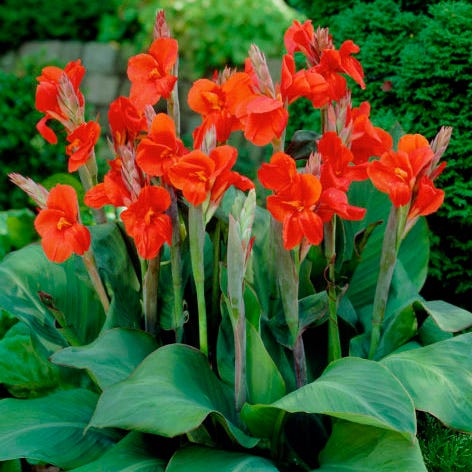
Canna is a moisture-loving plant that thrives near water features, ponds, canals, and stream banks. It is commonly used as a large specimen plant for landscaping along water edges — its bold tropical foliage and striking red and yellow flowers create dramatic visual impact in garden borders, parks, and public landscapes.
Light and Planting Position
For best flowering results Canna should be planted in the ground rather than containers. It requires full sun exposure — a minimum of 6 to 8 hours of direct sunlight daily. Plants grown in shade produce abundant foliage but significantly fewer flowers. Waterside or consistently moist locations produce the most vigorous growth and longest flowering season. Bed planting is preferable for Canna. Row to row distance should be 12 inches minimum and Bulb to bulb distance should be 9 inches with planting depth at 3 inches.
Plants should be hoed when gain 6 inches height & should be earthed up.
Landscape Uses
Canna’s large bold leaves and tall flowering stems — reaching 1 to 2.5 meters depending on variety — make it ideal for:
- Back-of-border planting in mixed flower beds
- Screening and privacy plantings
- Pond and water garden margins
- Tropical-themed garden designs
- Large container growing on patios and terraces
Rhizome Division and Propagation
Canna is propagated by dividing the underground rhizomes — fleshy horizontal stems that store energy and produce new growth. Divide rhizomes in early spring before new growth begins. Each division must have at least one healthy growing eye (bud) to develop into a new plant successfully.
| Propagation Method | Best Time | Success Rate |
|---|---|---|
| Rhizome division | Early spring | ⭐⭐⭐⭐⭐ Excellent |
| Seed propagation | Spring — after scarification | ⭐⭐⭐ Moderate |
| Offsets from parent plant | Throughout growing season | ⭐⭐⭐⭐ Good |
Popular Varieties Worldwide for Garden Use
| Variety | Height | Flower Color | Special Feature |
|---|---|---|---|
| Canna ‘Tropicanna’ | 1.5–2m | Orange | Stunning bronze-striped foliage |
| Canna ‘Wyoming’ | 1.5m | Orange | Deep burgundy leaves |
| Canna ‘Pretoria’ | 1.8m | Orange | Green and yellow striped leaves |
| Canna ‘The President’ | 1.2m | Red | Classic red — most widely grown |
| Canna ‘Lucifer’ | 0.6m | Red/yellow | Compact — ideal for containers |
Soil Requirements
Canna thrives in rich, moisture-retentive soil with good organic matter content. Unlike most ornamental plants it tolerates — and actually prefers — consistently moist to wet soil conditions. Incorporate well-rotted compost or farmyard manure at planting time for best results.
Fertilizing
Apply a balanced fertilizer high in potassium every 4 to 6 weeks during the active growing season to promote continuous flowering. Avoid excessive nitrogen which encourages leaf growth at the expense of blooms. NPK at the rate of 1 kg per 100 sq. ft is very optimum for its growth and flowering.
Winter Management
In frost-prone climates lift rhizomes after the first frost, allow to dry for 2 to 3 days, and store in dry peat or sand in a frost-free location through winter. Ideal storage temperature is 15 to 20oC Replant in spring after the last frost date. In frost-free regions Canna can remain in the ground year-round as a permanent perennial.
Common Pests and Problems
| Problem | Cause | Solution |
|---|---|---|
| Rolled leaves with caterpillars | Canna leaf roller moth | Remove affected leaves, apply appropriate insecticide |
| Rust spots on leaves | Canna rust fungus | Improve air circulation, apply fungicide |
| Rhizome rot | Waterlogged poorly drained soil | Improve drainage, reduce watering frequency |
| Slugs and snails | Moist conditions | Slug pellets or copper barrier |
For detailed Canna cultivation research and variety trials visit the Royal Horticultural Society’s complete growing guide at rhs.org.uk — one of the world’s most authoritative horticultural references covering planting times, variety selection, and pest management for Canna in temperate climates.
If you are planning a water-efficient garden design alongside your Canna planting, our Kitchen Gardening Guide at fasalbachao.com covers companion planting strategies and garden layout planning that work beautifully alongside ornamental plants for a productive and visually stunning outdoor space.