Fall Armyworm: Identification, Life Cycle and Control

What is fall armyworm?
Fall armyworm is Spodoptera frugiperda, a moth caterpillar in the family Noctuidae, native to the Americas and now spread across warm tropical regions, including Africa and Asia. The name comes from the way large numbers of larvae move across a field together, like an army on the march, once the plants around them are eaten bare. Two strains are recognised, a corn strain and a rice strain.
The pest attacks more than 80 major recorded hosts, and some counts exceed 350 plant species. Grasses are preferred, especially maize, sorghum, rice, wheat and turf, but cotton, soybean and peanut are also attacked. Adult moths do no feeding damage at all, so every loss in the field is caused by the larvae, which feed mainly at night. Because one female lays roughly 1,000–2,000 eggs in her lifetime, numbers build very quickly once moths arrive in a crop.
How to identify fall armyworm at every stage
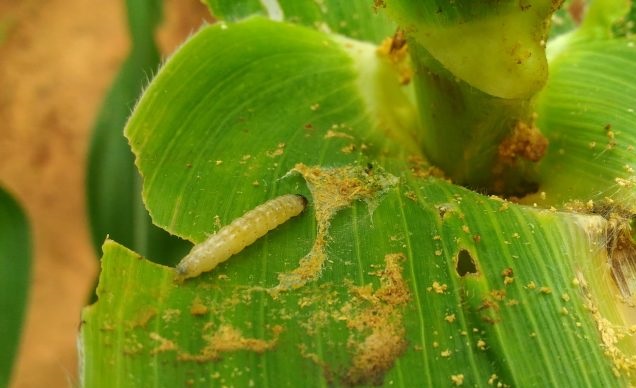
A pale inverted-Y mark on the dark head, together with four dark spots arranged in a square on the second-to-last body segment, identifies a fall armyworm larva more reliably than its colour. Colour alone misleads, because mature larvae vary from green to brown or black, and leaf chewing by itself can be confused with disease or other pests — the guide to major diseases of mash and mung shows how easily crop problems are mixed up. Look for the Y mark, the square of spots on the eighth abdominal segment, four more spots in a trapezoid on the segment before it, and smooth skin.
Eggs are dome-shaped, about 0.4 mm across, laid in masses of 100–200, often in layers, on the underside of leaves low on the plant near the leaf–stem junction. The female covers the mass with grey, felt-like hairs that she sticks on from the tip of her abdomen, so a fresh mass looks like a small patch of mould. The pupa is reddish-brown and is found in the soil, sometimes inside a soil clod, while the moth has mottled grey-brown forewings and the male carries a distinct white spot or triangular mark.
| Stage | What to look for |
|---|---|
| Egg mass | 100–200 dome-shaped eggs in a layered mass on a leaf underside, covered with grey felt-like hairs |
| Young larva | Tiny caterpillar that scrapes the leaf surface, leaving windowpane or net-like patches; may travel between plants on a silk thread |
| Mature larva | About 35 mm long, smooth skin, pale inverted-Y on the dark head, four dark spots in a square near the tail end |
| Pupa | Reddish-brown, about 0.5–0.75 in long, buried 2–8 cm deep in the soil |
| Moth | Wingspan about 32–40 mm; mottled grey-brown forewings; male carries a white spot or triangular mark |
The life cycle takes about 30 days in warm weather
Fall armyworm completes its life cycle in about 30 days in summer, stretching to 60–90 days in cooler spring or autumn conditions. Eggs hatch in just 2–3 days when it is warm, although hatching can take up to 10 days in cool weather. The female lays most of her eggs in her first 4–5 days, so egg masses appear in waves soon after moth flights arrive.
The larva passes through six instars, occasionally seven, in about 14 days in warm weather, feeding mainly at night and hiding deep in the whorl by day. It then pupates in the soil at 2–8 cm deep, inside an earthen cocoon; if the soil is too hard to burrow into, it pupates instead hidden among fallen leaves on the ground. The emerging moth lives about 10 days, with a range of 7–21 days. Warm regions can see 4–6 generations a year. The pest has no diapause and cannot overwinter where winters are cold; it reinvades by migration, flying up to 100 km in a night and up to about 500 km before laying eggs.
| Stage | Duration | Key facts |
|---|---|---|
| Egg | 2–3 days warm; up to 10 days cool | Masses of 100–200; a female lays roughly 1,000–2,000 eggs in her lifetime |
| Larva | About 14 days warm | Six instars; early instars around days 3–6, later instars around days 6–14; all crop damage happens at this stage |
| Pupa | 8–9 days warm; 20–30 days cool | In the soil at 2–8 cm deep, inside an earthen cocoon |
| Adult moth | About 10 days (7–21) | Nocturnal and migratory; lays most eggs in the first 4–5 days; does no feeding damage |
What damage does fall armyworm do at each crop stage?
Fall armyworm damage starts as pale windowpane patches and ends, in severe attacks, with bored cobs and ruined kernels. The youngest larvae cannot bite through a leaf, so they scrape away the surface tissue; on young plants this scraping makes leaves look net-like. The tiny larvae then disperse between plants by ballooning on silk threads carried by the wind, which is how a single egg mass becomes a scattered infestation.
Older larvae feed deep inside the whorl, the funnel of rolled leaves at the top of the plant, leaving ragged holes and sawdust-like frass when the leaves open. Feeding in the whorl of a young plant can kill the growing point, so the plant never recovers, and heavy whorl feeding can also stop the tassel from forming. On older plants, large larvae prefer the cob: they eat through its protective leaves and bore in to feed on the kernels. Severe attacks on maize and sorghum are cited as defoliating up to about 70% of the foliage.
Monitoring and thresholds: scout before you spray
Monitoring with pheromone traps and weekly scouting is what turns fall armyworm control from guesswork into timing. Pheromone traps catch male moths and warn that a flight has arrived and egg-laying is under way. Scout weekly while the crop is at a vulnerable stage, checking 20 plants at 5 locations spread across the field. Regular scouting also keeps different problems separate — chewing damage needs a different response from a virus problem, as the guide to diseases of potato virus and their management makes clear for virus-affected crops. On each visit, look for:
- Clusters of yellow to light-brown eggs under leaves, covered in felt-like hairs
- Windowpane or net-like scraping and small, ragged holes in opening leaves
- Small larvae in the whorl, and fresh sawdust-like frass packed around them
- Moths caught in pheromone traps since the last visit
The CABI guidance behind this page gives a concrete version of the same routine for maize fields: set one pheromone trap for every three acres to detect arriving moths, begin checking on the fifth day after the crop emerges and inspect weekly, and examine ten plants at three places in each acre. On that count, if two of the thirty sampled plants are infested, it is time to act.
In corn, act while the larvae are still small: at 3 or more larvae per plant, at about 20% of plants infested at the late-whorl stage, or when 10% of ears are infested. In small grains, the guide figure is 3 larvae per row-foot. Every threshold is set to trigger action early, because small larvae are the only stage sprays and biological products reach reliably.
Cultural control and prevention come first
Planting early and uniformly, and avoiding late or staggered planting, is the simplest cultural defence against fall armyworm. A field that stays young while neighbouring crops mature collects the worst attacks, so sowing the whole area at the same time removes that target. Start with certified, good-quality seed, keep plants healthy with correct spacing and balanced soil nutrition, and keep fields clean, because vigorous plants tolerate feeding better than stressed ones. Plough deeply before sowing to clear the previous crop’s residues out of the soil, and destroy weeds regularly through the season.
Intercropping also helps: planting with nitrogen-fixing legumes, including push-pull systems, diversifies the field, and resistant varieties can be used where they are available. On small areas, hand-picking and crushing egg masses and young larvae is practical and effective. It is the same prevention-first order set out in the guide to pest and disease control methods in plantations: sanitation, plant health and diversity first, chemistry last.
Biological control: protect the allies already in the field
Tiny parasitic wasps are the strongest biological allies against fall armyworm, because they attack the egg stage before any feeding begins. Trichogramma and Telenomus parasitise the eggs, with 61–95% parasitism reported in cited studies, and Telenomus alone reaching about 90% in some reports. Larval parasitoids — Chelonus, Cotesia, Hyposoter and tachinid flies — kill caterpillars from inside, while predators such as earwigs, ground beetles, lacewings, damsel bugs, spined soldier bugs and lady beetles hunt larvae in the crop.
Microbial options add a second layer: the baculovirus SfNPV is cited as killing 40–70% of larvae, the fungi Beauveria bassiana and Metarhizium infect caterpillars, and Bt sprays and neem-based botanicals fit a biological programme. In maize, Bt plant traits such as Vip3A are also used, although resistance to the older Cry1F trait has been reported. Conserving these allies matters: broad-spectrum sprays kill parasitoids and predators along with the pest, and remove the free control that was already working.
When is chemical control justified?
Chemical control is justified only when scouting passes threshold and cultural and biological measures are not holding the pest — and it works only against eggs and early instars, the first to third larval stages. Older larvae shelter deep inside whorls and husks, where spray droplets barely reach them. Apply in the evening or in overcast conditions, when larvae are active, and direct the spray into the whorl. Accurate application matters as much as product choice, so follow the guidance on spray techniques and spray machinery calibration, and always wear the protective equipment listed in the safety measures during spray whenever you handle or apply any insecticide.
Resistance decides which chemistry still works. Fall armyworm has developed resistance to carbamates, organophosphates and some pyrethroids, and pyrethroids are generally weak — often ineffective on their own — against larger larvae. Rotate between different modes of action from one application to the next, and always follow the local label for the product, rate and timing in your area. The table below summarises the full control ladder, in the order it should be used.
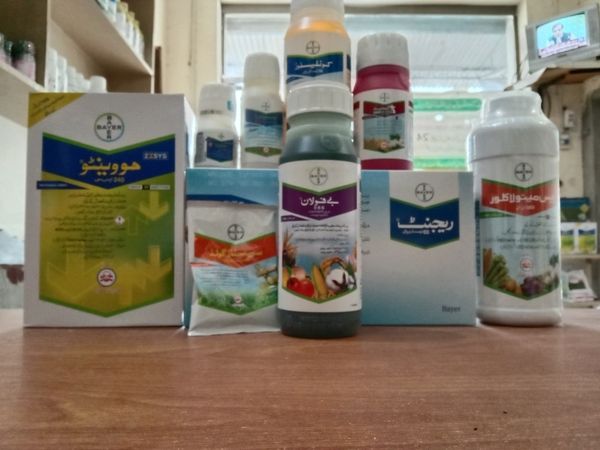
For growers following the CABI guidance behind this page, the poster names five insecticides for larval control, at these per-acre rates:
- Spinetoram 120 SC — 100 ml per acre
- Emamectin benzoate 19 EC — 200 ml per acre
- Bifenthrin 56 EC — 300 ml per acre
- Chlorantraniliprole 20% SC — 50 ml per acre
- Flubendiamide 48% SC — 25 ml per acre
These rates are reproduced from the poster as local guidance. Product registrations and approved labels differ between countries and change over time, so verify the product, formulation and rate against the current product label before use, and use only products approved for your crop and your area.
| Method | Examples from this guide | Notes |
|---|---|---|
| Cultural / prevention | Early, uniform planting; certified seed; intercropping and push-pull; correct spacing and soil nutrition; hand-picking | First line of defence; keeps plants vigorous and fields less attractive to egg-laying moths |
| Biological | Trichogramma and Telenomus egg parasitoids; predators; Bt sprays; SfNPV; Beauveria and Metarhizium fungi; neem botanicals | Works best when broad-spectrum sprays are avoided so natural enemies survive |
| Chemical (last resort) | Chlorantraniliprole, flubendiamide, spinetoram, spinosad, methoxyfenozide, indoxacarb, carbaryl, methomyl | Target small larvae, spray into the whorl in the evening, rotate modes of action, follow the local label |
Frequently asked questions
How can I tell fall armyworm apart from other caterpillars?
Check for the combination of a pale inverted-Y on the dark head and four dark spots in a square on the second-to-last segment, with four more in a trapezoid just in front of it. The skin feels smooth, a mature larva is about 35 mm long, and sawdust-like frass packed into the whorl supports the identification.
Do adult moths damage the crop?
No, adult moths do no feeding damage at all. All damage — windowpanes, ragged whorl holes, killed growing points and bored kernels — is done by the larvae. Moths matter because they lay the eggs: one female produces roughly 1,000–2,000 eggs in masses of 100–200, mostly in her first 4–5 days.
When is the best time to spray for fall armyworm?
Spray as soon as scouting crosses threshold and the larvae are still in their first to third stages, while they are small and reachable. Apply in the evening or in overcast weather, direct the spray into the whorl, rotate the mode of action, follow the local label, and wear the protective equipment the label specifies.
Why do pyrethroid sprays often fail against fall armyworm?
Pyrethroids fail mainly because resistance to them is reported and they are generally weak on this pest, especially on larger larvae. Size makes it worse: big caterpillars sit deep inside whorls and husks where droplets do not reach. Target small larvae instead, and rotate to a different mode of action for the next application.
Can fall armyworm survive a cold winter?
No, fall armyworm has no diapause and cannot overwinter in cold regions. It persists in warm areas and reinvades cooler cropping zones each season by migration, with moths flying up to 100 km in a night. That is why pheromone trap catches early in the season are such a valuable warning.
اردو خلاصہ: فال آرمی ورم
فال آرمی ورم کی زندگی کے دورانیے میں انڈے، سنڈی کی بڑھوتی کے چھ مراحل، کوپا اور پروانہ شامل ہیں۔ مادہ پروانہ عام طور پر پودے کے نچلے حصے میں پتوں کی نچلی سطح پر، پتے اور تنے کے جوڑ کے قریب، عموماً ایک سو سے دو سو (100-200) انڈے دیتی ہے۔ انڈے حفاظتی بالوں سے ڈھکے ہوتے ہیں، اور گرم مرطوب موسم میں دو سے تین دن میں ان میں سے سنڈیاں نکلنا شروع ہو جاتی ہیں۔ سنڈی کی بڑھوتی کا پہلے سے تیسرا مرحلہ چار سے چھ دن پر محیط ہوتا ہے؛ چھوٹی سنڈیاں پتوں کی نچلی سطح کو کھرچ کر کھاتی ہیں جس سے پتے جالی نما نظر آتے ہیں، اور ریشمی دھاگوں کے ذریعے ہوا کے ساتھ دوسرے پودوں تک پہنچتی ہیں۔ سنڈیاں رات کے وقت زیادہ مستعدی سے کھاتی ہیں؛ چھوٹے پودوں میں کونپل اور بڑے پودوں میں بھٹے کو ترجیح دیتی ہیں، اور بڑی سنڈیاں بھٹے کے حفاظتی پتے کھا کر اندر کے دانوں تک پہنچتی ہیں۔ بڑی سنڈیوں کی لمبائی 30 سے 40 ملی میٹر تک ہوتی ہے اور ان کی جلد چھونے پر ملائم محسوس ہوتی ہے۔ مکمل سنڈی دو سے آٹھ سینٹی میٹر تک سرنگ بناتے ہوئے زمین کے اندر جا کر مٹی کی خول نما جھلی میں کوپا میں تبدیل ہو جاتی ہے؛ کوپا سرخی مائل بھورے رنگ کا ہوتا ہے، اور سرد موسم میں اس کا دورانیہ 20 سے 30 دن تک طویل ہو سکتا ہے۔ پروانے کے پھیلے ہوئے پروں کا سائز 2.5 سے 3.0 سینٹی میٹر ہوتا ہے اور نر پروانے کے اگلے پروں پر سفید رنگ کا واضح نشان ہوتا ہے۔
بچاؤ: علاقے میں مکئی ایک ہی وقت میں کاشت کریں، تصدیق شدہ معیاری بیج اور سفارش کردہ اقسام استعمال کریں، کاشت سے پہلے گہرا ہل چلا کر پچھلی فصل کی باقیات ختم کریں اور جڑی بوٹیوں کو باقاعدگی سے تلف کریں۔ نگرانی: پروانوں کی موجودگی معلوم کرنے کے لیے ہر تین ایکڑ میں ایک جنسی پھندہ (فیرومون) لگائیں، فصل کے اگاؤ کے پانچویں دن سے نگرانی شروع کر کے ہر ہفتے جائزہ لیں، اور فی ایکڑ تین جگہوں پر دس دس پودے دیکھیں؛ اگر ان میں سے دو پودے متاثر ہوں تو تدارک کریں۔ پتوں کی نچلی سطح پر انڈوں کے گچھے، جالی نما پتے اور ابتدائی سنڈیاں تلاش کریں۔ تدارک: انڈوں کے گچھے اور چھوٹی سنڈیوں کو ہاتھوں کی مدد سے مسل کر تلف کر دیں، اور اگر زہر کی ضرورت پڑے تو مقامی سفارش کے مطابق، لیبل کی ہدایات پر عمل کرتے ہوئے استعمال کریں۔