Rock Gardening
What a rock garden (rockery) is
You build a rock garden by recreating a rocky mountainside in miniature: choose an open, sunny, free-draining site, set stones of one type with at least a third of each buried and their layers running the same way, fill the pockets between them with a lean, gritty soil mix, and plant low, drought-tolerant alpine and rock plants into the gaps, leaving roughly half the stone and gravel surface showing.
A rock garden is a type of garden that features extensive use of rocks or stones, along with plants native to rocky or alpine environments. Rockery is the British synonym for exactly the same feature, and build guides for the two terms are interchangeable. The form varies: an outcrop rockery on a slope or mound, a flat scree bed, plants tucked into a crevice garden — flat stones set vertically on edge, planted in the gaps — or a dry-stone wall, and trough or raised-bed versions.
Gardeners build one because rock gardens are comparatively easy to make and need very little maintenance next to a formal or cottage garden — a sensible alternative for busy gardeners. A rockery also turns a dry slope or thin soil into planting ground.
Scree and the scree garden
Scree is loose gravel formed by weathering in the mountains, and a scree garden recreates those conditions at home as a deep gravel bed where creeping and cushion plants grow.
In nature, water freezes inside stone and slowly breaks large rocks apart, and the fragments accumulate at the base of mountain slopes. Streams add stones of varying sizes, melting snow waters the plants in summer, and a snow blanket protects them from frost and drying winds in winter.
That habitat is harsh but well drained. Scree gives excellent drainage, yet its plants must withstand hot, dry summers and sub-freezing winters, and deep root systems and small size help them survive those swings. A garden scree bed copies the drainage and the lean, stony root run, then lets creeping plants grow across a gravel surface.
Where to put a rock garden
You should put a rock garden on an open, sunny site, ideally on a gentle slope, away from overhanging trees, frost pockets and any spot where water pools.
Full to half sun grows the widest range of plants, and a sunny bed stays well lit even in winter. Shade from overhanging trees brings autumn leaf fall onto the plants as well as darkness, so keep clear of tree canopies. A gentle slope drains naturally; on flat ground, build a low mound or berm, and keep any artificial slope to no more than about 4 ft high so it still looks natural. A deep new mound is full of air: build it about a third higher than the finished height, and expect months, not weeks, before it settles stable.
Plan the layout on paper before you clear anything: the largest rocks are hard to move once set, so their positions need deciding first. Clear the site thoroughly. It is essential to rid the site of perennial weeds, digging out the roots of dandelions, brambles and dock, because they cannot be removed cleanly once rocks and gravel are down. A soil analysis now tells you what will grow well in the location. Finally, site the garden within reach of a hose for establishment watering, against a background of evergreens, shrubs, a fence or a pond. A rockery can also sit inside a wider low-water landscape, whose irrigation and zoning a full xeriscaping guide covers.
How to build a rock garden, step by step
You build a rock garden in one order: clear the site, lay the drainage base, set the largest rocks first, a third buried, fill pockets, let it settle, then plant.
- Clear and mark out. Remove weeds and roots; mark the bed’s shape.
- Lay the drainage base. Spread about 6 in (15 cm) of rubble or pea shingle, covered with upturned turves or permeable fabric. Dig grit in on clay.
- Set the rocks, largest first. Use one geological type of stone, ideally local, working upward. Bury each by at least a third, nearer half on slopes, keep strata lines one way, usually horizontal, and tilt stones slightly back.
- Fill the pockets. Pack gritty mix between stones, about 4 in (10 cm) deep, with 6–8 in (15–20 cm) pockets for shrubs.
- Let it settle, then plant. Wait several weeks, watering if no rain falls, then plant at pot depth under a 1 in (2.5 cm) grit top-dressing.
Arrange rocks in irregular groups, not dotted like salt and pepper or built as a fortress. Watch how water runs first: well-placed rocks slow or redirect it and stop soil washing away. Stones also shelter plants, keep roots cool and form planting nooks. Boulders in drifts read as a dry stream bed, and the same setting method edges ponds and stream banks — pond construction sits in a full waterscaping guide. Do not overload a small space with huge rocks. Move heavy stone by barrow or lever, never with hands under a propped rock.
How to build a scree bed
You build a scree bed as a layered pit: dig out about 75 cm (30 in) of soil, add rubble and stone layers for drainage, then a thin gritty soil mix, and finish with a gravel surface the plants grow through.
Dig the hollow on the sunny, weed-free site, its base sloping gently so excess moisture drains away without the top going over-dry. Cover the base with about 15 cm (6 in) of rubble, add another 15 cm of small stones about 2.5 cm (1 in) across, and fill the hollow with stone chips and gravel. Lay about 7.5 cm (3 in) of soil mix on top — 1 part loam or good topsoil, 1 part leaf mould or peat substitute, 2 parts grit by volume — then top off with about 5 cm (2 in) of gravel, up to 7 cm on a pure scree surface. Use limestone chips for alpines from chalk or limestone areas, and shingle, washed gravel or granite chippings for plants from acid or neutral soils; avoid flint, which does not conserve moisture.
| Layer, bottom to top | Material | Depth |
|---|---|---|
| Drainage base | Rubble | About 15 cm (6 in) |
| Stone layer | Small stones about 2.5 cm (1 in) across | About 15 cm (6 in) |
| Fill | Stone chips and gravel | Fills the hollow up to the soil mix |
| Soil mix | 1 part loam : 1 part leaf mould : 2 parts grit | About 7.5 cm (3 in) |
| Surface | Gravel | About 5 cm (2 in); up to 7 cm on a pure scree surface |
Worked example: a bed 3 m by 2 m covers 6 m². Its soil-mix layer needs 6 × 0.075 = 0.45 m³ of mix, which at 1:1:2 is about 0.11 m³ of loam, 0.11 m³ of leaf mould and 0.23 m³ of grit. The gravel top needs 6 × 0.05 = 0.30 m³. Set a few larger stones into the finished bed: they add character, shelter plants, and serve as stepping-stones when you weed.
The soil rock garden plants need
Rock garden plants need soil that is well drained but still moisture-retentive, lean rather than rich, and gritty enough that roughly half the mix is mineral material.
Suitable soil is nearly the whole secret of success, because rock plants put down long roots: allow roughly 18 in (45 cm) of developed soil in a ground bed. Heavy, consistently damp soil, especially in winter, is what kills these plants — winter wet, not cold, is the enemy. On heavy clay, grow them in containers or raised constructions instead of in the ground.
Recipes vary by bed type, but the principle never changes. The scree mix above and the 50:50 container mix below are the two anchors worth copying exactly; other published mixes keep the same lean balance in different proportions. For a bed of your own size, a topsoil calculator turns its dimensions into the loam and compost volumes you need to order.
| Use | Mix, by volume | Source |
|---|---|---|
| Scree bed | 1 part loam or good topsoil : 1 part leaf mould or peat substitute : 2 parts grit | RHS |
| Container or trough | 50:50 soil-based peat-free compost : horticultural grit | RHS |
| General ground bed | 1 part topsoil : 1 part organic material : 1 part ⅜-in chip stone or coarse sand | Dave’s Garden |
| Sunny ground bed | 1 part topsoil : 1 part peat moss : 1 part stone mixture | Fine Gardening |
| Alpine nursery mix | 2 parts crushed granite : 1 part soft sand : 3 parts peat-free compost | D’Arcy & Everest (via Gardeningetc) |
| Crevice garden | 1 part garden soil : 1 part mushroom compost : 1 part perlite, sand or PermaTill | NC State Extension |
The best plants for a rock garden
The best plants for a rock garden are compact alpine and rock plants that prefer well-drained soil and low water use, chosen by colour, texture, height and growth habit, and grouped by shared sun and water needs.
Alpines originate above the mountain treeline, enduring cold, drought, strong winds, harsh sun and thin rocky soil. Most are perennials and stay dwarf, usually under 1 ft (30 cm), forming carpets, cushions or rosettes; dwarf bulbs add spring colour, and dwarf conifers and shrubs give structure if kept in check. Many plants sold as alpines are not true alpines, so check the label for what the plant actually wants. Cushion and mat-forming plants suit scree best; avoid rampant growers, tall plants and large foliage. Agave, from the original gallery, is a frost-tender desert succulent for warm, dry-climate rock gardens only — not a scree plant.
Below is the original scree gallery, verified against expert scree lists, plus standard rockery plants:
| Plant | Form / role | Season | Notes |
|---|---|---|---|
| Alpine pink (Dianthus alpinus) | Cushion | Summer | Wants sandy soil, sharp drainage |
| Alpine poppy (Papaver alpinum) | Rosette | Summer | To 30 cm tall |
| Mountain alyssum (Alyssum montanum) | Low mound | Spring | Relative basket of gold cascades over walls |
| Persian candytuft (Aethionema spp.) | Small mound | Summer | Candytuft prefers gravelly soil |
| Rock jasmine (Androsace spp.) | Tight cushion | Spring–summer | Scree-listed, both seasons |
| Horned violet (Viola cornuta) | Mat | Spring–summer | General rockery use |
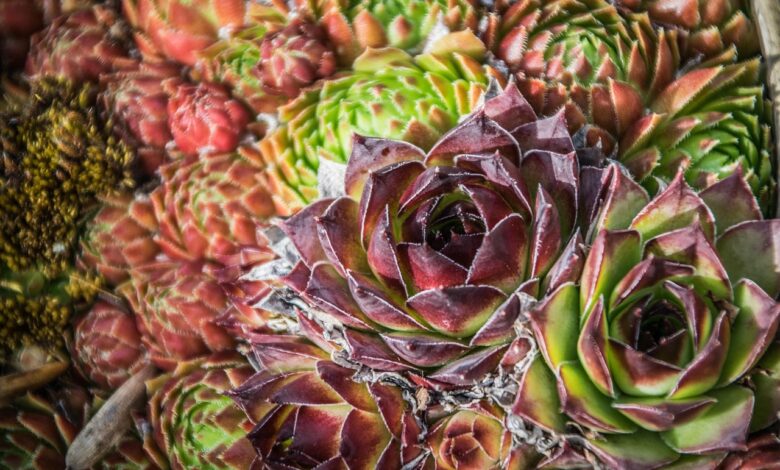
| Hen and chicks (Sempervivum) | Rosettes | Foliage all year | Narrow crevices, lean soil |
Ground covers that spread between rocks and along paths
Creeping thyme, creeping phlox, aubrieta, low sedums and ice plant in the hottest spots are the ground covers that spread between rocks and along paths, softening edges and knitting the pockets between stones together.
Set the plants out in their pots first and arrange them so taller plants will not shade smaller ones; then, whatever you plant, water it well first, set it at pot depth with stems and leaves clear of the mix, and firm in by hand. Plant covers where they can run into gaps rather than over their neighbours, and keep spreading plants away from cushion types so the cushions are not swamped. Blue star creeper and Irish moss suit the joints between stepping stones, where a soft, low mat copes better than a flowering cushion. Discipline matters more than coverage: leave about 40–60% of the rock or scree surface exposed and unplanted, because covers spread over time and a fully planted new rock garden crowds itself out and hides the stone that defines it. For covers on banks, in dense shade and where grass fails, the site’s full guide to ground covers in hedges, shades and covers covers the wider topic.
Planting the shady pockets of a rock garden
You can plant shooting stars, heucheras, lewisias and saxifrages in the shady pockets of a rock garden, especially on the north side of large rocks and in spots shaded for part of the day.
Even a sunny rockery has these pockets, and they suit plants that dislike a baked root run. Primula auricula, ramonda and some campanulas and gentians also take partial shade, and primulas and epimediums are used in shaded rock planting as well. Match the mulch to the light: chopped dry leaves suit a shady rock garden where grit suits a sunny one.
Can you make a rock garden in a trough or container?
You can make a rock garden in a container, and a stone trough, old sink or shallow terracotta pan is the smallest complete rock garden you can build.
Containers suit small gardens, patios and balconies, and they are the answer on heavy clay, where ground planting fails in winter wet. Use a container with plenty of drainage holes, stand it on feet or bricks so the holes stay clear, and fill it with 50:50 soil-based peat-free compost and horticultural grit. Top with grit after planting; container plants dry out faster than ground plants and need repotting into fresh soil every few years.
Keep the container outdoors. Rock garden plants grow well in containers but will not do well in indoor warmth, so place it on a balcony, in a window box or on a cold windowsill: these are hardy outdoor plants that expect a cold winter rest. Scale applies here too: small container, small stones, small plants. A planted trough is effectively a miniature garden built around stone, and it obeys the same rules of scale and proportion.
Looking after a rock garden
You look after a rock garden with establishment watering, regular hand-weeding, a kept-up grit mulch and protection from winter wet: the care is light and seasonal, but a rock garden is low-maintenance, not no-maintenance.
Water new plantings regularly until roots establish, and containers whenever they dry out, because they dry fastest. Established plants root deeply and need much less, but at low altitude in warm gardens they dry out faster than in the mountains, so water in long dry spells. Always water the soil, not the foliage, because alpines rot if kept damp. The grit mulch earns its keep: it keeps necks and lower leaves off damp soil and prevents rot, stops rain splashing soil onto flowers, hinders weed seeds and helps deter slugs and snails.
Weed by hand regularly, because compact plants are quickly overwhelmed. Where the bed meets a lawn, fit a heavy permanent edging to keep grass from creeping in. On a scree bed, remove dead leaves and twigs as they fall and rake the scree twice in summer to destroy annual weeds rooting in the gravel. Feed lightly: slow-release fertiliser for containers in early spring, a light May top-dressing of soil mix for a scree bed. Trim spreaders after flowering and divide overgrown clumps. In winter, suspend acrylic or polycarbonate over fluffy-leaved plants from October to March in wet-winter climates, and move containers into a wall’s rain-shadow. The problems to watch for are few, and most come back to wet:
- Winter-wet rot and fungal disease. The main threat; the grit mulch keeps necks and lower leaves dry, which helps prevent rot.
- Slugs and snails. They graze soft young shoots; the grit mulch and raised troughs help against them.
- Ants. They colonise gritty soil and containers.
- Vine weevil. A container pest.
- Aphids. They damage growth and spread virus.
- Birds. They pull cushion plants apart.
Frequently asked questions about rock gardens
Most rock garden questions come down to names, burial depth, difficult ground, planting time and how much work the finished garden really needs.
What is the difference between a rock garden and a rockery?
There is no difference between a rock garden and a rockery: rockery is simply the British name for the same planted rock feature. Build guides, plant lists and care advice for one term apply in full to the other. Nurseries and stone suppliers use the two words interchangeably, so use whichever your local nursery uses.
Is a rock garden the same as a Zen garden?
A rock garden is not the same as a Zen garden: a rock garden or rockery is a planted garden of living alpine and rock plants growing among stones. The dry gravel-and-rock garden is karesansui, one type of Japanese garden, where gravel represents water and planting is minimal or absent — a different discipline from the planted rockery covered here. For that dry-garden tradition in full, see Japanese garden design.
How deep should rocks be buried in a rock garden?
Rocks should be buried by at least one-third of their size below the surface in a rock garden. Bury nearer half on a slope or for a tall stone that needs stability. A rock merely laid on the surface shifts in winter frosts and looks placed, while a buried rock looks as if it grew there.
Can you build a rock garden on flat ground or clay soil?
You can build a rock garden on flat ground by first building a low mound or berm, because the slope gives the bed its drainage. Keep an artificial slope to about 4 ft high at most. On heavy clay, skip the ground bed and grow the plants in troughs, sinks or raised beds, where winter wet cannot sit around the roots.
When is the best time to plant a rock garden?
The best time to plant a rock garden is spring, as the soil warms, with early autumn as the second good window. Alpines can be planted at almost any time, but they settle in best in those seasons, and specialist growers rate the very end of August especially highly. Avoid planting in hot or very cold weather, when new plants struggle until rooted.
How much maintenance does a rock garden need?
A rock garden needs low maintenance, not none: watering until plants establish, hand-weeding before weeds overwhelm compact plants, and seasonal winter checks. The routine settles to topping up grit mulch, raking a scree bed twice in summer, trimming spreaders and protecting fluffy-leaved plants from winter wet. That is far less work than a formal or cottage garden asks for.