Securing Pakistan’s Soil: Comprehensive Perimeter Security Strategies for Modern Farms
On a quiet night in rural Punjab or Sindh, a single security breach can wipe out a farmer’s entire life savings. Across Punjab, Sindh, Khyber Pakhtunkhwa and Balochistan, millions of farming households quietly carry the burden of feeding the nation — yet most of these rural properties operate with almost no structural protection. With input costs at an all-time high, neglecting perimeter security is not just a risk to one season’s yield; it is an existential threat to a family’s livelihood.
Agriculture in Pakistan has entered a high-stakes era. Farms increasingly run on expensive technology — high-efficiency solar-powered tube wells, modern harvesters and computerised drip irrigation systems — and that investment has turned the modern farm into a high-value commercial asset. The Ministry of National Food Security and Research (MNFSR) has consistently advocated exactly this shift in thinking: modernisation cannot stop at better seed varieties and advanced fertilisers. It must also include robust physical fencing, strategic illumination and real-time electronic monitoring. This guide works through each layer in turn, with real local costs, so you can build protection in the order that gives the most security for every rupee spent.
What Is Perimeter Security for a Farm?
Perimeter security is the coordinated collection of physical, electronic and procedural elements that identify, monitor and secure the limits of a farm property. Unlike an urban warehouse or a town house, a farm cannot simply be locked up at night — the boundary itself has to do the guarding, in all weather, across open land.
A farm perimeter plan has to answer challenges that town properties never face:
- Weather extremes: systems must survive monsoon flooding, summer heat above 50°C and constant dust.
- Large, uneven boundaries: Pakistani farms span everything from small 2-acre plots to estates of more than 500 acres.
- Darkness: criminal behaviour is predominantly nocturnal, and darkness is the greatest enabler of farm encroachment.
- Weak infrastructure: many rural locations suffer unstable grid electricity and mobile connectivity, so security has to work off-grid.
The sections below build the answer in layers — barriers first, then gates, lighting, electronics, the assets inside the fence, and finally the human routines that tie everything together.
Physical Barriers: Fencing That Fits Your Land and Budget
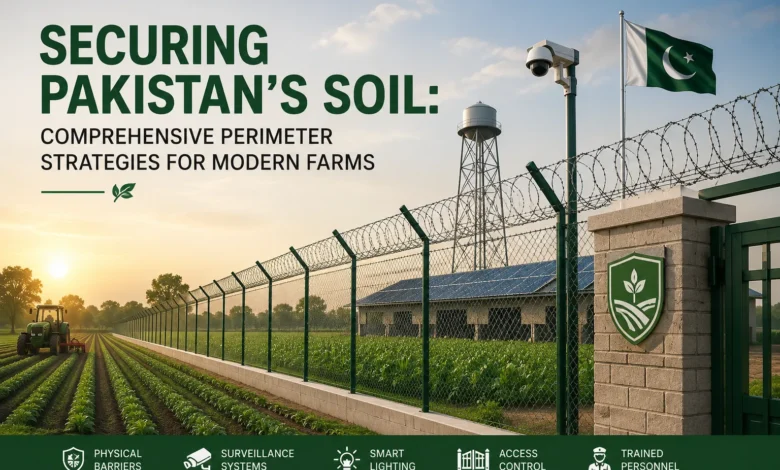
A robust physical barrier is your first line of defence, because every other security measure works better behind a boundary that slows an intruder down and makes noise to cross. The right choice depends on your crop value, your livestock assets and your budget — and in Pakistan’s local market, five proven options cover almost every situation:
| Fencing option | Best for | Cost per metre (PKR) | Expected lifespan |
|---|---|---|---|
| Thorn hedgerow (Keekar) | Small farms and traditional boundaries | 80–200 | Permanent, with regular trimming |
| Barbed wire (2–3 strand) | Broad grain fields and expansive land boundaries | 180–350 | 5–10 years |
| Barbed-top chain-link fence | Orchards and high-value vegetable plots | 500–1,000 | 15–20 years |
| Solar electric fence | Livestock pens, dairy farms and wildlife defence | 700–1,500 | 10–15 years |
| Concrete block wall | Residential farmhouses, high-end livestock units and machinery yards | 4,000–8,000 | 25+ years |
The traditional Keekar (Acacia nilotica) hedgerow deserves special mention. It grows rapidly, requires minimal water and forms a dense, thorny thicket that discourages both human intruders and stray livestock — which is why it remains an excellent, budget-friendly biological barrier across Punjab and Sindh. Where a wire fence already stands, planting a thorny hedgerow six to eight feet inside the fence line creates a double barrier; the hedge needs two to three years to fully establish, then largely maintains itself and improves with age.
Wire quality matters as much as wire layout. High-tensile wire fencing delivers 15 to 20 years of reliable service with minimal maintenance, while cheaper wire can fail within five to seven years — a false economy on a long boundary. A typical high-tensile installation uses posts every 20 feet with three strands of wire, a pattern that also suits the barbed-wire runs in the table above.
Gates and Entry Points: Control Who Comes In
Every farm needs one well-defined, controlled entry, because a strong fence with a weak gate protects nothing. Where possible, work towards a single gated entrance and exit, and close off private access points that are no longer used; wide yard openings can be controlled with locking posts or temporary obstructions.
Gate hardware is where many farms quietly lose the battle:
- Invert and cap the gate hinges, so the gate cannot simply be lifted off them.
- Check that fixing bolts are secure, and use covered padlocks that shrug off weather.
- Reinforce the gate itself with solid steel framing and heavy-duty locks.
- On larger operations, consider RFID or code-locked gates, so entry is granted by credential rather than by whoever pushes the gate open.
Keep a written record of everyone who crosses the boundary. A daily logbook of visits, labourers and vehicle movements costs almost nothing, yet it transforms any investigation when something goes missing. The Government of Punjab’s rural development programmes have pushed this idea further through model village security programmes, supporting visitor registration at community level near farm clusters.
Where vehicles are the threat, the land itself can help. Deep ditches dug along vulnerable boundaries control and deter unwanted vehicle access, and tree trunks, rocks and earth mounds make effective blocks at informal crossing points.
Lighting the Boundary: The Cheapest Deterrent You Can Buy
Strategic outdoor lighting gives the best return of any perimeter security measure, because darkness is the criminal’s best friend and light is the farmer’s cheapest deterrent — well-lit boundaries strongly discourage the opportunistic, late-night intrusions that make up most farm theft. Modern LED technology has made that deterrent affordable to run: LED outdoor lights use 70 to 80 percent less power than conventional sodium vapour or halogen floodlights, while offering better coverage and brightness.
Four lighting types cover a farm perimeter:
- Floodlights: high-lumen LED floodlights (150W–300W) mounted on corner posts and gate structures carry the main load. See the Hyundai LED Lights Outdoor Range for the class of units used for this work.
- Motion-activated lights: PIR sensor lights along access routes and fence lines save energy and snap on the moment movement is detected; mounting them roughly every 100 feet along your most vulnerable fence sections gives continuous coverage where it matters most.
- Equipment-yard lighting: irrigation pumps, tractors and harvesters are common targets, and the danger of theft drops significantly when equipment yards are permanently lit.
- Solar standalone units: solar LED lights with a 12-hour battery backup give independent coverage to remote boundary sections far from the grid, and modern solar units typically deliver six to eight hours of illumination per night.
Pakistan is unusually well placed for solar security lighting: most agricultural areas receive 5.5 to 7.5 kWh/m²/day of solar irradiation, among the highest levels in the world. A single 100W solar panel with an 80Ah battery can power four to six high-efficiency LED perimeter lights for the duration of the night, with no ongoing electricity costs — and pairing panels with the right solar battery storage for farms keeps those lights running through cloudy spells and load-shedding alike.
Cameras and Alarms: Electronic Eyes on the Boundary
Cameras and alarms turn a passive boundary into a watched one, alerting you while an intrusion is happening rather than after the loss is discovered. Modern IP cameras with at least IP66 weatherproof housing and infrared night vision of 30 to 40 metres are widely available in Pakistan, and a standard 4-camera system with DVR storage can be fully installed for PKR 25,000 to 60,000.
Position cameras where the value and the traffic are:
- Main entry gates
- Fuel tanks
- Grain storage facilities and cold storage rooms
- The widest-angle corners of the perimeter fence
Alarms should reach you, not just ring in an empty yard. GSM-based alarm packages — now widely available from local Pakistani startups with Urdu-language mobile interfaces — link fence-line vibration sensors and motion detectors directly to your phone, sending real-time SMS or WhatsApp alerts the moment a boundary line is breached. Wireless motion sensors do the most good at natural chokepoints such as gate entrances, barn doors and equipment stores, where anyone approaching your assets must pass.
| Electronic system | What it protects | Key specification |
|---|---|---|
| 4-camera CCTV kit | Gates, fuel tanks, grain storage and cold stores | IP66 housing; infrared night vision 30–40 m; DVR storage; PKR 25,000–60,000 installed |
| GSM alarm package | The whole boundary line | Fence-line vibration and motion sensors; real-time SMS or WhatsApp alerts; Urdu-language interface |
| Motion-activated LED lights | Fence lines, access routes and yards | PIR sensors; spaced about every 100 feet on vulnerable sections; solar units give 6–8 hours per night |
| Solar LED floodlights | Farmhouse and machinery yard | 150W–300W units; four to six lights run all night from one 100W panel with an 80Ah battery |
Protecting Livestock, Fuel and Machinery Inside the Fence
A perimeter only delays a thief, so the assets inside still need their own protection — livestock, diesel and machinery are exactly what rural thieves come for.
Livestock come first on most farms. Check your animals and the security of boundary fencing regularly: walk the fields where animals are kept, confirm that no fence has been breached, and treat livestock making more noise than usual as a possible sign that something has disturbed them. Make every animal identifiable with ear tags, horn brands, freeze marking or tattooing, so stolen stock can be recognised and recovered. Guardian animals add a living layer that works around the clock without electricity: livestock guardian dogs patrol boundaries and raise the alarm, while donkeys and llamas bond with herds and drive off predators — a single llama can protect up to 200 sheep or goats. Planning animal routines around a livestock breeding season calendar also helps you schedule extra checks for the months when valuable young stock are on the ground.
Machinery and fuel need the same layered thinking:
- Lock equipment away in a secure building when it is not in use; hitch locks, wheel clamps and ground anchors slow any attempt to move it, and keys stay in your possession.
- Mark tools and equipment, and keep a written record of valuable items. Electric fence energisers are a known theft target — photograph yours, and record its make, model and serial number.
- Fit GPS trackers to expensive machinery; a hidden tracker turns a theft into a recoverable loss instead of a total one.
- Keep fuel tanks close to the farmhouse where they can be seen, protect isolated tanks with fencing and lighting, and check fuel levels regularly for early signs of theft.
Keeping machines in working order matters as well — a tractor that cannot move cannot be brought in to safety or used for patrols — so basic upkeep, such as working through tractor starting problems and their fixes, is part of protecting the asset rather than separate from it.
Patrols and Neighbours: The Human Layer
No fence, light or camera replaces human presence, and unpredictable human presence is what experienced thieves fear most. Regular patrols create exactly that — provided they never become predictable.
On properties under 20 acres, a walking patrol can cover the critical areas — equipment storage, livestock pens and ripening fields — in 30 to 45 minutes; vary the timing and the route daily. On large estates, vehicle patrols can cover 100 acres or more and reach the remote corners a walking round cannot, and their engine noise alone announces that the farm is awake. Dawn and dusk deserve special attention, as these are peak periods for criminal activity around farms.
Neighbours multiply your eyes at zero cost. Build a watch network with the farms around you: exchange contact numbers, share real-time alerts about suspicious vehicles or unfamiliar people through a group messaging chain, and coordinate with local law enforcement — including asking for extra patrols during harvest, when valuable produce and machinery are on the move. Punjab’s model village security programmes show the same principle working at community scale.
Your 4-Step Action Plan: Where to Start
Start with the layer that removes the most risk per rupee, and add the next layer only when the previous one is stable. The four-step sequence below is the order that works:
| Step | Action | What it achieves |
|---|---|---|
| 1 | Light up the core | Standalone solar LED floodlights around the farmhouse and machinery yards remove the darkest, richest targets first |
| 2 | Establish the perimeter | Repair broken boundaries; plant Keekar along vacant borders and string barbed wire along vulnerable entry routes |
| 3 | Secure the gates | Solid steel framing, heavy-duty locks and a daily logbook for outside labour and incoming transport vehicles |
| 4 | Deploy electronic eyes | Add an IP66-rated 4-camera CCTV kit and a GSM sensor system once the physical boundary is stable |
One discipline ties the plan together: check every piece of security equipment regularly to confirm it still works. A camera that failed in the monsoon and a floodlight with a dead battery protect nothing — and you will only discover the failure when you can least afford it.
Frequently Asked Questions
What is the cheapest way to secure a farm boundary in Pakistan?
A Keekar thorn hedgerow is the cheapest durable boundary, at PKR 80 to 200 per metre, and it is effectively permanent with regular trimming. For an instant result, two to three strands of barbed wire at PKR 180 to 350 per metre secure broad grain fields quickly. If money is shortest of all, light the farmhouse and machinery yard first — light is the cheapest deterrent per rupee spent.
How many cameras does a farm actually need?
A standard 4-camera system with DVR storage covers most farms and can be fully installed for PKR 25,000 to 60,000. Choose cameras with at least IP66 weatherproofing and 30 to 40 metres of infrared night vision, and aim them at the main entry gate, fuel tanks, grain storage and cold storage rooms, and the widest-angle corners of the perimeter fence.
Can solar lighting really run all night on a farm?
Yes — most agricultural areas of Pakistan receive 5.5 to 7.5 kWh/m²/day of solar irradiation, and a single 100W solar panel with an 80Ah battery can run four to six high-efficiency LED perimeter lights for the duration of the night. Standalone solar units with a 12-hour battery backup cover boundary sections that have no grid connection at all.
What should I do first — fencing, lighting or cameras?
Follow the order in the action plan: light up the core first, then establish the physical perimeter, then secure the gates, and only then deploy cameras and GSM alarms. Electronics watch a stable boundary very well, but they cannot compensate for a broken fence or a gate that lifts off its hinges.
How do GSM farm alarms work without internet?
GSM alarm packages use the mobile phone network rather than the internet. Fence-line vibration sensors and motion detectors trigger real-time SMS or WhatsApp alerts to your phone the moment a boundary is breached, and local Pakistani suppliers offer Urdu-language mobile interfaces — so the system stays usable in areas where connectivity means basic mobile coverage and little more.
Final Thoughts
An integrated security strategy — strong physical barriers, outdoor lighting, current surveillance technology and simple human awareness — is an affordable and very useful investment for farms of all sizes in Pakistan’s different regions. You do not have to do everything at once. Installing LED lighting (like a Hyundai light) around your main borders is a good way to quickly discourage opportunistic, late-night burglary, and each layer you add afterwards multiplies the value of the ones before it.
Keeping our farms safe becomes crucial as our agricultural environment shifts toward high-yield crops, computerised irrigation systems and sophisticated technology. The technology is accessible, the costs are realistic, and the path forward is clear.