Document Package for ISO Certification: What Agricultural Businesses Need to Prepare
ISO certification often feels to agribusiness owners like starting a major harvest season renovation — the task list keeps growing, and it’s unclear where to begin. In practice, it becomes much simpler once you identify the minimum set of required documents and understand which ones are truly essential for the audit versus which can be refined along the way.
For agricultural businesses, ISO certification goes far beyond reputation. It opens doors to international export markets, strengthens trust with buyers and supply chain partners, helps secure government tenders and agri-financing, and brings much-needed order to farm and processing operations.
Why Preparing ISO Documents in Advance Matters
Properly organized ISO certification documents are not just a “folder for the sake of a folder.” They are proof that your agribusiness genuinely manages its processes, risks, responsibilities, and continuous improvements. An auditor looks not only at whether procedures exist, but whether they are actually applied in day-to-day farm or processing operations.
A minimum document package helps agricultural businesses — from small family farms to large agro-processing companies — move through preparation without chaos. This is especially important in agriculture, where a single manager may simultaneously oversee field operations, worker safety, food quality, and supplier relationships. Documentation in this context becomes a roadmap: showing who does what, how decisions are made, and how the business responds when things go wrong.
What Goes Into the Minimum ISO Document Package
The exact documents depend on the chosen standard, the size of your operation, your agricultural sector (crop production, livestock, food processing, agrochemicals, etc.), and the maturity of your current processes. However, the core package typically covers policy, procedures, responsibility allocation, and records that confirm compliance.
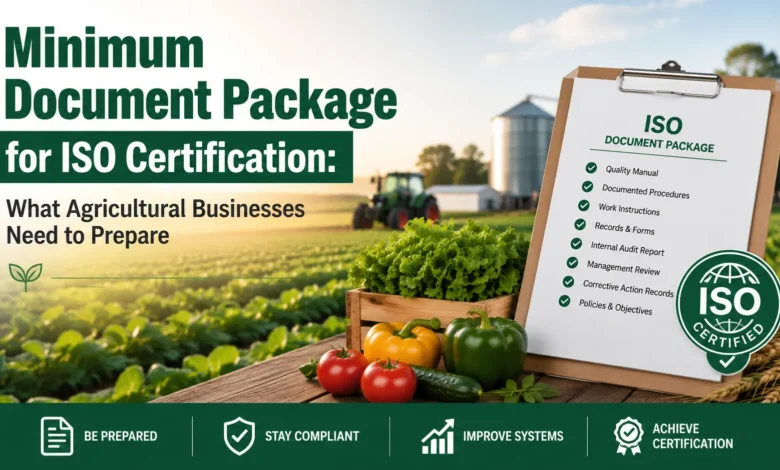
Before starting the certification process, agricultural businesses should prepare:
- Scope description of the management system as it applies to your operation
- Policy document covering quality, food safety, environmental management, or occupational health — depending on your chosen standard
- Map of key business processes (planting cycles, supply chain, processing, distribution, etc.)
- Roles, responsibilities, and authorities clearly assigned across your team
- Document and records management procedures
- Risk register and action plan for identified risks (crop failure, contamination, equipment breakdown, etc.)
- Internal audit results
- Management review minutes signed off by leadership
- Corrective actions for identified non-conformities
- Proof of employee training and competence
ISO Document Requirements by Standard — Quick Reference
| Document | Priority | ISO 9001 (Quality) | ISO 14001 (Environment) | ISO 45001 (Safety) | ISO 22000 (Food Safety) |
|---|---|---|---|---|---|
| Scope of management system | Must have | ✓ | ✓ | ✓ | ✓ |
| Quality / safety policy | Must have | ✓ | ✓ | ✓ | ✓ |
| Process map | Must have | ✓ | ✓ | ✓ | ✓ |
| Roles & responsibilities | Must have | ✓ | ✓ | ✓ | ✓ |
| Risk register & action plan | Must have | ✓ | ✓ | ✓ | ✓ |
| Internal audit records | Must have | ✓ | ✓ | ✓ | ✓ |
| Management review minutes | Must have | ✓ | ✓ | ✓ | ✓ |
| Corrective action records | Must have | ✓ | ✓ | ✓ | ✓ |
| Employee training records | Must have | ✓ | ✓ | ✓ | ✓ |
| Environmental aspects register | Must have | – | ✓ | – | – |
| Legal compliance register | Must have | – | ✓ | ✓ | – |
| Hazard identification (HIRA) | Must have | – | – | ✓ | – |
| Incident & accident log | Must have | – | – | ✓ | – |
| HACCP plan | Must have | – | – | – | ✓ |
| Prerequisite programmes (PRPs) | Must have | – | – | – | ✓ |
| Traceability procedure | Must have | – | – | – | ✓ |
| Customer complaint procedure | Recommended | ✓ | – | – | ✓ |
| Supplier evaluation records | Recommended | ✓ | – | – | ✓ |
| Calibration records | Recommended | ✓ | – | – | ✓ |
| Emergency response plan | Recommended | – | ✓ | ✓ | ✓ |
✓ = Required for this standard — – = Not applicable
This list is not always final, but it forms a solid foundation. If your farm or agribusiness is pursuing certification for the first time, avoid trying to create “perfect” documents immediately. What matters more is that the documents reflect how your business actually operates — not a generic internet template that has nothing to do with your fields or facilities.
ISO Standards Particularly Relevant to Agriculture
Different ISO standards serve different needs within the agricultural sector:
- ISO 9001 (Quality Management) is widely used by agro-processors, exporters, and food manufacturers to demonstrate consistent product quality to buyers and importers.
- ISO 14001 (Environmental Management) is increasingly demanded by export markets and international buyers who want assurance that farming practices minimize environmental harm — covering soil health, water usage, pesticide management, and waste.
- ISO 45001 (Occupational Health & Safety) is critical for operations with large workforces — covering field workers, machinery operators, and processing plant employees who face significant safety risks.
- ISO 22000 / FSSC 22000 (Food Safety Management) is essential for any business involved in food processing, packaging, or export, covering hazard analysis, contamination control, and traceability.
Check out закажите консультацию по сертификации ISO в Baltum Bureau
Common Mistakes When Preparing Documents
One of the most frequent mistakes is preparing too many documents without practical purpose. A large volume of paperwork does not make a system stronger. Sometimes it has the opposite effect — workers don’t know which rules are current and which were created just to fill space.
Another common problem is missing records. Policies and procedures show what a company plans to do; records prove it actually happens. For an auditor, both matter equally: the rule and the evidence of its application.
Agricultural businesses should pay attention to the following:
- Documents must be current, reviewed, and formally approved
- Employees — from field supervisors to warehouse managers — must understand their specific responsibilities
- Risks must be genuinely assessed, not just listed on paper
- An internal audit must be completed before the external certification audit
- Non-conformities must be closed with documented corrective actions
- The system must be functioning before the certification audit — not switched on the morning of the inspection
Good documentation works like an operations manual for a working farm machine: it should not collect dust in a drawer, but should help your business act faster, more clearly, and more safely every single day.
Getting Started with ISO Certification for Your Agribusiness
For farmers, agro-processors, exporters, and agricultural entrepreneurs, the most important first step is understanding exactly which documents your specific operation will need — not a generic checklist, but one tailored to your standard, your sector, and your scale.
Starting with a preliminary consultation saves significant time and helps you focus on what truly matters for your chosen standard, rather than chasing unnecessary templates.
If your agricultural business is planning ISO certification or wants to assess its readiness for audit, the right move is to seek expert guidance early, clarify your documentation requirements, and begin your path to international certification with a clear, practical plan.
For more details: Check: закажите консультацию по сертификации ISO в Baltum Bureau