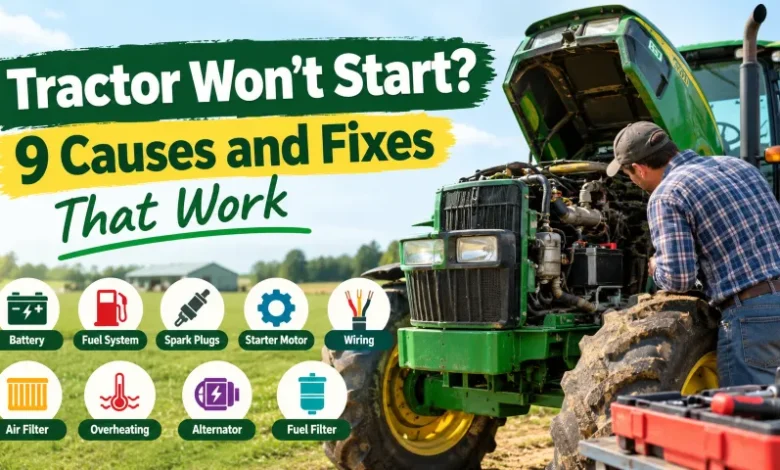
Tractor Won’t Start? 9 Causes and Fixes That Work
Why Won’t My Tractor Start?
A tractor won’t start most often because of a weak battery link, a closed fuel shutoff valve, stale fuel, or a safety circuit that is not satisfied. Dealer technicians say the cause is usually a simple fix, and owners report much the same.
Begin by separating two different complaints. A tractor that gives only a clicking sound has an electrical problem, while one that spins freely and never fires has a fuel, air or heat problem. Experienced owners insist on this split because a tractor cannot start until it can crank. A machine that refuses to crank may simply have an open neutral switch circuit, so check the gear position before anything else.
Every tractor starting system rests on the same basics: a battery, a tractor ignition system, a starter and a fuel supply that all have to cooperate on the same morning. Technicians sum up running as fuel, air and spark, and a diesel replaces the spark with heat from compression.
Cold regions add another layer, because diesel gelling can choke fuel flow between the tank and the injection pump. Electric models sidestep this whole routine, which is part of why electric tractors are becoming the next big shift in agriculture. For petrol and diesel machines, the sections below follow the order in which faults usually show up.
What Is a Tractor Starting System and How Does It Work?
A tractor starting system is the chain of parts that turns the key’s signal into cranking power and then into a running engine: the battery, the ignition circuit, the starter, the safety interlocks and the fuel supply. Every agricultural machinery starting system follows this chain, and a fault at any one link can stop the whole machine.
The electrical side carries the load first. The battery feeds the starter through the ignition circuit and its connections, which is why dealer technicians point to the battery and the cable path between battery and starter when a tractor only clicks. Safety interlocks sit in the same circuit, and owners list the seat, the PTO, the neutral position and the brake as typical switches that must agree before the starter is allowed to turn.
Once the engine cranks, the fuel side takes over. Technicians reduce running to fuel, air and spark, and they check the fuel valve and the intake filter in that order. Diesel models also depend on heat, so a farm equipment starting system on a diesel often includes a cold start aid, and a malfunctioning one can stop the tractor from starting at all.
Starting systems in agriculture are not all electrical. One manufacturer makes spring starters for diesel engines from 0.5 to 18 litres that use hand-winding and need no battery, cables or electronics, and it presents them as a backup or primary option for tractors, pumps and generators. That is the maker’s own description, so treat it as a claim and not a guarantee.
How Do You Start a Tractor Properly Before Troubleshooting?
To start a tractor properly, put the range lever in neutral, move the engine speed lever to half, confirm the safety controls are satisfied, and then turn the key. A dealer checklist for 1-series and 3-series models opens with these basics because a lever left in the wrong place is a common reason a healthy machine stays silent.
- Place the range shift lever in neutral.
- Move the engine speed lever to half.
- Confirm the safety interlocks agree: operator presence (the seat), the PTO lever, and the brake or clutch, depending on the model.
- Inspect the battery terminals; if they look corroded, scrub them with a wire brush and retighten.
- Turn the key and watch whether the starter spins.
Before a long tillage day, such as pulling a disc harrow that turns rough ground into a planting-ready seedbed, this two-minute routine is cheap insurance. Skipping it is how a perfectly healthy tractor ends up blamed for a fault it does not have.
Why Won’t Your Tractor Turn Over?
A tractor won’t turn over when the starter circuit receives too little current or none at all, which points to a weak battery, a loose cable, or a safety switch that blocks the key. It is frustrating to hear a lone snap and nothing else, yet that symptom usually means a bad battery or a bad connection between the battery and the starter.
Clean and tighten the alternator and battery connections first, then read the battery with a multimeter; a low reading usually means a replacement battery. A good-looking battery does not clear the electrical side, though. One owner measured 12.9 volts at the battery and still got no crank, and another traced the fault to a cable that had rotted internally.
When a tractor won’t turn over at all, check that the gearshift is truly seated in neutral, because a start-lock circuit can refuse the key. To diagnose the starter itself, some owners touch jumper cables from the battery to the starter’s power bolt. They do it only in neutral, with eye protection on and their body clear of the wheels, because an engine that starts in gear can run over the operator.
Replacement starters have also caused grief: owners have reported units with 9 teeth on the pinion instead of 11, so confirm the tooth count before you buy.
| Symptom | Likely cause | First fix |
|---|---|---|
| A lone snap, then silence | Weak battery or poor connection | Clean and tighten connections, read the battery with a multimeter |
| Nothing at all | Safety switch, fuse or control circuit not passing current | Check neutral, clutch and brake switches; test the fuse with a multimeter |
| Slow, grinding crank | Worn starter | Have the starter tested, then rebuild or replace |
| Spins freely but won’t fire | Fuel, air or heat shortage | See the next section |
What Are the Most Common Tractor Starter Problems?
The most common tractor starter problems are a worn tractor starter motor, a faulty switch in the start circuit, rotted cables, and weak supply from the charging side. A starter often fails quietly: one owner had a unit tested at an auto parts store, which told him it had failed, and a local shop rebuilt a similar one in two days.
The charging side matters as well, since alternators keep the battery topped up, and technicians advise checking alternator connections along with the battery. Control parts cause more confusion than starters do. Owners describe relays that tested fine on the bench, and another replaced two bad key switches on a Bobcat CT230. A jump pack is a quick way to rule out a weak battery, and one Yanmar owner found it made no difference, which pointed away from the battery.
A different route exists: a mechanical spring starter that works through hand-winding, with no battery or cables involved. If the starter or cables are beyond saving, buy matched parts, the same discipline you apply to the reliable farm machinery parts for tillage maintenance you keep for implements. A mechanic or your local dealer can confirm the correct unit.
Why Is Your Tractor Not Starting Even Though It Cranks?
A tractor that cranks but won’t start is missing fuel, intake air, or enough warmth in the engine, so check the fuel level, fuel valve and fuel filter first, then the air intake element. Technicians recommend that order: if fuel reaches the engine, look at air, and if both look right, consider cold.
In cold conditions, pull the throttle back to its lowest setting while the engine warms, then raise it to half and try again. Damp or cold conditions are among the usual reasons for a non-start. An engine fitted with dirty injectors may crank all day without catching, and one that does catch may sputter before it smooths out. One owner described 10 to 20 seconds of that.
Most tractor starting problems in this category trace back to fuel quality. Diesel contains paraffin, which is why it can gel, and one owner now uses an anti-gel additive every winter after gelling his fuel. Every hour lost in sowing season counts, and the tractor time calculator estimates field work duration, which shows what a morning of downtime does to the schedule.
| Missing element | What to check |
|---|---|
| Fuel | Fuel level, fuel valve, fuel filter |
| Air | Intake element: replace if covered in oil, torn or cracked |
| Warmth | Lowest speed while warming, then half speed |
Why Won’t a John Deere Tractor Start?
A John Deere tractor that won’t start usually fails one of nine basic checks, from lever positions to a plugged filter. If it only clicks, the cause is most likely a bad battery or a poor connection between the battery and the starter. The checks were written for 1-series and 3-series compact tractors, but the order carries over to other models.
The fuel valve sits at the water separator, so open it there. If the fuel smells sour or shows clumps when drained, flush it and refill. Use the manual’s recommended oil viscosity, because the wrong grade is one of the nine causes. Some owners add a fuel conditioner year-round, though that is an owner’s habit and not a dealer recommendation.
Check the fuel filter and the air filter too, since a plugged element can cut power before the engine refuses to start. On a cold engine, let it warm at idle before trying half speed. If none of this works, contact a John Deere dealer. Matching the machine to the job, as covered in how the right tractor can increase crop yields, helps here, and the habits in how to extend the life of your farm equipment reduce repeat breakdowns.
Why Won’t a Diesel Tractor Start?
A diesel tractor won’t start when the cylinder cannot reach the heat needed for combustion, which usually means weak cranking, thick oil, restricted fuel flow or tired heating elements in the chamber. A cold diesel needs four things: free-flowing fuel, heat at the combustion point, free-flowing oil, and a strong enough battery.
Worn heating elements give off less warmth and can burn out completely. A malfunctioning cold start system can stop a tractor from starting at all, and that is a job for a technician. Because the diesel tractor starting system leans so heavily on the battery, some owners look at battery-free options.
One manufacturer sells spring starters for diesel engines up to 18 litres and describes them as maintenance-free. That is a vendor claim, so weigh it as one. Even so, it shows why a diesel tractor won’t start more often in winter: the electrical side is the weakest link.
How Do You Cold Start a Diesel Tractor in Freezing Weather?
To cold start a diesel tractor in freezing weather, warm the engine first with a heated garage or a block heater, cycle the glow plugs, and then crank. Diesel tractors are especially exposed to sub-freezing temperatures, with fuel trouble, thickening oil and weakening batteries all working against a cold start tractor.
- Warm the engine: park in a heated garage or plug in the block heater, which runs from a regular outlet.
- Use fuel suited to the season, since fuel bought in warmer regions may not be treated for cold.
- Cycle the glow plugs before cranking. One owner cycles them about 10 seconds and reports a first or second try start.
- Crank the engine, then give it time. One owner advises about 10 minutes of warm-up in severe cold.
Worn glow plugs deserve attention too, because old ones produce much less heat. This is the same diesel tractor cold start logic behind every tractor-won’t-start-in-cold-weather complaint: heat, free-flowing fuel and oil, and a battery with enough strength.
Why Does My Tractor Click but Not Start?
A tractor clicks but does not start when the starter solenoid receives a signal but the starter cannot turn, which most often means a bad battery or a poor connection between the battery and starter. Check that the connections are clean and tight, then test battery voltage with a multimeter; a low reading means a replacement battery is probably needed. Owners add that a cable can look perfect outside and still be rotted inside.
Is Ether a Safe Way to Start a Tractor in Cold Weather?
Owners advise against ether on any engine fitted with glow plugs unless you are certain the plugs cannot heat, so it is not a first choice. Other workarounds exist: warming a cold part with a hair dryer or heat gun, or tenting the machine under tarps with a space heater. These are owner workarounds, not manufacturer guidance, and heat near fuel needs real care. A plug-in engine warmer is the more controlled route.
Do You Need a Block Heater Overnight?
Plugging in the block heater overnight is the usual recommendation when possible, though owners report that an hour or two is enough in moderate cold. Keep a long extension cord on hand so the heater can reach the machine wherever it sits. One owner adds that a tractor may start without preheating, but warming it first is still a sound habit.