Wheat Rust Diseases and their Control / گندم کی بیماری کنگی
Wheat rust is not one disease but three — leaf rust, stripe rust and stem rust — and together they are the most dangerous fungal threat to the wheat crop. The Wheat Research Institute (WRI) of the Ayub Agricultural Research Institute, Faisalabad, calls rust a threat to food security, because wheat meets more than 75% of the country’s food requirement, as its booklet on rust identification notes. The good news is that rust can be beaten: resistant varieties stop most attacks before they start, and a correctly timed fungicide spray stops most of the rest. This guide brings the WRI booklet’s identification and control advice together with current research, so you can recognise each rust in the field, know the weather that favours it, and act at the right moment.
The three wheat rusts at a glance
All three rusts are caused by Puccinia fungi, but each attacks a different part of the plant, shows a different colour and pattern, and favours different weather — which is why correct identification decides the whole control plan. Use the chart below in the field, and compare it with the broader disease control chart for other wheat problems.
| Feature | Leaf rust (brown rust) | Stripe rust (yellow rust) | Stem rust (black rust) |
|---|---|---|---|
| Fungus | Puccinia triticina | Puccinia striiformis f. sp. tritici | Puccinia graminis f. sp. tritici |
| Where pustules appear | Leaves, mainly the upper surface | Leaves, upper surface; sometimes the head | Stems and leaves, both leaf surfaces; sometimes head and grain |
| Colour and arrangement | Orange-brown pustules, scattered singly and at random | Orange-yellow pustules arranged in clear stripes along the leaf | Orange-red to dark-red oval pustules that tear the stem surface; they turn black late in the season |
| Temperature the WRI booklet links to its spread | 15–22 °C | 12–20 °C | 20–30 °C |
| Damage reported in the WRI booklet | Yield falls 20–30%; attacks almost all districts | Early attack can cost 20–50% of yield; damages more than brown rust | Long minor in Punjab, but the Ug99 race is warned of as a danger |
Leaf rust (brown rust): the attack almost every district sees
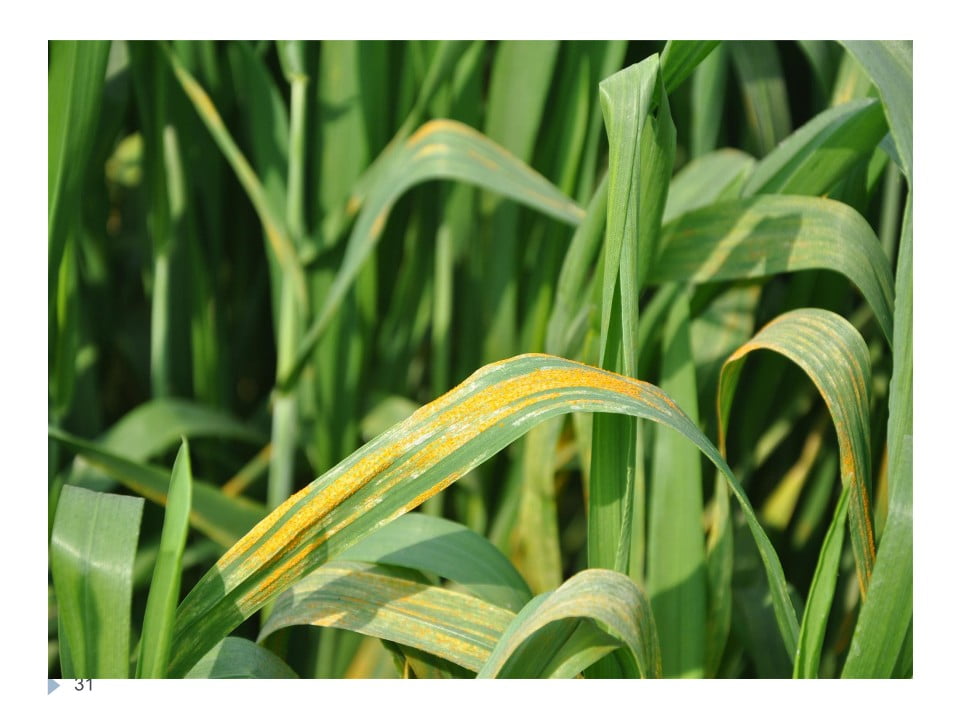
Leaf rust is the most widespread of the three: the WRI booklet records that it attacks almost uniformly in nearly all districts of Punjab and can take epidemic form. You recognise it by the orange-brown powdery pustules scattered on the upper surface of the leaves. Those pustules cover the leaf, so the plant’s food-making (photosynthesis) is badly affected, the plant weakens, and — as the booklet puts it — yield falls by 20 to 30%. Extension research agrees on the mechanism: leaf rust does its worst damage when the upper leaves are severely rusted before flowering, because heavy rusting kills those leaves early, shortens the grain-filling period and leaves smaller, lighter kernels. In the severe 2007 Great Plains epidemics in North America, leaf rust cut yields by up to 14%, and local losses exceeded 50% where weather favoured the disease, infection started early and the variety was susceptible. Leaf rust infects best at 15–20 °C with at least six hours of moisture on the leaf, so dewy, mild spells during tillering and stem elongation are its favourite window.
How do you recognise stripe rust (yellow rust)?
Stripe rust gives itself away by its pattern: small yellow pustules lined up in stripes along the leaf veins, usually after the first yellowish (chlorotic) patches appear. The booklet reports that stripe rust attacks mostly northern Punjab and some central districts, from Rawalpindi to Faisalabad, but with the changing climate it is now seen across the whole province — and it warns that stripe rust damages the crop more than brown rust, with an early-stage attack costing 20 to 50% of yield. University of Arkansas extension recorded the same pattern in the United States: stripe rust took 7% of the state wheat crop in 2000, yet some untreated fields lost 50% or more. Stripe rust is the cool-weather rust of the three: it infects at just 7–12 °C and develops fastest at 10–15 °C, which is why it explodes in cool, wet late-winter weather and fades as temperatures climb. One caution from the booklet is worth underlining: yellow leaves alone do not prove stripe rust — a crop can yellow for other reasons, such as nutrient deficiency — so confirm the striped pustules before you decide to spray.
Stem rust (black rust) and the Ug99 warning
Stem rust is the heavyweight of the three: it can destroy entire fields within a few weeks and is capable of causing 100% yield loss. Its pustules are larger and oval, orange-red to dark red, and they burst through the surface of stems and leaves so the tissue looks torn; severely infected stems weaken, lodge, and produce shrivelled, prematurely ripened grain. Late in the season the pustules turn black — hence “black rust”. The WRI booklet notes that stem rust has long been unimportant in Punjab, but it was found in parts of Sindh (Hyderabad and Badin) and elsewhere in the country in 2006-07, and it warns specifically about the race called Ug99. That warning matches the international record: race Ug99 (TTKSK) of the stem rust fungus was detected in Uganda in 1998 and is feared because it defeats a large number of the resistance genes carried by widely grown wheat varieties; CIMMYT reports that variants of the Ug99 lineage have since spread through eastern and southern Africa to Yemen, Iran and Egypt. Stem rust is also the warmth-loving rust — it develops fastest at 26–30 °C — so a hot, humid spell late in the season is its moment.
How rust spreads through a field
Rust spreads by wind-blown spores, and under the right weather it multiplies fast enough to turn a few pustules into an epidemic within weeks. The rust fungi are obligate parasites — they can grow only on living plant tissue — and their repeating spores (urediniospores) are carried by wind and splashing water from plant to plant and field to field. A spore that lands on a wet leaf can infect it within hours of moisture: roughly six hours of leaf wetness for leaf rust, six to eight hours for stem rust, and about eight hours for stripe rust. Under ideal conditions a new generation of pustules appears just 7 to 10 days after infection, and the cycle repeats again and again through the season. This is exactly the epidemic recipe the WRI booklet describes: susceptible varieties grown over wide areas, timely rain, and humidity above 70%. Break any one of those three conditions — above all, by not planting susceptible varieties — and the epidemic loses its fuel.
Resistant varieties are the first line of defence
Resistant varieties are the cheapest and strongest rust control there is: the WRI booklet calls genetic resistance the best method of all, because it adds no extra cost and is completely environment-friendly. Its advice, repeated in the original post, is simple — stop growing old, banned or unapproved varieties that have become susceptible, and grow the newly approved rust-resistant varieties recommended by the Agriculture Department and the research institutes. The booklet names resistant varieties of its time such as Faisalabad-2008, Aas-2011, NARC-2011, Pakistan-2013, Ujala-2016, Bhakkar Star, Johar-16, Anaj-17, Markaz-19, Akbar-19 and Ghazi-19, and warns just as clearly against varieties that have lost their resistance, such as Inqlab-91, Bhakkar-2002, Shafaq-2006, Seher-2006 and Galaxy-2013. Two research findings explain why the variety list keeps changing. First, rust fungi constantly form new races that can overcome a variety’s resistance, so a variety that was safe five years ago may not be safe now. Second, plant breeders now build adult plant resistance from several slow-rusting genes combined — the approach CIMMYT used against Ug99 — which holds up far longer than a single resistance gene. Until you sow, the practical rule is: check the current season’s approved variety list, and never rely on one variety across your whole farm.
Cultural practices that keep rust pressure low
Good crop management lowers rust pressure before any spray is needed, because it removes the conditions the fungus exploits. The WRI booklet and the original recommendations agree on the following practices:
- Finish sowing on time: the booklet advises completing wheat sowing by 20 November in all cases, using clean, healthy, treated seed.
- Grow more than one variety: planting several varieties with different resistance backgrounds means one rust race cannot take the whole farm — researchers call this cultivar complementation.
- Avoid over-dense crops: a lower, recommended seed rate opens the canopy, so leaves dry faster and spores find less of the long leaf-wetness they need.
- Manage weeds all season: weeds keep the canopy humid and can shelter the disease cycle, so season-long weed management helps control diseases.
- Scout from late January: the booklet tells farmers to inspect fields regularly after 20 January, keeping an eye on the weather, and to get a diseased sample confirmed by experts when in doubt.
Seed treatment: protection from day one
Treating seed with a fungicide before sowing is the one chemical step the original recommendations actively encourage, because it protects the young crop cheaply and uses very little chemical. The post lists three options, any one of which may be used, at the doses printed there. Seed treatment is also your first defence against the seed borne diseases that travel inside the seed lot itself.
| Seed treatment (as printed) | Dose |
|---|---|
| Difenoconazole | 1 ml per kg seed |
| Thiophanate-methyl | 2 g per kg seed |
| Imidacloprid + Tebuconazole | 4 ml per kg seed |
Doses are reproduced as printed in the original recommendations. Always verify the dose against the current product label before use, and use only products registered for wheat seed treatment.
When should you spray a rust fungicide?
Timing decides whether a fungicide spray saves the crop or wastes money: spray at the first confirmed appearance of rust, protect the flag leaf, and never wait until the disease is everywhere. The WRI booklet is blunt about late spraying — if rust is not identified in time and spreads unseen through the field, starting fungicides afterwards proves expensive and ineffective. Its timing rules are practical: know your field’s previous rust history, scout regularly after 20 January, and if rust appears even in patches, spray the whole field, because a patch is where an epidemic starts. Extension research adds the crop-stage rule: the most valuable spray window runs from flag leaf emergence to full heading (Feekes growth stages 8 to 10.5), with full boot (GS 10) the ideal moment for a single spray, because the flag leaf feeds the grain. Stripe rust is the exception that cannot wait for a growth stage — fields with active stripe rust hot spots should be sprayed as soon as the disease is found. Correct spray techniques matter as much as timing: the booklet specifies a hollow-cone nozzle, no spraying in strong wind or rain, the nozzle held at a proper distance from the crop at a suitable walking speed, and protective measures before and after spraying — the full safety measures during spray are worth reading before you start. Finally, the booklet’s red-letter note: stop all pesticide sprays on wheat 40 days before harvest, because residues that reach the grain are extremely dangerous for human health.
Fungicides for wheat rust
When an epidemic threatens, the fungicides below — the list carried in the original post and built around the same active ingredients the WRI booklet names (propiconazole, tebuconazole, trifloxystrobin + tebuconazole, triadimefon) — are the recommended options; use any one of them, not a mixture of all. Fungicides remain the second line of defence, behind resistant varieties, and are meant for genuine epidemic danger, not routine use. For a wider look at the fungicide groups used in the country, see the guide to major fungicides.
| Fungicide (active ingredient) | Example products, as printed | Dose per acre, as printed | FRAC group |
|---|---|---|---|
| Propiconazole | Tilt (Syngenta) | 200 ml | 3 |
| Azoxystrobin + Difenoconazole | Amistar, Rekado, etc. | 200 ml | 11 + 3 |
| Triadimefon | — | 100 g | 3 |
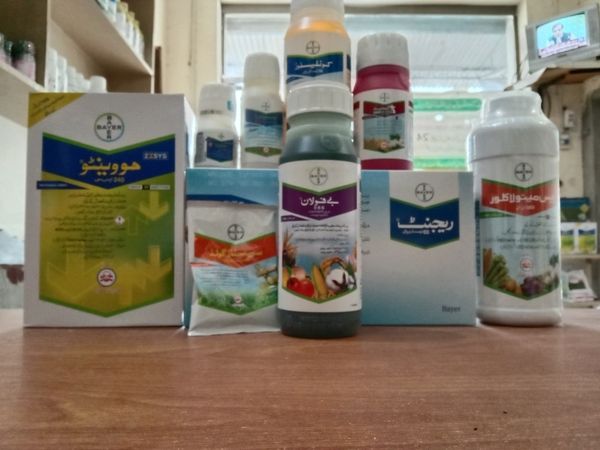
| Trifloxystrobin + Tebuconazole | Nativo (Bayer) | 65 g | 11 + 3 |
| Flutriafol + Tebuconazole | Topguard (Swat Agro) | 200 ml | 3 + 3 |
| Difenoconazole | — | 200 ml | 3 |
| Sulfur | — | 500 g | M02 (multi-site) |
Doses and product names are reproduced exactly as printed in the original recommendations. Formulations and registrations change: always verify the dose, crop registration and pre-harvest interval against the current product label before use, and buy genuine, unadulterated chemical from a reliable source, as the booklet insists.
Why you must rotate FRAC groups
Rotating between fungicide groups is what keeps these products working, because a rust population sprayed again and again with the same mode of action learns to survive it. The FRAC code in the table above is the mode-of-action group: every Group 3 product is a DMI (triazole) fungicide, every Group 11 product is a QoI (strobilurin), and sulfur is a multi-site protectant (Group M02) that attacks the fungus at many points at once. The University of Arkansas fungicide guide states the rule plainly: fungicides with the same FRAC code share the same mode of action, and rotating fungicides with different FRAC codes can minimise the development of fungicide-resistant strains. In practice, that means alternating — for example, a Group 3 spray followed, if a second spray is truly needed, by a Group 11 + 3 mixture or sulfur — rather than repeating one product. It is also why the original recommendations warn against large-scale, routine foliar spraying: every unnecessary spray spends the chemistry’s useful life.
Frequently asked questions
What is the difference between leaf, stripe and stem rust?
Leaf rust makes scattered orange-brown pustules on the upper leaf surface; stripe rust makes yellow pustules arranged in stripes along the leaf; stem rust makes larger dark-red pustules that tear open on stems and leaves and turn black late in the season. Each is caused by a different Puccinia fungus and favours different temperatures — cool for stripe rust, warm for stem rust.
How much yield can wheat rust actually take?
More than most farmers expect. The WRI booklet reports 20–30% loss from leaf rust and 20–50% from an early stripe rust attack; extension research records stripe rust losses up to 40% in susceptible varieties (74% in experimental plots), leaf rust losses above 50% locally, and stem rust capable of 100% loss in a destroyed field.
When is the best time to spray fungicide on wheat rust?
At the first confirmed appearance of rust — and, for a planned single spray, around full boot to flag leaf stage (Feekes GS 8–10.5), so the flag leaf stays clean for grain filling. Stripe rust hot spots should be sprayed immediately when found. Spraying after the disease has spread through the whole field is, in the booklet’s words, expensive and ineffective.
Why did my resistant variety get rust this year?
Because rust fungi keep producing new races that can defeat a variety’s resistance genes — the same process that made Ug99 dangerous. Varieties lose resistance over time, which is why the booklet lists once-good varieties that must no longer be grown and tells farmers to shift to the currently approved resistant varieties each season.
Is a fungicide spray a substitute for resistant varieties?
No. Both the WRI booklet and the original recommendations put resistant varieties first and fungicides second, as an emergency tool for epidemic conditions. A resistant variety protects the crop all season at no extra cost; a fungicide protects for a few weeks, only if it is timed and applied correctly.
Sources: Wheat Research Institute, AARI Faisalabad — “Identification of Wheat Rust and its Control” booklet; University of Nebraska–Lincoln Extension NebGuide G2180, “Rust Diseases of Wheat”; University of Arkansas MP154 wheat fungicide guide and FSA-7547; Singh et al., CIMMYT, on the emergence and spread of new stem rust races (Ug99).


Good information
Thank you Mr. Naveed